




Red alert
FEMA camps, martial law, indefinite detention without trial
"The President has the power to seize property, organize and control the means of production, seize commodities, assign military forces abroad, call reserve forces amounting to 2 1/2 million men to duty, institute martial law, seize and control all menas of transportation, regulate all private enterprise, restrict travel, and in a plethora of particular ways, control the lives of all Americans...
"Most [of these laws] remain a a potential source of virtually unlimited power for a President should he choose to activate them. It is possible that some future President could exercise this vast authority in an attempt to place the United States under authoritarian rule.
"While the danger of a dictatorship arising through legal means may seem remote to us today, recent history records Hitler seizing control through the use of the emergency powers provisions contained in the laws of the Weimar Republic."
-- Joint Statement, Sens. Frank Church (D-ID) and Charles McMathias (R-MD) September 30, 1973
www.politechbot.com/p-00106.html
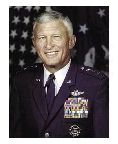 |
General Ralph Eberhart, who was in charge of air defense on 9-11, was the first commander of "Northern Command," the domestic unified military command established in October 2002. If the domestic use of the U.S. military escalates into full-scale martial law, the Northern Command would essentially manage it. If 9/11 had been an "intelligence failure," it is likely that General Eberhart would have been court-martialed instead of promoted. |
www.counterpunch.com
March 16, 2006
Dachau's 73rd "Grand Anniversary" Celebrated
Feds Schedule $385 Million Concentration Camp To Be Built By Halliburton Subsidiary
By CLANCY SIGAL
The following article appeared in a Munich newspaper in 1933 to mark the "grand opening" of Dachau, Germany's first concentration camp. This month marks the 73d anniversary:
Münchner Neueste Nachrichten,
Tuesday, March 21, 1933
A Concentration Camp for Political Prisoners in the Dachau Area
In a statement to the press, Himmler, Munich's Chief of Police announced:
On Wednesday the first concentration camp will be opened near Dachau. It has a capacity of 5000 people. Here, all communist and-so far as is necessary- Reichsbanner and Marxist officials, who endanger the security of the state, will be assembled. In the long run, if government administration is not to be very burdened, it is not possible to allow individual communist officials to remain in court custody. On the other hand, it is also not possible to allow these officials their freedom again. Each time we have attempted this, the result was that they again tried to agitate and organize. We have taken these measures without concern for each pedantic objection encountered, in the conviction that we act to calm the concerns of the nation's people, and in accordance with their aims.
Himmler gave assurance that in each individual case, preventive custody will not be maintained longer than necessary. It is obvious, however, that the astonishingly large quantity of material evidence seized will take a long time to be examined. This police will only be delayed, if they are continually asked when this or that person in preventive custody will be released. The incorrectness of rumors frequently spread regarding the treatment of prisoners is shown by the fact that for those prisoners who requested it, for example, Dr. Gerlich and Frhr. v. Aretin, counseling by priests is supported and approved without hesitation.
Note: Himmler's reference to the 'Reichsbanner' is to a Social Democratic group, formed to oppose Hitler's 1923 attempted putsch, that evolved into a fairly ordinary get-together society. The 'Dr Gerlich' mentioned at the end (who was permitted to see a priest) was a devout Christian anti-Nazi shot by the Gestapo at Dachau in 1934, his body burned. His widow refused his ashes.
Tom Ridge's Mea Culpa:
The Code Orange Terror Alerts were based on Fake Intelligence
by Michel Chossudovsky
www.globalresearch.ca 12 May 2005
The URL of this article is: http://globalresearch.ca/articles/505A.html
Secret Police Concentration Camps www.hermes-press.com/gonzalez5.htm
In a revealing admission in June, 1997, the Director of Resource Management
for the U.S. Army confirmed the validity of a memorandum relating to the establishment
of a civilian inmate labor program under development by the Department of the
Army. The document states, "Enclosed for your review and comment is the
draft Army regulation on civilian inmate labor utilization" and the procedure
to "establish civilian prison camps on installations."
Amid widespread rumors, Congressman Henry Gonzales clarified the question of
the existence of civilian detention camps. In an interview, Gonzalez stated,
"The truth is yes -- you do have these stand by provisions, and the plans
are here...whereby you could, in the name of stopping terrorism...evoke the
military and arrest Americans and put them in detention camps."
http://news.pacificnews.org/news/view_article.html?
article_id=eed74d9d44c30493706fe03f4c9b3a77
Homeland Security Contracts for Vast New Detention Camps
News Analysis/Commentary, Peter Dale Scott,
New America Media, Jan 31, 2006
Editor's Note: A little-known $385 million contract for Halliburton subsidiary KBR to build detention facilities for "an emergency influx of immigrants" is another step down the Bush administration's road toward martial law, the writer says.
BERKELEY, Calif.--A Halliburton subsidiary has just received a $385 million contract from the Department of Homeland Security to provide "temporary detention and processing capabilities."
The contract -- announced Jan. 24 by the engineering and construction firm KBR -- calls for preparing for "an emergency influx of immigrants, or to support the rapid development of new programs" in the event of other emergencies, such as "a natural disaster." The release offered no details about where Halliburton was to build these facilities, or when.
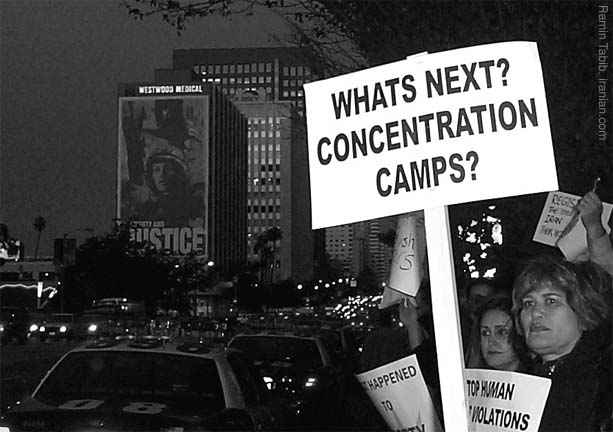
Iranian - Americans protest Ashkroft round-up (Los Angeles, CA)
Color Wheel of Fascism
www.falloutshelternews.com/ColorWheelFascism.html
a handy guide to terror alerts
Bush civil rights commissioner warns of detention camps
www.wsws.org/articles/2002/jul2002/kirs-j26.shtml
www.cryptome.org/garden-plot.htm
martial law plans are not new
("Homeland Security" is a term coined
toward the end of the Clinton administration)
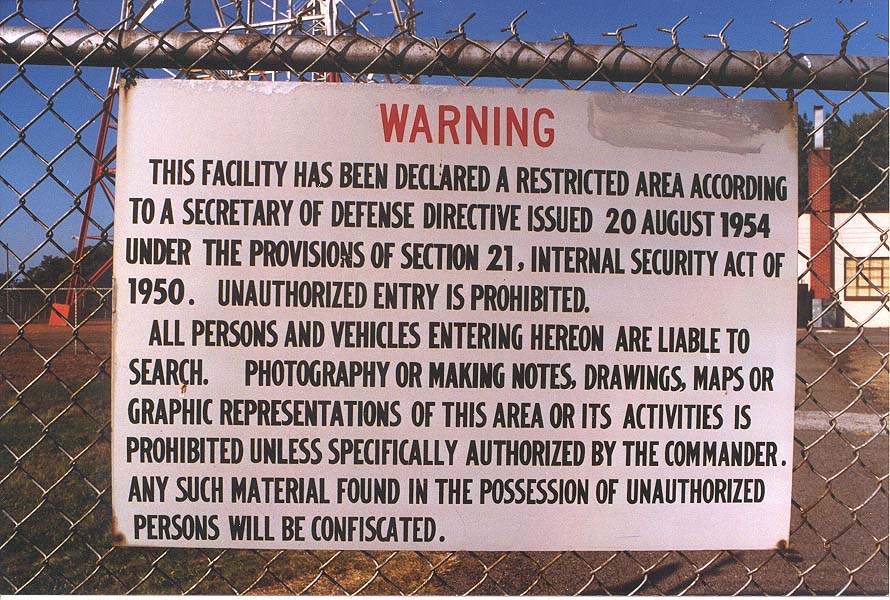
New Jersey says "red alert" means entire state must stay
home --
MARTIAL LAW -- STATE OF SIEGE
www.southjerseynews.com/issues/march/m031603e.htm
Red alert? Stay home, await word
Sunday, March 16, 2003
By TOM BALDWIN
Gannett State Bureau TRENTON
If the nation escalates to "red alert," which is the highest in the color-coded readiness against terror, you will be assumed by authorities to be the enemy if you so much as venture outside your home, the state's anti-terror czar says.
"This state is on top of it," said Sid Caspersen, New Jersey's director of the office of counter-terrorism.
Caspersen, a former FBI agent, was briefing reporters, alongside Gov. James E. McGreevey, on Thursday, when for the first time he disclosed the realities of how a red alert would shut the state down.
A red alert would also tear away virtually all personal freedoms to move about and associate.
"Red means all noncritical functions cease," Caspersen said. "Noncritical would be almost all businesses, except health-related."
A red alert means there is a severe risk of terrorist attack, according to federal guidelines from the Department of Homeland Security.
"The state will restrict transportation and access to critical locations," says the state's new brochure on dealing with terrorism.
"You must adhere to the restrictions announced by authorities and prepare to evacuate, if instructed. Stay alert for emergency messages."
Caspersen went further than the brochure. "The government agencies would run at a very low threshold," he said.
"The state police and the emergency management people would take control over the highways.
"You literally are staying home, is what happens, unless you are required to be out. No different than if you had a state of emergency with a snowstorm."
www.post-gazette.com/nation/20030330codered0330p6.asp
Code Red would trigger a virtual lockdown
Top terror alert could shut landmarks, ground planes, stop trains or trigger
roadblocks
Sunday, March 30, 2003
By Michael Collins, Scripps Howard News Service
WASHINGTON -- National landmarks such as the Washington Monument, Ellis Island and the Gateway Arch in St. Louis could be shut down.
Planes could be grounded, trains could stop running, and bridges and tunnels could be closed. U.S. borders might be sealed off, and roadblocks might be set up on interstates and other major highways.
The United States is prepared to go into lockdown mode if the government should raise the nation's terror alert to Code Red, the highest threat level for terrorism. Code Red means there is a severe risk of terrorist attack, or that an attack is imminent or may already be under way.
"It essentially means you stop doing everything except protecting yourself," said Dave McIntyre, deputy director of the Anser Institute for Homeland Security, a nonprofit research group in Arlington, Va.
Homeland security officials have put Americans on notice to brace for the possibility of terrorist attacks while the country is at war with Iraq. The threat level was raised to orange, the second highest, just two days before the war began March 19.
"There are no plans, nor have their been any discussions, about elevating the threat level to Code Red," said Gordon Johndroe, spokesman for the Department of Homeland Security.
To trigger such an alert, U.S. intelligence would have to be "very specific, credible, corroborated [and] provide us with information such as time, date, location" of a possible attack, Johndroe said.
Still, federal, state and local officials across the country are going over emergency plans to be prepared in the event that the terror level should be raised to red.
Homeland security officials have been vague about what protective measures might be taken under Code Red.
But Homeland Security Secretary Tom Ridge has said such measures might be similar to those put in place Sept. 11, 2001, which means planes could be grounded, borders closed, government buildings shut down and road and rail traffic curtailed.
The specific response would depend on the nature of the threat.
It's doubtful that the entire country would be placed under a Code Red alert, McIntyre said. A more realistic scenario is that a red alert would result from a specific threat to a particular region or industry.
If, for example, there were a terrorist threat against the trucking industry in the Southeast, truck traffic might be temporarily halted in that region but be allowed to continue elsewhere, McIntyre said.
Code Red wouldn't mean automatic closure of the Washington Monument and other national landmarks. But superintendents at national parks have been advised that shutting down the facilities is an option at their discretion, said David Barna, a spokesman for the National Park Service.
Security was tightened at eight high-profile landmarks, including the Washington Monument, the Liberty Bell pavilion and the Statue of Liberty, after Sept. 11 because they are symbols of democracy and are thus potential terrorist targets, Barna said.
Visitors at those landmarks now face airport-security type measures, such as metal detectors, bag searches and checks for explosive devices. Patrols also have been stepped up since the terror alert was raised to orange.
But Barna said the landmarks would remain open if possible because they are places of solace that should be available to the public in times of war.
A Code Red alert also serves as an advisory to state and local officials, who then must decide whether to put in place protective measures. Emergency plans will vary with each community, but might include calling up the National Guard, closing government buildings and shutting down key roads and bridges.
Some schools have plans to lock down their facilities during Code Red and already have begun advising parents not to rush to pick up their children.
Residents would be advised to stay away from gathering places, such as sporting events, and listen to the radio or television for instructions. They should be prepared to leave if necessary, but should remain in their homes or offices until they are instructed to leave, McIntyre said.
"The worst thing you can do is to flee without reason," which could create gridlock on the streets and keep emergency vehicles from getting through, he said.
Emergency measures taken under Code Red would be expensive and aren't intended to remain in effect for extended periods, McIntyre said
www.presstelegram.com/Stories/0,1413,204~21474~1251515,00.html
WASHINGTON
Should war with Iraq erupt, Southern Californians could find themselves living
in a world of restricted travel, constrained trade, closed schools and public
buildings, canceled events and hypersecurity.
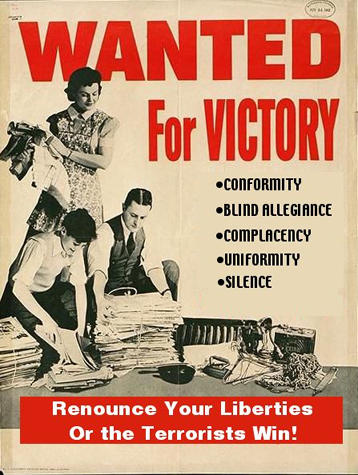
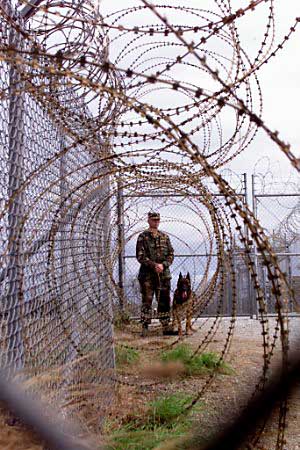
your tax dollars at work
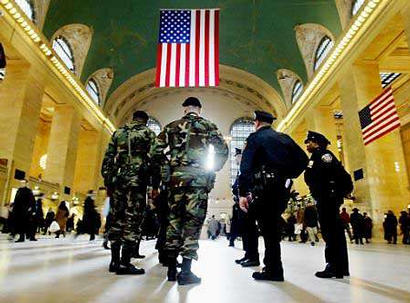
Grand Central Station, New York City, February 2003
partial-martial law has already begun

Concentration Camps for Citizens - Ashcroft's Hellish Vision
http://www.latimes.com/la-oe-turley14aug14.story
www.commondreams.org/views02/0814-05.htm
www.counterpunch.com/shivani0807.html
21st century police state
www.counterpunch.com/shivani0813.html
"What's next, concentration camps?"
www.counterpunch.org/valentine0824.html
Operation Phoenix and Homeland (in)Security
Phoenix program (vietnam war assassination program) vet runs part of Homeland Security agency
www.counterpunch.com/homeland1.html
more on Operation Phoenix - the model for Homeland inSecurity
Guantanamo - 'A Live Experiment
In Long-Term Interrogation'
Meanwhile 4,000 Miles Away In Guantanamo Bay, 660
Prisoners Have No Idea When They Will Be Freed
By Andrew Buncombe
The Independent - UK
11-19-2003
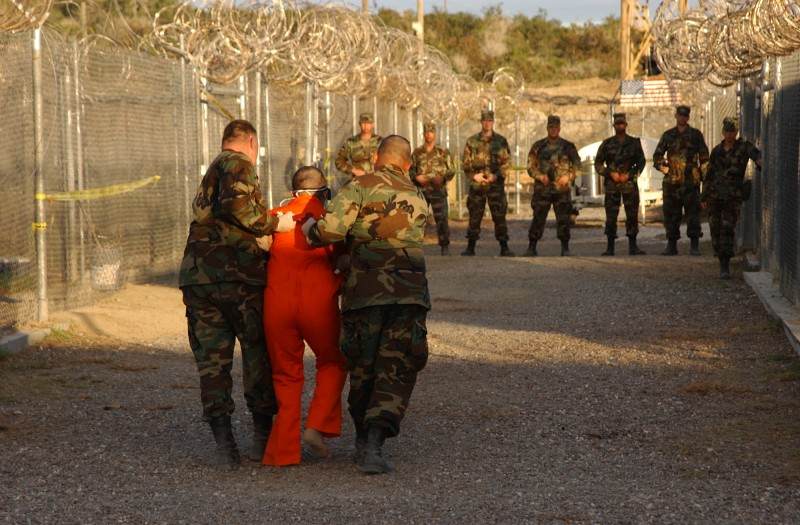

Indefinite Detention
There is a long list of outrages to our democratic rights in recent years - the "legalization" of indefinite detention on the mere assertion of the president may be one of the most troubling yet.
Associated Press [US]
January 8th, 2003
WASHINGTON - A federal appeals court ruled Wednesday that the government can hold U.S. citizens as enemy combatants during wartime without the constitutional protections afforded Americans in criminal prosecutions.
In overturning a lower court ruling, the 4th U.S. Circuit Court of Appeals in Richmond, Va., said the status of 21-year-old Yaser Esam Hamdi as a citizen did not change the fact he was captured in Afghanistan while fighting alongside Taliban and al-Qaida fighters.
"Judicial review does not disappear during wartime, but the review of battlefield captures in overseas conflicts is a highly deferential one" to the government, the judges wrote.
Attorney General John Ashcroft hailed the decision, calling it "an important victory for the president's ability to protect the American people in times of war."
"Detention of enemy combatants prevents them from rejoining the enemy and continuing to fight against America and its allies, and has long been upheld by our nation's courts, regardless of the citizenship of the enemy combatant," Ashcroft said in a statement.
Hamdi was captured in Afghanistan in November 2001 after a prison uprising by suspected Taliban and al-Qaida members. He was transported along with hundreds of other alleged enemy soldiers to a prison at the U.S. Navy base at Guantanamo Bay, Cuba.
It was discovered Hamdi had been born in Louisiana to Saudi parents, who later returned with their son to Saudi Arabia.
He has been held in a naval brig in Norfolk, Va., since April.
Hamdi's case is seen by some as a major legal test case to determine the government's ability to hold citizens without access to a lawyer or the courts. If Hamdi can be imprisoned in a military jail with few of the constitutional protections afforded Americans facing criminal prosecution, critics say, then other U.S. citizens could be similarly held.
A federal judge in Norfolk, Va., agreed, ruling in August that Hamdi should at least have a right to a lawyer and a chance to see the government's evidence against him.
The circuit court agreed that the case raises serious questions about the rights of citizens but concluded that, in wartime, the government's authority is supreme in deciding who may be held indefinitely.
Hamdi, the judges said, was "squarely within the zone of active combat" when captured and is being lawfully detained. The courts, they added, have only limited authority to intervene in such national security matters.
"Any effort to ascertain the facts concerning the petitioner's conduct while amongst the nation's enemies would entail an unacceptable risk of obstructing war efforts authorized by Congress and undertaken by the executive branch," the 54-page opinion said.
http://story.news.yahoo.com/news?tmpl=story&ncid=533& e=3&cid=533&u=/ap/20030108/ap_on_go_ot/ afghan_american_prisoners
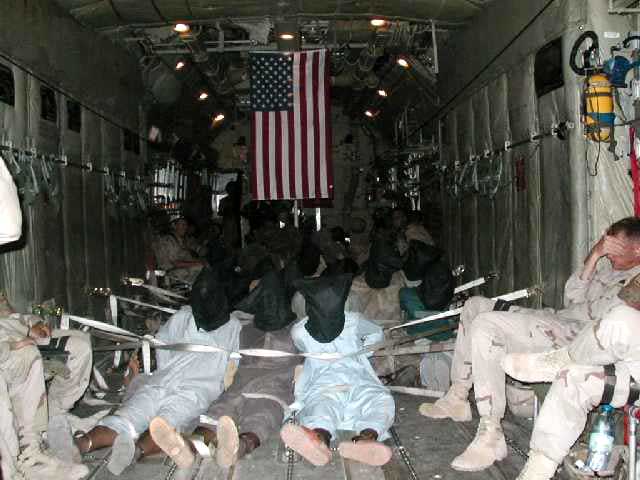
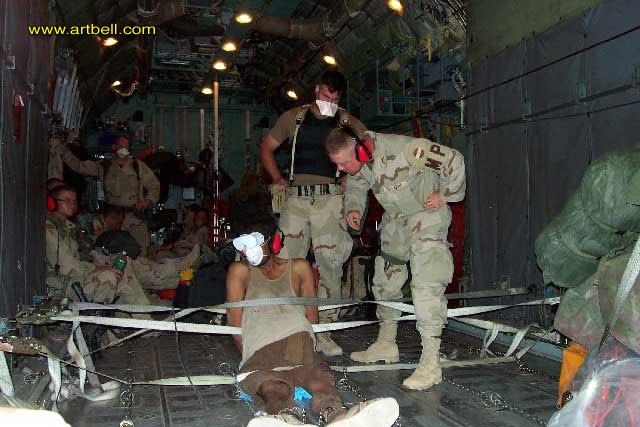
US prisoners from Afghanistan being flown to the Guantanamo Bay concentration
camp (built by Halliburton corporation, Dick Cheney's company)
photos leaked to the Art Bell show
note the total sensory deprivation (goggles, nose and mouth muzzle, ear muffs
and lack of provisions for bathroom functions (each prisoner has a towel under
them to soak up urine)
Hi,
The following is a press release for the press conference organized in
support of Cpt. James Yee by Cecilia Chang of Justice for New
Americans here in San Francisco. This is the statement I will make on
behalf of the National Lawyers Guild Military Law Task Force.
Marti HikenMilitary Law Task Force
National Lawyers Guild
318 Ortega Street
San Francisco, CA 94122
415-566-3732 * fax: 415-564-1945
Contact: Marti Hiken, co-chair MLTF
mlhiken@pacbell.net
November 12, 3003
My name is Marti Hiken. I'm co-chair of the NLG MLTF.
Cpt. Yousef (James) Lee was stationed at The U.S. Naval Base
Guantanamo -- a 45 square mile piece of land on the southeastern side
of Cuba. There is a 17.4 mile fence, guarded by 120 Marines,
separating the base from Cuba. He was one of about 3500 troops,
sailors, Coast Guard and intelligence agents on the base working at
the Navy airstrip and harbor, and the prison.
The U.S. Southern Command established The Joint Task Force- Guantanamo
to command the base. It states that its mission is to support detainee
operation activities at the Holding Facility for Al Qaeda, Taliban or
other terrorist personnel that come under US control as a result of
the ongoing War on Terrorism, and also to serve as the Department of
Defense's focal point for interrogation operations in support of
Operation Enduring Freedom.
Camp Delta, Guantanamo is a concentration camp. Except for Auschwitz's
mass slaughter of its prisoners, Guantanamo is run no differently from
Manzanar or the German equivalents during WWII. Like Auschwitz,
Guantanamo is housed on foreign soil but controlled by the invading
country.
Cpt. Yousef Lee was one of the few who had contact with the prisoners
at this concentration camp.
The US government has systematically denied the human rights of those
660 imprisoned there. Some of them are teenagers, some are older than
80 years old. Attempted suicides, torture and the development of new
torture and control techniques is occurring in the name of the
American people.
The government is step-by-step eliminating all contact from anyone
having contact with the prisoners. The Lynn Stewart case is an
indication that this government will attempt to disbar any attorney
who provides defense and support to the "terrorist" clients.
After lawyers, who else would have access to the prisoners that the
government would eliminate? Chaplains. Thus, Chaplain Yee is arrested
and confined.
Who is next next in line? Translators. Ahmad Al-Halabi and Ahmed Fathy
Mehalba. Both currently confined in military brigs. They also had the
opportunity to meet solo with some of the prisoners.
The Camp Delta prisoners are held incommunicado, no charges, no
counsel. By excluding attorneys, chaplains, translators, the media,
and human rights organizations, the prisoners are left to the
interrogators and prison guards.
As with any concentration camp, ultimately the fact that it exists
will come back to haunt us as a people. Yee should be set free
immediately -- Camp Delta should be shut down and the entire base at
Guantanamo returned to the Cuban people.
Bringing the War Home
by Ron Ridenhour with Arthur Lubow
From New Times, 28 November 1975, Vol.5, No.11, pp. 18, 20-24.
The Pentagon is training police and guardsmen to help the army crush any revolt
in the streets of America. It's part of a detailed secret plan that could end
up crushing our liberties.
http://www.namebase.net:82/ppost14.html
www.ratical.org/ratville/CAH/AOPof911p10.html
Domestic Terrorism: General Ashcroft's
"Enemy Citizens," Martial Law and Internment Camps
One of General Ashcroft's campaigns that has received a minimum of coverage in the press are efforts to set up detention and internment camps in the United States as part of preparations for the possibility of declaring martial law. This past summer, journalist Ritt Goldstein wrote two articles -- "Foundations are in place for martial law in the US" and "Internment Camps and Authoritarian US Fast Becoming Reality" [49] -- that detail how "democratic freedoms which have long defined American life are under seige." http://www.ratical.org/ratville/CAH/martialLaw.html http://www.ratical.org/ratville/CAH/internment.html
This goes back to President Jimmy Carter's creation of the Federal Emergency Management Agency (FEMA) through Executive Order 12148 in 1979. While FEMA's charter originally called for planning and training activities concerning "natural disasters, nuclear war, the possibility of enemy attack on U.S. territory, and incidents involving domestic civil unrest," it was with the advent of the Reagan era in 1981 that FEMA's scope was augmented to be a "national emergency" entity, headed by a federal "emergency czar".[50]
"The birth of FEMA's dark side originated in secret during the Reagan administration. FEMA's domestic disaster management role was then broadened to allow it to practice for the imposition of martial law and the internment of so-called aliens and radicals. During this period, a joint exercise was held with the military to prepare for such a contingency, Rex-84. Concurrently, FEMA began assembling files on those whom the Agency might target. . . . The exercise's purpose was to test military capabilities in anticipation of `civil disturbances, major demonstrations', incidentally illustrating the evolution of civil defense into civil control." [51]
After a period of abuse of power, culminating with the constitutional crisis later labeled Iran Contra (which was never fully revealed in public as vital moments during congressional hearings were conducted behind closed doors [52]), then Attorney General William French Smith concluded that activities FEMA had been involved in were openly unconstitutional including compiling dossiers on those it might seek to intern. "The FBI challenged FEMA's right to pursue domestic spying, resulting in FEMA's turning over `12,000 political dossiers' to the Bureau." [53]
FEMA's involvement in martial law plans surfaced momentarily during the Iran Contra hearings. What was arguably the most important question of those hearings never got a public answer. In July 2002, Southwestern University School of Law Professor Butler Shaffer pondered the question, "Will a Police State Protect Your Liberty?":
"It requires no great genius or years of scholarly study to understand how the future is implicit in the present. In July, 1987, the Miami Herald, along with some other newspapers, ran news stories about secret plans, in the Reagan White House, to suspend the Constitution, establish martial law, turn over the functioning of the US government to the Federal Emergency Management Agency, and have military commanders running state and local governments, in the event of a national crisis. One of the architects of this plan was the conservative godling, Lt. Col. Oliver North. There were even rumors, in some circles, that government concentration camps were being readied for such a possibility.
"While news of such a plan failed to arouse the attention of most legislators, there was one -- Congressman Jack Brooks of Texas -- who, during the Iran-Contra hearings then being conducted, sought to question North about such reports. Brooks was quickly cut off by the Committee chairman, Hawaii Senator Daniel Inouye. In the New York Times report of July 14, 1987, Inouye told Brooks: `that question touches upon a highly sensitive and classified area,' to which Brooks responded: `I read in Miami papers and several others that there had been a plan developed, by that same agency [NSC], a contingency plan in the event of emergency, that would suspend the American Constitution.' Inouye concluded: `May I most respectfully request that that matter not be touched upon, at this stage. If we wish to get into this, I'm certain arrangements can be made for an executive session.' In other words, Sen. Inouye was determined to live up to the pronunciation of his name: `in no way' are we going to let the public know what we have planned for them!" [54]
It is not publically known what process and command structures of FEMA's past are deceased, dormant or active today. Goldstein cites an August 15th 2002 Los Angeles Times story recounting ``Ashcroft's announced desire to create "camps for US citizens he deems to be `enemy combatants'" [and that] Ashcroft aides "have indicated that a `high-level committee' will recommend which citizens are to be stripped of their constitutional rights and sent to Ashcroft's new camps"''.[55] This is described in conjunction with a July 15th NewsMax.com story that FEMA is pursuing a "crash effort" to build "sprawling temporary cities to handle millions".
John Ashcroft resorts to euphemistic subterfuge when he pretends that he can simply rename a citizen of the U.S. as an "enemy combatant". With Ashcroft's penchant for portraying 9-11 as an act of war, he is now seeking to strip any American he wants to target of their constitutional rights and liberties by labeling them "enemy combatant". In terms of Americans, General Ashcroft should call such person's "enemy citizens" since such person is still protected by our constitutional system of law, even if Ashcroft would rather deny them their rights.
Given General Ashcroft's zeal to create camps for U.S. citizens he deems to be "enemy combatants" (although FEMA's public claim is to handle millions of displaced persons in the event of a terrorist attack), it is not unreasonable to expect such camps will be employed to intern Americans. What would be Ashcroft's grounds for internment? Many people will go to the streets to challenge the brazen and continued aggrandizement of power in the hands of the Chief Executive and his officers if another alleged terrorist attack supplies them with more justification to identify and lock up enemy citizens.
FEMA's activities during Reagan's terms included national training exercises in preparation for a suspension of the constitution in case of massive domestic political turmoil. The Department of Homeland Security intends to "build upon the Federal Emergency Management Agency (FEMA) as one of its key components." [56] Goldstein stresses that FEMA's 1980s downfall (of pursuing openly unconstitutional goals) "was a direct outgrowth of its pursuit of proactive methods, its attempt to legitimize the assumption of extraordinary powers under the very cloak of `counterterrorism'."
"At present, the final contents and disposition of the Reagan security initiatives, part of a national crisis plan, remains beyond public knowledge. But given the `War On Terror's' scope, even if a formal crisis is not declared, speculation exists that a de facto drift into an effective deployment of FEMA's crisis powers could occur. And this February, the former FEMA executive, John Brinkerhoff, who reportedly drafted the martial law/internment portions of the national crisis plan, revealed it was `approved by Reagan, and actions were taken to implement it.'" [57]
"A Miami Herald article on July 5, 1987, reported that the former FEMA director Louis Guiffrida's deputy, John Brinkerhoff, handled the martial law portion of the planning. The plan was said to be similar to one Mr Giuffrida had developed earlier to combat `a national uprising by black militants'. It provided for the detention `of at least 21 million American Negroes' in `assembly centres or relocation camps'." [58]
General Ashcroft clearly is up to the task he believes he faces. Given last December's performance, when he aggressively bullied the Senate Judiciary Committee with extreme doublespeak such as "To those who scare peace-loving people with phantoms of lost liberty, my message is this: your tactics only aid terrorists" and "terrorists are taught how to use America's freedoms as a weapon against us", it would be more accurate to charge the General with applying newspeak tactics to promote his idea of freedoms as a weapon against the people of this nation-state.
It is not clear how far the General's zealotry will carry him and us. Nat Hentoff, writing on September 4th about "General Ashcroft's Detention Camps, Time to Call for His Resignation" notes the status of two American citizens, Yaser Esam Hamdi and Jose Padilla, currently "locked up in military brigs as `enemy combatants.'"
"In Hamdi's case, the government claims it can hold him for interrogation in a floating navy brig off Norfolk, Virginia, as long as it needs to. When Federal District Judge Robert Doumar asked the man from the Justice Department how long Hamdi is going to be locked up without charges, the government lawyer said he couldn't answer that question. The Bush administration claims the judiciary has no right to even interfere. . . .
"Returning to General Ashcroft's plans for American enemy combatants, an August 8 New York Times editorial -- written before those plans were revealed -- said: `The Bush administration seems to believe, on no good legal authority, that if it calls citizens combatants in the war on terrorism, it can imprison them indefinitely and deprive them of lawyers. This defiance of the courts repudiates two centuries of constitutional law and undermines the very freedoms that President Bush says he is defending in the struggle against terrorism.'
"Meanwhile, as the camps are being prepared, the braying Terry McAuliffe and the pack of Democratic presidential aspirants are campaigning on corporate crime, with no reference to the constitutional crimes being committed by Bush and Ashcroft. As Supreme Court Justice Louis Brandeis prophesied: "The greatest menace to freedom is an inert people." And an inert Democratic leadership." [59]
As with the bedrock of law in the international arena, we are now witnessing the Bush II repudiation of two centuries of the domestic span of constitutional law undermining the basis of freedoms we presume to be cast in concrete and impermeable to the wiles of such aggrandizement of power. This nullification is being justified behind the all-encompassing façade of a holy "war" against, not a another national entity, but an ambiguous idea that means different things to different people. The supine leadership of Congress is in collusion with this renunciation of constitutional law proceeding apace, given that Congress is not exercising its constitutionally mandated powers of oversight over the Department of Justice.
Last month Mr. Hentoff wrote about retired California Congressman Don Edwards as "the Congressman from the Constitution". On August 10th Edwards received the American Bar Association's Thurgood Marshall Award for his "unswerving devotion to the Constitution and its values throughout his career."
"He served in the House from 1962 to 1995; for 23 years, Don was chair of the House Subcommittee on Civil and Constitutional Rights-which has oversight of the FBI. Himself a former FBI agent, Don set unprecedentedly high standards for containing the FBI within the bounds of the Constitution, very much including the Bill of Rights. . . .
"In the 1970s, Edwards -- along with Senator Frank Church and his committee -- exposed the FBI's pervasive abuses of civil liberties in J. Edgar Hoover's Cointelpro (counter-intelligence program), which monitored, infiltrated, and disrupted entirely lawful civil rights and anti-war organizations.
"Edwards . . . worked with Gerald Ford's attorney general Edward Levi in formulating FBI investigative guidelines faithful to the Constitution. It is these guidelines that John Ashcroft has contemptuously discarded in order to allow the FBI to go back to the hunting fields of Cointelpro.
"Characteristically, Edwards, though respected even by his opponents in Congress, refused a repeated request that he join the Intelligence Committee. He said that the people's business should be done in public, and through his influence in the House he blocked various expansions of unreviewable intelligence-authorization powers.
"Recently, I asked Don Edwards what he thought of the Bush-Ashcroft conception of the Bill of Rights. `The Bill of Rights,' he said, `is under assault. For example, locking people up-citizens or noncitizens-without being charged and without access to a lawyer is wrong. Under our system of justice, you must have a lawyer if you're imprisoned.
"`Also,' he added vigorously, `Congress is not exercising its oversight powers over the Department of Justice, including the FBI. Committees should be hauling in Justice Department officials to justify what they're doing.'" [60]
So far General Ashcroft and Bush II have felt justified in locking up two citizens of the United States without access to a lawyer and claiming the judiciary has no right to interfere. Aides to Ashcroft "have indicated that a `high-level committee' will recommend which citizens are to be stripped of their constitutional rights and sent to Ashcroft's new camps." We find ourselves living our own contemporary Scoundrel Time and must draw inspiration from Lillian Hellman and her accounts of how people stood up to and challenged the unconstitutional authority of an earlier pack of scoundrels: ruthless, ambitious politicians who engaged in their own assault on our constitutional laws and principles.
by Adam Cohen, New York Times [US]
September 22nd, 2002
rehnquist When America is at war, according to Chief Justice William Rehnquist,
people have to get used to having less freedom.
There is a limit to what courts will do to help those deprived of rights, he
says, because judges have a natural "reluctance" to rule "against
the government on an issue of national security during wartime." In fact,
there is "some truth," he concludes, to the Latin maxim "inter
arma silent leges" — in time of war, the law is silent.
With all of the war talk today — the so-called war on terror and the prospect
of a real one in Iraq — it may sound as if the chief justice is laying
the groundwork for a drastic rollback in civil liberties. But these reflections
come from a history book, "All the Laws but One: Civil Liberties in Wartime,"
that he wrote four years ago. When it came out, "All the Laws but One"
seemed like an academic exercise. But with several major terrorism cases headed
to the Supreme Court, court watchers are starting to pick it up as a possible
guidebook.
If Mr. Rehnquist the jurist sees the world as Mr. Rehnquist the historian does,
there is cause for concern.
The Supreme Court term that begins next month could prove momentous. It will
be the justices' first chance to rule on the impact on civil liberties from
the Sept. 11 attacks and their aftermath. The court could resolve several key
questions: whether American citizens can be held indefinitely without access
to lawyers simply because they have been labeled "enemy combatants,"
whether terrorism suspects can be held in secret detention and whether their
deportation hearings can be closed to the public.
"All the Laws but One," which discusses civil liberties during the
Civil War and World Wars I and II, does not answer those questions. But its
central message is that in wartime, the balance between order and freedom tips
toward order. In recounting the history, Justice Rehnquist gives all the arguments
for order, and far too few for freedom. The people whose liberties are taken
away are virtually invisible.
Justice Rehnquist's selective blindness is most evident in his discussion of
the worst denial of civil liberties in American history, the internment of 120,000
people of Japanese ancestry at the start of World War II. He lavishes pages
of detail on the military reasons for the roundup. Against that, he offers a
single sentence about the hardship imposed on those put in the camps. His account
is as dubious as it is brief: he writes that there was "no physical brutality,"
but historians report that some prisoners were beaten and shot.
Justice Rehnquist endorses only part of the Japanese internments, but he seems
far more accepting than many scholars who regard the entire episode as a disaster.
It would be harder for the reader to accept his conclusions if he had included
details about the men, women and children who were rounded up, and the economic,
physical and emotional toll imposed on them.
It is much the same with the book's discussion of President Abraham Lincoln's
decision, during the Civil War, to suspend habeas corpus — the right of
someone taken into custody to challenge his imprisonment before a judge. It
offers considerable detail about the wartime problems confronting Lincoln, but
only a vague sense of how many innocent people may have been kept in prison
as a result. Justice Rehnquist readily accepts Lincoln's famous formulation:
that if he had preserved habeas corpus, it would have meant allowing "all
the laws, but one, to go unexecuted, and the government itself go to pieces,
lest that one" — habeas corpus — "be violated." It
is this quotation, of course, that gives the book its title.
Justice Rehnquist's eagerness to see things from the viewpoint of those charged
with keeping order — and his relative lack of concern about their victims
— could have important implications for the cases the court hears this
term. If the justices think only of terrorism and the threat to national security,
they may be inclined to uphold whatever restrictions the Bush administration
imposes. The more they actually consider the people being held in secret, or
denied the right to see a lawyer, the more likely they are to appreciate the
costs of those policies.
Another problem with "All the Laws but One" is its contention that
presidents cannot be reined in during wartime, so it is pointless to try. Justice
Rehnquist quotes, with approval, Francis Biddle, President Franklin Roosevelt's
attorney general, who said, "The Constitution has not greatly bothered
any wartime president." The opposite case can be made. When President Harry
Truman tried to seize the nation's steel mills during the Korean War —
arguing that an impending strike threatened national security — he backed
down when the Supreme Court objected. Other presidents would probably be just
as compliant.
But the most disturbing aspect of Justice Rehnquist's book is the lack of outrage,
or even disappointment, he evinces when rights are sacrificed. The greatest
American patriots have been eloquent about the danger of letting freedom lapse
even briefly. Benjamin Franklin said, "They that can give up essential
liberty to obtain a little temporary safety deserve neither liberty nor safety."
There are times when Justice Rehnquist sees the wisdom of standing up to wartime
fervor — he is particularly good about the importance of freedom of speech
and assembly. But too often, giving up essential liberty for temporary safety
seems an easy call for him.
Shortly after "All the Laws but One" came out, in an interview on
C-Span, Justice Rehnquist was asked what he thought of writing books. "It's
very nice," he responded, "to be able to write something you don't
have to get four other people to agree with you [on] before it can become authoritative."
This may be the term when we see which of these views he can get four justices
to agree with him on. His colleagues should be cautious. If we keep sacrificing
"one" law to save "all the laws," there will eventually
be no laws left to save.
http://www.nytimes.com/2002/09/22/opinion/22SUN3.html
http://xymphora.blogspot.com/2002_08_01_xymphora_archive.html
More on AshKroft's Kamps:
1. Apparently, some think that the original article on the camps has been completely
debunked. The point is that there are at most 20 prison cells in question, and
that fact, while unfortunate, is not enough to get upset about. The camps issue
is thought to be a red herring, and the real issue is still the indefinite detention
of 'enemy combatants', especially when the determination of whether one is an
'enemy combatant' is made solely by the Bush Administration. It seems to me
that this is true, but it is also important not to forget the issue of the camps.
The actual physical construction of the camps is irrelevant. FEMA (the agency
that can predict the future) and no doubt other organizations already have suitable
camps, constructed for legitimate and semi-legitimate reasons. Once the precedent
is set using Padilla and Hamdi (it is possible that the Padilla case is worse
than the Hamdi case), and the mechanism is set up to allow the Administration
to process 'enemy combatants' in bulk (and anyone who followed the Eichmann
trial knows how important the institutional mechanics of repression are to this
type of person), it would therefore be easy to 'scale' the 20 cells into 200,
2000, or 20,000. The critical point is the fact that the precedent of Padilla
and Hamdi has been set, and as hardly anyone complained about it, it can be
used against anyone, even an American citizen arrested in the United States.
2. The whole system being proposed by Ashcroft is actually the equivalent of
pulling yourself up by your own bootstraps. His theory is that once he has determined
that you are an 'enemy combatant', then all normal Constitutional protections
immediately evaporate. However, presumably the protections can't evaporate before
he makes that determination, i. e., in that legal millisecond before he makes
his determination the courts still must be able to examine the Constitutional
validity of the making of the determination, and in examining this, presumably
have the right to consider all the facts of the case. The judge in the Hamdi
case is alive to these issues. The whole 'enemy combatants' issue appears to
be a rather transparent method to avoid human rights protections using the circular
argument that the Constitution doesn't apply because it doesn't apply to 'enemy
combatants', coupled with the dubious notion that you can become an 'enemy combatant'
by your alleged involvement in the never-ending and ill-defined 'war on terror'.
3. The most interesting questions about Padilla have never been asked. He was
detained in early May, but his detention only came to light with Ashcroft's
announcement in early June. Since the Administration felt absolutely no qualms
about Padilla's detention, and almost didn't bother to mention it until it needed
a big distraction from the Coleen Rowley testimony, the whole issue of how many
other detainees like Jose Padilla there are remains completely open. The camps
may already be full!
4. Jonathan Turley, who seems to hold a monopoly in writing about these issues,
points out that Ashcroft now wants to turbo-charge the secret court which interprets
and enforces the Foreign Intelligence Surveillance Act to make its draconian
powers apply to American citizens. This would presumably grant the government
practically unlimited powers of investigation in order to obtain the information
required to label the 'enemy combatants', as well as on anyone else the Administration
would like to investigate without regard to that nasty Constitution (somewhere
in hell, Richard Nixon must be laughing).
5. There is an interesting pattern here in the Administration's use of the media.
We constantly hear about 'leaks' from the Bush Administration, and sometimes
(e. g., Rumsfeld) even hear complaints about the 'leaks'. The 'leaks' and general
use of the media appear to be the work of a master manipulator (Rove?):
* the Padilla case was clearly set out for the American people, and the full
implications of his treatment explained, allowing for his case to be used as
a precedent for the indefinite detention without trial or legal representation
for any American citizen labelled an 'enemy combatant';
* the constant flow of warnings about imminent terror attacks, to continue the
charade of the 'war on terror';
* all the 'leaks' involving plans on Iraq, which may be a combination of trial
balloons and misdirection, especially if the real goal of the Administration
is also to capture Saudi oil fields;
* all the obvious media manipulation concerning the anthrax attacks and Steven
Hatfill, a patsy who is apparently to be used to distract public attention from
the real issues of the case (with apparently another patsy in the wings to take
over once the Hatfill investigation peters out).
But hey, if you don't want to worry about the AshKroft Kamps, then don't worry
about the AshKroft Kamps. As long as you're white and quiet and don't criticize
the government, you'll probably be fine.