


Operation Iran Liberation (OIL)
US and Israel 2026 war seeks to break up country to control oil
reporter: "Do you think the map of Iran looks the same after this is all done?"
Donald Trump: "That I can't tell you. Probably not."
- conversation with press on Air Force One, en route to Miami, Florida, March 7, 2026
related pages: new Middle East map - 2007: Zbigniew Brzezinski warned against Iran war - 1980 October Surprise
- wars on Iran
- Bush Cheney Cold War
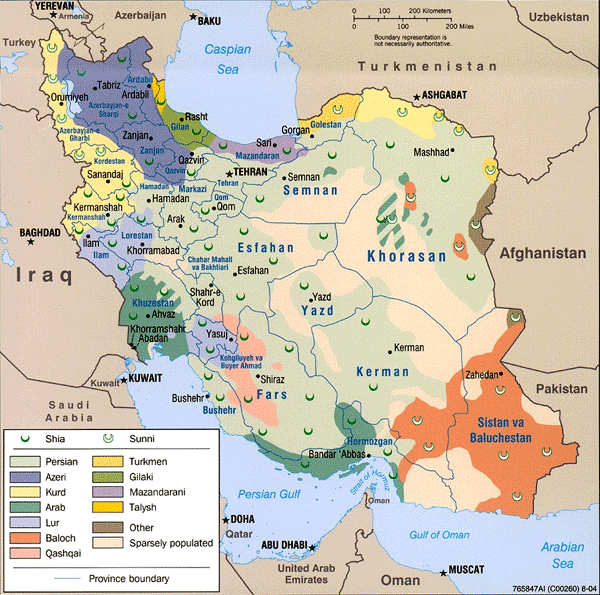
- most Iranian oil in Khuzestan: Arab province
- nuclear Iran
- related pages
 March 9, 2026: Donald has done the nearly unthinkable - start a full scale war, fighting with Israel, against Iran, without direct provocation, Congressional authorization, UN Security Council resolution or any other pretext that this attack has any legal or moral justification.
It is tempting to say that this is to distract the American public from revelations in the Trump Epstein files, and it is, partly, but war plans have been simmering for decades. The construction of military attack systems now being used on Iran were built long before Donald decided to give up sleazy real estate deals and bad TV shows to become a politician.
It is also tempting to say this war is to benefit fantasies of "Greater Israel" (from the Nile to the Euphrates) or to promote crackpot dreams of a Rapture. Those are real concerns, but it is the presence of concentrated wealth on an unprecedented scale that motivates this militarism. Iran has among the largest supplies of oil and natural gas, and as country after country slides into decline of oil production (due to depletion) while growing economies continue to demand more and more and more, the US empire's desire to control what's left gets more intense.
In 1920, after World War I, the British and the French drew new borders through the Middle East, without asking any locals for their inputs. Now, US warplanners quietly seek to change new borders, especially around the Persian Gulf oil fields.
It's anyone's guess what the medium and long term consequences of this new war will be. Donald's misadministration markets this as the downfall of the theocracy - and there are many Iranians, in Iran and in the diaspora, who can't wait for the end of that regime. But this is not the ideal way to accomplish that goal. How much collateral damage, so called, will be caused when this campaign is over (assuming it ends)? Will radicalized populations in the region have spillover effects in other countries? Next door Pakistan is watching these events and no doubt their people are furious watching the US and Israel destroy with impunity - and Pakistan definitely does have nuclear weapons plus missiles to deliver them.
US and Israel plan to 'Balkanise' Iran
Sunday, 08 March 2026 - 16:49
Foad Izadi, a professor at the University of Tehran, has told Al Jazeera that the United States and Israel are "planning to disintegrate Iran", pointing out Trump's statement that suggested that Iran's map may not look the same once the war ends.
It shows, the professor said, the US and Israel plan to "Balkanise" the country.
"I think Trump is interested in separating the oil-rich sections of Iran, which is … [located on] the northern side of the Persian Gulf. He would probably put someone in charge of the oil-rich sections, and he wouldn't have much use for the rest of Iran," he said, referring to the Gulf, also known as the Arabian Gulf.
"So other parts of Iran could be taken over by neighbouring countries, or just left alone if they don't have oil," Izadi said.
"Trump likes oil – he likes Venezuelan oil, he likes Iranian oil.
"And you need to have a government that is not functioning, without a leader. They [Israel and the US] would probably want to kill Iran's president as well. So we would have the collapse of the Iranian government, and change Iran's map," he said.
- Al Jazeera
January 4, 2020: The Cold War on Iran is on the verge of going hot. The US assassination of General Soleimani, top military commander for the Islamic Republic, could not be more brazen and reckless. Potentials for severe escalation are obvious and terrifying. If Trump had been President during the 1962 Cuban Missile Crisis, there would have been a nuclear war.
Under the US Constitution, Congress has sole authority to declare war, but Congress no longer exercises this requirement and will not impeach imperial Presidents who start illegal, immoral wars. Trump escalated immediately just before the Senate trial of his impeachment. Starting a war to deflect from the trial is not only a crime against peace - the US prosecuted Nazis at Nuremberg for this - it also risks further inflaming other conflicts around the region, disrupting the oil flows and imploding the global economy.
www.cbc.ca/radio/asithappens/as-it-happens-friday-edition-1.5414075/iranian-broadcaster-warns-escalation-is-not-the-way-forward-amid-calls-for-soleimani-retaliation-1.5414077
Iranian broadcaster warns 'escalation is not the way forward' amid calls for Soleimani retaliation 'The stakes are high for everybody, including Canada,' says Ghanbar Naderi of Iran's state-run Press TV, CBC Radio, Jan 03, 2020
1953 Coup Consequences
US and British intelligence overthrew the democratically elected government of Iran in 1953. Prime Minister had Mosaddegh nationalized Iran's oil, which was unacceptable to Washington and London.
In 2009, President Obama admitted US responsibility for the coup on his first overseas trip, to Egypt (possibly anticipating the upcoming Arab Spring, probably not precisely but the ferment was already noticeable and increasing). But that history was universally known throughout the region. Perhaps only in the US "homeland" is there little understanding of this crime.
One connection rarely made is part of the US management of the overthrow of Iranian democracy was by Allen Dulles, Eisenhower's CIA director, who also overthrew the US government a decade later via the extrajudicial removal of President Kennedy from office. Allen's brother John Foster Dulles was Eisenhower's Secretary of State, but died before JFK became President.
The coup in Iran was one of the great tragedies for the unraveling of the Islamic world in the 20th century. Without it, there might not have been the Shah, the rise of Khomeini, the Iran-Iraq war, and US wars on Iraq. Kennedy tilted toward nationalists instead of religious fundamentalists in the Middle East, and it is tempting to consider how different this region would have been if he had been allowed to remain President. Kennedy snubbed the King of Saudi Arabia when he came to the US. He pressured Israel, then building the Dimona nuclear weapons factory, not to go nuclear. (Perhaps a second term of JFK might have prevented the Six Day War of 1967, whose legacy includes Israeli domination of the West Bank.) JFK's opposition to the Shah could have resulted in a very different country than the Islamic Republic of Iran, itself a reaction to the Shah's dictatorship. The cycles of violence and trauma continue to destabilize and destroy the Middle East.
Opposition to US war on Iran does not imply support for the severe human rights abuses of the theocracy, including
- mass murder of Bahai religious minority
- one of the worst users of the death penalty in the world
- violent repression of dissent
- misogynistic control of women
- support for the war criminal Assad in Syria and Hezbollah in Lebanon
War on Iran makes accountability for these crimes less likely. In most countries, citizens who disagree with oppressive leaderships usually rally around the flag when their country is under attack. On 9/11, President George W. Bush's approval rating doubled from the 40s percentage to about 90 percent. It's worth remembering that immediately after 9/11 the Iranian government encouraged sympathy rallies with America. Iran also considered al-Qaeda to be an enemy.
Iranian oil revenues in decline
Economic warfare damaged the Iranian economy and makes the government's problems more desperate.
Sanctions cut the ability of Iran to sell oil and fund government operations.
Iran's growing population uses more of its oil domestically, with less remaining to sell abroad. The lowered price of oil caused in part by tar sands and fracking in America (which postponed rationing) economically stressed Iran, as happened with other oil states.
US and Israel vs. Iran
The US and Israel "collaborated" on the "Stuxnet" cyber attack that damaged centrifuges. Nuclear scientists have been assassinated.
Israeli fear that Netanyahu will start war to save his skin won't make it into the 'NYT'
Media Analysis James North on December 28, 2019
The Haaretz headline tells it all: "Netanyahu should not be allowed to start a war with Iran to save himself." The two authors note that Israel's prime minister goes into his third election campaign in a year facing three criminal indictments, and
"The concern is that he could initiate a major armed conflict with Iran in the hope of convincing the Israeli electorate that there is no substitute for his leadership in spite of the costs to Israel of such a war."
What makes the article even more compelling is that its authors are hardly left-wing extremists. Shlomo Brom is a retired Brigadier General in Israel's army, and Shimon Stein is a retired ambassador who is a senior fellow at the Institute for Security Studies at Tel Aviv University.
Attacking Iran risks wider wars with Russia and China
RUSSIA SAYS U.S. SOLEIMANI STRIKE WILL DAMAGE REGIONAL STABILITY, IMPACT MILLIONS OF PEOPLE
BY DAVID BRENNAN ON 1/3/20
and a comment from "Quark Hadron"
Middle East stability.... I have to chuckle....
Since the early 1950's it has been US foreign policy to promote instability in the Middle East. Trump is only doing what his predecessors have done since then.
(Before replying in the negative, use that internet connection you obviously have, do web search on something like "united states middle east destabilization policy" and educate yourself first.)
At the beginning of my military career I was training with Iranians. Then I was training Iraqis. Then I was helping bomb Iraqis...... Then we're back to training them and trying to 'help them rebuild'
QASSEM SOLEIMANI ONCE MOCKED TRUMP AS A 'CABARET OWNER' AND A 'GAMBLER,' WARNED U.S. NOT TO THREATEN IRAN
BY DAVID BRENNAN ON 1/3/20
www.newsweek.com/iran-warns-us-middle-east-dominance-over-naval-drills-russia-china-1479628
IRAN WARNS U.S. ITS MIDDLE EAST DOMINANCE IS OVER AFTER NAVAL DRILLS WITH RUSSIA, CHINA
BY DAVID BRENNAN ON 12/30/19
What could have been (or maybe in the future, after Trump)
Drought stricken, Iran buys US wheat for first time in 27 years
Aug 25, 2008 - Agence France Press
Wracked by drought, Iran has turned to the United States for wheat for the first time in 27 years, marking a setback for Tehran's search for agricultural self-sufficiency.
According to a recent US Department of Agriculture report, Iran has bought about 1.18 million tonnes of US hard wheat since the beginning of the 2008-2009 crop season in June.
The number, which has been growing steadily all summer, already represents nearly 5.0 percent of US annual exports forecast by the USDA.
The last time Iran imported US wheat was in 1981-1982. ....
Analysts noted that Tehran could have used an intermediary, like Syria, to import US wheat to avoid having the sale recorded in official data.
Bush Cheney Cold War on Iran
The Cheney-Bush administration was blocked from attacking Iran during their second term. A significant faction of the intelligence agencies and generals in the US and Israel were opposed - not out of humanitarian considerations, but that this would increase the havoc in the region, which risks devastating consequences. Trump and his backers are aiming for a second shot at full scale war, but a decade after Cheney and Netayahu failed to launch full scale war the precariousness of the global economy's dependence on Middle East oil is even more severe.
While there are too many variables, it seems unlikely that the US can attack Iran in a full scale war. There is no elasticity in the oil system any more. There is no more untapped capacity in any country to bridge the gap of Iran's shutdown. Iran's military could retaliate in many ways. Iran's Navy would probably try to disrupt oil flows through the Straits of Hormuz. Perhaps Iran would launch a (conventionally armed) missile at the Saudi oil export terminal at Ras Tanura, just across the Gulf from Iran. If that ever happens, it would blow up the whole global economy, without nuclear weapons. Europe, Japan, China, India and other industrialized giga-economies are completely dependent on this strategic flow, despite pledges to become carbon neutral some day (perhaps as the oil fields are depleted).
Hopefully the more "realist" faction of the US establishment / deep state / military industrial intelligence complex will prevail over the crazies who want to do to Iran what was done to Iraq.
In some planners' minds, accelerating chaos throughout the region could permit the oil empire to use ethnic and religious difference to draw a new Middle East map.
Iran war plan: impeachable
"The degree to which this President [Bush] continues to take steps to go to war against Iran without consulting with the full Congress is the degree to which he is increasingly putting himself in jeopardy of an impeachment proceeding."
-- Representative Dennis Kucinich
http://kucinich.house.gov/News/DocumentSingle.aspx?DocumentID=56365
Kucinich introduced a bill to impeach Bush and Cheney, but no member of Congress co-sponsored it. Rep. Cynthia McKinney introduced a separate, similar bill which also had zero co-sponsors. The Democratic Party leadership kicked both members out of Congress. Kucinich's district was gerrymandered to ensure his defeat. McKinney had a more pliable African American primary challenger who was backed by both parties. (Republicans knew they could not replace McKinney with a Republicans since the district is Democratic and African American.)
Perhaps if there had been impeachments of Bush and Cheney for threatening war on Iran, waging wars on Iraq and Afghanistan, along with their other war crimes, we would not now see the spectacle of the Trump administration escalation. If there is ever Truth and Reconciliation in America, part of the inquiry could examine acquiescence of the Democrats to Republican war crimes.
Gary Hart warned about a pretext to trigger a War on Iran
Former Senator and Presidential candidate Gary Hart was part of a study group before the 2000 "election" that was apparently the first place where the term "Homeland Security" was used. It is interesting to see part of the foreign policy establishment warning against a Cheney/Bush pretext to attack Iran before January 20, 2009 -- similar to Zbigniew Brzezinski's warning to the Senate Foreign Relations Committee in February 2007.
Senator Hillary Clinton voted at the time of Hart's editorial in support of a resolution accusing part of the Iranian military as a "terrorist" organization. This was a dangerous escalation that gave the Bush administration more political cover to to attack Iran. (Nearly all military forces are "terrorist" -- they use violence for political objectives.)
www.huffingtonpost.com/gary-hart/unsolicited-advice-to-the_b_65984.html
Unsolicited Advice to the Government of Iran
by Gary Hart
Posted September 26, 2007 | 03:22 PM (EST)
Presuming that you are not actually ignorant enough to desire war with the United States, you might be well advised to read the history of the sinking of the U.S.S. Maine in Havana harbor in 1898 and the history of the Gulf of Tonkin in 1964.
Having done so, you will surely recognize that Americans are reluctant to go to war unless attacked. Until Pearl Harbor, we were even reluctant to get involved in World War II. For historians of American wars the question is whether we provoke provocations.
Given the unilateral U.S. invasion of Iraq in 2003, you are obviously thinking the rules have changed. Provocation is no longer required to take America to war. But even in this instance, we were led to believe that the mass murderer of American civilians, Osama bin Laden, was lurking, literally or figuratively, in the vicinity of Baghdad.
Given all this, you would probably be well advised to keep your forces, including clandestine forces, as far away from the Iraqi border as you can. You might even consider bringing in some neighbors to verify that you are not shipping arms next door. Tone down the rhetoric on Zionism. You've established your credentials with those in your world who thrive on that.
If it makes you feel powerful to hurl accusations at the American eagle, have at it. Sticks and stones, etc. But, for the next sixteen months or so, you should not only not take provocative actions, you should not seem to be doing so.
For the vast majority of Americans who seek no wider war, in the Middle East or elsewhere, don't tempt fate. Don't give a certain vice president we know the justification he is seeking to attack your country. That is unless you happen to like having bombs fall on your head.
www.salon.com/opinion/feature/2007/09/19/iran/
Why Bush won't attack Iran
Despite saber-rattling, and the Washington buzz that a strike is coming, the president doesn't intend to bomb Iran. Cheney may have other ideas.
By Steven Clemons
09/20/07 "Salon" -- - During a recent high-powered Washington dinner party attended by 18 people, Zbigniew Brzezinski and Brent Scowcroft squared off across the table over whether President Bush will bomb Iran.
Brzezinski, former national security advisor to President Carter, said he believed Bush's team had laid a track leading to a single course of action: a military strike against Iran's nuclear facilities. Scowcroft, who was NSA to Presidents Ford and the first Bush, held out hope that the current President Bush would hold fire and not make an already disastrous situation for the U.S. in the Middle East even worse.
The 18 people at the party, including former Pakistani Prime Minister Benazir Bhutto, then voted with a show of hands for either Brzezinski's or Scowcroft's position. Scowcroft got only two votes, including his own. Everyone else at the table shared Brzezinski's fear that a U.S. strike against Iran is around the corner.
www.wsws.org/articles/2007/sep2007/iran-s11_prn.shtml
British academics warn US is preparing “shock and awe” attack on Iran
By Peter Symonds
11 September 2007
An 80-page study written by two British security analysts and released on August 28 makes a chilling estimation of the overwhelming force that the US would use in the event of any attack on Iran. “The US has made military preparations to destroy Iran’s WMD, nuclear energy, regime, armed forces, state apparatus and economic infrastructure within days, if not hours, of President George W. Bush giving the order,” the paper declared.
The authors, Dr Dan Plesch and Martin Butcher, concluded on the basis of publicly available sources that “US bombers and long range missiles are ready today to destroy 10,000 targets within Iran in a few hours. US ground, air and marine forces already in the Gulf, Iraq and Afghanistan can devastate Iranian forces, the regime and the state at short notice.”
http://rawstory.com//news/2007/Study_US_preparing_massive_military_attack_0828.html
Study: US preparing 'massive' military attack against Iran
Larisa Alexandrovna and Muriel Kane
Published: Tuesday August 28, 2007
The United States has the capacity for and may be prepared to launch without warning a massive assault on Iranian uranium enrichment facilities, as well as government buildings and infrastructure, using long-range bombers and missiles, according to a new analysis.
The paper, "Considering a war with Iran: A discussion paper on WMD in the Middle East" – written by well-respected British scholar and arms expert Dr. Dan Plesch, Director of the Centre for International Studies and Diplomacy of the School of Oriental and African Studies (SOAS) at the University of London, and Martin Butcher, a former Director of the British American Security Information Council (BASIC) and former adviser to the Foreign Affairs Committee of the European Parliament – was exclusively provided to RAW STORY late Friday under embargo.
www.smirkingchimp.com/thread/5209
This is like Hitler's Suicide Order from the Bunker
By Dave Lindorff
Created Feb 1 2007
This is madness!
I wrote last September that Bush was gearing up for war with Iran, as evidenced by the moving up of the deployment date of the carrier group headed by the recently re-fueled and re-armed USS Eisenhower, some of whose crewmembers had leaked that its mission was to attack Iran.
At the time, there was considerable skepticism expressed about the article, which appeared in the Nation’s online edition.
Now, four months later, it is widely assumed in Europe that the U.S. is planning to attack Iran, and even in the U.S., members of Congress are openly talking about their concern that Bush is planning to attack Iran. ....
Iran is the second largest oil producing country in the world, and it borders the entire eastern shore of the Persian Gulf, through which a third of the world’s oil passes every year. If it was attacked, all of Iran’s oil, and most of the oil produced by Kuwait, Bahrain, Saudi Arabia, would be taken out of circulation indefinitely. Oil prices would soar way past $100/barrel, and maybe past $200 a barrel, causing a U.S. and a global depression.
So why are we even talking about this?
We’re talking about this because the President of the United States, the Vice President, and the neoconservative political gang that has brought the nation six years of war, destruction and Constitution-wrecking, is under attack, and this cabal of madmen and mad women has decided that chaos, death and destruction offers the best hope of salvation.
We are, it appears, about to witness the American equivalent of Hitler’s suicide orders to the German people as he scurried to his bunker in Berlin.
What to do? The answer is simple.
It is time for the Congress, and the American people, to act.
If Senators and Representatives pass a resolution barring the use of any military forces against Iran, or the expenditure of any funds for war against Iran, Bush will not be able to push the country over the precipice. American military leaders would have reason to ignore any orders that would put them in violation of the law of the land.
This would be a historic moment—a reassertion by Congress of its Constitutional primacy in matters of war and peace.
Members of Congress should follow up that move by initiating impeachment proceedings against this whacko immediately.
Congress must not duck its patriotic duty. President Clinton was impeached for a little blowjob. This president wants to blow a hell of a lot more than an intern.
An attack on Iran would be an international crime under the Nuremberg Charter, which calls the invasion of a country that doesn’t pose an immediate threat a “Crime Against Peace.” But even aside from such matters, anyone with a lick of sense knows that it would be crazy to go into another even larger war while the American military is completely tied down in two other desperate situations.
The whole Bush administration has clearly gone stark raving mad, and is willing to sacrifice the nation for its own short-term gain.
This cannot be allowed to happen.
No War against Iran!
Impeach the President now!
consortiumnews.com
Iran Clock Is Ticking
By Robert Parry
January 31, 2007
While congressional Democrats test how far they should go in challenging George W. Bush’s war powers, the time may be running out to stop Bush from ordering a major escalation of the Middle East conflict by attacking Iran.
Military and intelligence sources continue to tell me that preparations are advancing for a war with Iran starting possibly as early as mid-to-late February. The sources offer some differences of opinion over whether Bush might cite a provocation from Iran or whether Israel will take the lead in launching air strikes against Iran’s nuclear facilities.
But there is growing alarm among military and intelligence experts that Bush already has decided to attack and simply is waiting for a second aircraft carrier strike force to arrive in the region – and for a propaganda blitz to stir up some pro-war sentiment at home.
One well-informed U.S. military source called me in a fury after consulting with Pentagon associates and discovering how far along the war preparations are. He said the plans call for extensive aerial attacks on Iran, including use of powerful bunker-busting ordnance.
Another source with a pipeline into Israeli thinking said the Iran war plan has expanded over the past several weeks. Earlier thinking had been that Israeli warplanes would hit Iranian nuclear targets with U.S. forces in reserve in case of Iranian retaliation, but now the strategy anticipates a major U.S. military follow-up to an Israeli attack, the source said.
Both sources used the same word “crazy” in describing the plan to expand the war to Iran. The two sources, like others I have interviewed, said that attacking Iran could touch off a regional – and possibly global – conflagration.
“It will be like the TV show ‘24’,” the American military source said, citing the likelihood of Islamic retaliation reaching directly into the United States.
Though Bush insists that no decision has been made on attacking Iran, he offered similar assurances of his commitment to peace in the months before invading Iraq in 2003. Yet leaked documents from London made clear that he had set a course for war nine months to a year before the Iraq invasion.
In other words, Bush’s statements that he has no plans to "invade" Iran and that he’s still committed to settle differences with Iran over its nuclear program diplomatically should be taken with a grain of salt.
There is, of course, the possibility that the war preparations are a game of chicken to pressure Iran to accept outside controls on its nuclear program and to trim back its regional ambitions. But sometimes such high-stakes gambles lead to miscalculations or set in motion dynamics that can't be controlled.
Monday, January 29, 2007
Name The False Flag Incident
William Rivers Pitt, in his piece A Cornered Animal :
"Question: What is the connection between a possible American attack on Iran and the perjury trial of I. Lewis Libby?
Answer: Vice President Dick Cheney."Indeed. Most people know that the real president has been Cheney, not the pretend self proclaimed Deciderer. Some say Cheney has been Bush' ventriloquist. Some say they placed the Crawford moron in his position as a convenient lightning rod to deflect criticism for all the disasters we've seen, as sort of an inside joke. I wouldn't disagree.
But now because of the Libby trial Shooter's garnering a lot of attention as being in the middle of treasonous activity. It's very possible that he may be forced to testify. Cheney has stated publicly he won't, even if subpoenaed. That would bring on a constitutional crisis and all hell would break loose.
One thing that's written in granite in the fascist playbook is that things should always appear to happen externally to be capitalized politically, not vice versa. Start wars, get the bump in polls. Pull off 9/11 and pass fascist legislation. Don't get involved in dirty political brawls because it will weaken your ability to manipulate and control. They've had a free ride since Black Tuesday but with americans slowly coming out of their coma and the Libby thing threatening to expose lies and corruption, they need to knock their troubles off the front page.
www.vanityfair.com/politics/features/2007/03/whitehouse200703?printable=true¤tPage=all
From the Wonderful Folks Who Brought You Iraq
The same neocon ideologues behind the Iraq war have been using the same tactics—alliances with shady exiles, dubious intelligence on W.M.D.—to push for the bombing of Iran. As President Bush ups the pressure on Tehran, is he planning to double his Middle East bet?
by Craig Unger March 2007
http://business.guardian.co.uk/print/0,,329700021-108725,00.html
Shell defies US pressure and signs £5bn Iranian gas deal
Terry Macalister
Monday January 29, 2007
Guardian Unlimited
Shell has signed an important deal to help Iran develop a major gas field, ignoring growing pressure from George Bush to isolate the country for being part of what he alleges is an "axis of evil".
www.usnews.com/usnews/politics/bulletin/bulletin_070119.htm
Friday, January 19, 2007
Cheney Reportedly Rebuffed Iran Offer
The AP reports Lawrence Wilkerson, the former chief of staff to Secretary of State Colin Powell, said Vice President Dick Cheney rejected "an Iranian offer to help the United States stabilize Iraq and end its military support for Hezbollah and Hamas" in 2003. In an interview with the British Broadcasting Corp., Wilkerson said the State Department was "open to the offer, which came in an unsigned letter sent shortly after the American invasion of Iraq." Wilkerson said State Department officials "thought it was a very propitious moment" to strike a deal, "but as soon as it got to the White House, and as soon as it got to the vice president's office, the old mantra of 'We don't talk to evil'...reasserted itself."
www.thenation.com/doc/20070122/klare
Ominous Signs of a Wider War
Michael T. Klare
On January 5 Defense Secretary Robert Gates announced that he was replacing Gen. John Abizaid as commander of the Central Command (Centcom)--the body responsible for oversight of all US forces in Iraq, Afghanistan and the greater Middle East--with Adm. William Fallon, currently the commander of the Pacific Command (Pacom). Fallon is one of several senior officers recently appointed by Gates to oversee the new strategy for Iraq now being shaped by President Bush.
The choice of Fallon to replace Abizaid was highly unusual in several respects. First, this is a lateral move for the admiral, not a promotion: As head of Pacom, Fallon commanded a larger force than he will oversee at Centcom, and one over which he will exercise less direct control since all combat operations in Iraq will be under the supervision of Gen. Dave Petraeus, the recently announced replacement for Gen. George Casey as commander of all US and allied forces. Second, and more surprising, Fallon is a Navy man, with experience in carrier operations, while most of Centcom's day-to-day work is on the ground, in the struggle against insurgents and warlords in Iraq and Afghanistan.
Part of the explanation for this move, of course, is a desire by the White House to sweep away bitter ground-force commanders like Abizaid and Casey who had opposed an increase in US troops in Iraq and argued for shifting greater responsibility for the fighting to Iraq forces, thereby permitting a gradual American withdrawal. "The Baghdad situation requires more Iraqi troops," not more Americans, Abizaid said in a recent interview with the New York Times. For this alone, Abizaid had to go.
But there's more to it. Abizaid, who is of Lebanese descent and served a tour of duty with UN forces in Lebanon, has come to see the need for a regional solution to the crisis in Iraq--one that inevitably requires some sort of engagement with Iran and Syria, as recommended by the Iraq Study Group. "You have to internationalize the problem, you have to attack it diplomatically, geo-strategically," he told the Times. "You just can't apply a microscope on a particular problem in downtown Baghdad...and say that somehow or another, if you throw enough military forces at it, you are going to solve the broader issues in the region of extremism."
If engagement with Iran and Syria was even remotely on the agenda, Abizaid is exactly the man you'd want on the job at Centcom overseeing US forces and strategy in the region. But if that's not on the agenda, if you're thinking instead of using force against Iran and/or Syria, then Admiral Fallon is exactly the man you'd want at Centcom.Why? Because combined air and naval operations are his forte. Fallon began his combat career as a Navy combat flyer in Vietnam, and he served with carrier-based forces for twenty-four years after that. He commanded a carrier battle wing during the first Gulf War in 1991 and led the naval group supporting NATO operations during the Bosnia conflict four years later. More recently, Fallon served as vice chief of naval operations before becoming the head of Pacom in 2005. All this means that he is primed to oversee an air, missile and naval attack on Iran, should the President give the green light for such an assault--and the fact that Fallon has been moved from Pacom to Centcom means that such a move is very much on Bush's mind.
The recent replacement of General Abizaid by Admiral Fallon, along with other recent moves announced by the Defense Secretary, should give deep pause to anyone concerned about the prospect of escalation in the Iraq War. Contrary to the advice given by the Iraq Study Group, Bush appears to be planning for a wider war--with much higher risk of catastrophic failure--not a gradual and dignified withdrawal from the region.
www.dailytimes.com.pk/default.asp?page=2007%5C01%5C09%5Cstory_9-1-2007_pg7_4
Tuesday, January 09, 2007
Iran threatens to block strategic oil strait
TEHRAN: A senior officer in the volunteer Basij militia said on Monday Iran could block oil traffic through the strategic Strait of Hormuz if the West threatens its economy over Tehran’s nuclear programme.
“Given Iran’s authority over the Strait of Hormuz, the passageway to more than 40 percent of the world’s energy, we have become so strong that the world’s economic and energy security are in the hands of Iran,” deputy Basij commander General Majid Mir Ahmadi was quoted as saying by the semi-official Fars news agency.
“We can exert pressure on the US and British economies as much as we ourselves are put under pressure,” he said. “US allies, especially those who host US military sites or facilitate American strategies against us, are exposed to our threat,” Mir Ahmadi added. “This is the Islamic republic’s strategy in the Persian Gulf – security for everyone or for nobody.”
Meanwhile, Iranian Supreme Leader Ayatollah Ali Khamenei has said that Tehran would never yield to international pressure to deprive it of its right to nuclear technology, state radio said.
“The Iranian nation will surely not abandon its right and Iranian officials have no right to deprive the nation of its right,” Khamenei was quoted as saying on the occasion of the Shia feast of Eidul Ghadir.
Khamenei, who was shown on television, was making his first public appearance since rumours appeared on websites on Thursday that he had died. Iran last week denied the reports.
Khamenei has final say on all state matters in the Islamic republic, including Iran’s nuclear standoff with the West.
www.timesonline.co.uk/article/0,,2089-2535310,00.html
The Sunday Times January 07, 2007
Revealed: Israel plans nuclear strike on Iran
Uzi Mahnaimi, New York and Sarah Baxter, Washington
www.amconmag.com/2006/2006_12_18/article.html
December 18, 2006 Issue
Copyright © 2006 The American Conservative
How to Lose an Army
Plow deep into Iraq and dare Iran to strike.
by William S. Lind
... what do the results of the election mean for a prospective attack on Iran? On the surface, the Democrats’ seizure of both houses of Congress would seem to be good news. Having won their majorities because the American people want out of a war, they ought to be reluctant to jump into a second one.
Regrettably, that logic may be too simple. Because an attack on Iran will be launched with no warning, the Bush administration will not have to consult Congress beforehand. Congress could take the initiative and forbid such an attack preemptively (“no funds may be expended…”). But in an imperial capital where court politics count far more than the nation’s interests, Democrats may prefer to risk a second war, and a second debacle, rather than open themselves up to a charge of being weak on terrorism. ....
If the U.S. were to lose the army it has in Iraq to Iraqi militias, Iranian regular forces, or a combination of both, cutting our one line of supply and then encircling us, the world would change. It would be our Adrianople, our Rocroi, our Stalingrad. American power and prestige would never recover. Nothing, not even Israel’s demands, should lead us to run this risk, which is inherent in any attack on Iran.
There is one action, a possibility opened by the Democrats’ electoral victory, that would stop the Bush administration from launching such an attack or allowing Israel to do so. If our senior military leaders, especially the Joint Chiefs of Staff, would go public with their opposition to such an adventure, the new Democratic majority in Congress would have to react. The public that put it in office on an antiwar platform would compel it to answer or lose all credibility. While the Joint Chiefs would infuriate the White House, they would receive the necessary political cover from the new Democratic Congress. The potential is there, for the generals and the Democrats alike.]
For it to be realized, and the disaster of war with Iran to be averted, all the generals must do is show some courage. If the Joint Chiefs keep silent now and allow the folly of an attack on Iran to go forward, they will share in full the moral responsibility for the results, which may include the loss of an army.
Published on 17 Jan 2006 by Energy
Bulletin. Archived on 18 Jan 2006.
The Proposed Iranian Oil Bourse
by Krassimir Petrov
I. Economics of Empires
A nation-state taxes its own citizens, while an empire taxes other nation-states. The history of empires, from Greek and Roman, to Ottoman and British, teaches that the economic foundation of every single empire is the taxation of other nations. The imperial ability to tax has always rested on a better and stronger economy, and as a consequence, a better and stronger military. One part of the subject taxes went to improve the living standards of the empire; the other part went to strengthen the military dominance necessary to enforce the collection of those taxes.
Historically, taxing the subject state has been in various forms—usually gold and silver, where those were considered money, but also slaves, soldiers, crops, cattle, or other agricultural and natural resources, whatever economic goods the empire demanded and the subject-state could deliver. Historically, imperial taxation has always been direct: the subject state handed over the economic goods directly to the empire.
For the first time in history, in the twentieth century, America was able to tax the world indirectly, through inflation. It did not enforce the direct payment of taxes like all of its predecessor empires did, but distributed instead its own fiat currency, the U.S. Dollar, to other nations in exchange for goods with the intended consequence of inflating and devaluing those dollars and paying back later each dollar with less economic goods—the difference capturing the U.S. imperial tax. Here is how this happened.
Early in the 20th century, the U.S. economy began to dominate the world economy. The U.S. dollar was tied to gold, so that the value of the dollar neither increased, nor decreased, but remained the same amount of gold. The Great Depression, with its preceding inflation from 1921 to 1929 and its subsequent ballooning government deficits, had substantially increased the amount of currency in circulation, and thus rendered the backing of U.S. dollars by gold impossible. This led Roosevelt to decouple the dollar from gold in 1932. Up to this point, the U.S. may have well dominated the world economy, but from an economic point of view, it was not an empire. The fixed value of the dollar did not allow the Americans to extract economic benefits from other countries by supplying them with dollars convertible to gold.
Economically, the American Empire was born with Bretton Woods in 1945. The U.S. dollar was not fully convertible to gold, but was made convertible to gold only to foreign governments. This established the dollar as the reserve currency of the world. It was possible, because during WWII, the United States had supplied its allies with provisions, demanding gold as payment, thus accumulating significant portion of the world’s gold. An Empire would not have been possible if, following the Bretton Woods arrangement, the dollar supply was kept limited and within the availability of gold, so as to fully exchange back dollars for gold. However, the guns-and-butter policy of the 1960’s was an imperial one: the dollar supply was relentlessly increased to finance Vietnam and LBJ’s Great Society. Most of those dollars were handed over to foreigners in exchange for economic goods, without the prospect of buying them back at the same value. The increase in dollar holdings of foreigners via persistent U.S. trade deficits was tantamount to a tax—the classical inflation tax that a country imposes on its own citizens, this time around an inflation tax that U.S. imposed on rest of the world.
When in 1970-1971 foreigners demanded payment for their dollars in gold, The U.S. Government defaulted on its payment on August 15, 1971. While the popular spin told the story of “severing the link between the dollar and gold”, in reality the denial to pay back in gold was an act of bankruptcy by the U.S. Government. Essentially, the U.S. declared itself an Empire. It had extracted an enormous amount of economic goods from the rest of the world, with no intention or ability to return those goods, and the world was powerless to respond— the world was taxed and it could not do anything about it.
From that point on, to sustain the American Empire and to continue to tax the rest of the world, the United States had to force the world to continue to accept ever-depreciating dollars in exchange for economic goods and to have the world hold more and more of those depreciating dollars. It had to give the world an economic reason to hold them, and that reason was oil.
In 1971, as it became clearer and clearer that the U.S Government would not be able to buy back its dollars in gold, it made in 1972-73 an iron-clad arrangement with Saudi Arabia to support the power of the House of Saud in exchange for accepting only U.S. dollars for its oil. The rest of OPEC was to follow suit and also accept only dollars. Because the world had to buy oil from the Arab oil countries, it had the reason to hold dollars as payment for oil. Because the world needed ever increasing quantities of oil at ever increasing oil prices, the world’s demand for dollars could only increase. Even though dollars could no longer be exchanged for gold, they were now exchangeable for oil.
The economic essence of this arrangement was that the dollar was now backed by oil. As long as that was the case, the world had to accumulate increasing amounts of dollars, because they needed those dollars to buy oil. As long as the dollar was the only acceptable payment for oil, its dominance in the world was assured, and the American Empire could continue to tax the rest of the world. If, for any reason, the dollar lost its oil backing, the American Empire would cease to exist. Thus, Imperial survival dictated that oil be sold only for dollars. It also dictated that oil reserves were spread around various sovereign states that weren’t strong enough, politically or militarily, to demand payment for oil in something else. If someone demanded a different payment, he had to be convinced, either by political pressure or military means, to change his mind.
The man that actually did demand Euro for his oil was Saddam Hussein in 2000. At first, his demand was met with ridicule, later with neglect, but as it became clearer that he meant business, political pressure was exerted to change his mind. When other countries, like Iran, wanted payment in other currencies, most notably Euro and Yen, the danger to the dollar was clear and present, and a punitive action was in order. Bush’s Shock-and-Awe in Iraq was not about Saddam’s nuclear capabilities, about defending human rights, about spreading democracy, or even about seizing oil fields; it was about defending the dollar, ergo the American Empire. It was about setting an example that anyone who demanded payment in currencies other than U.S. Dollars would be likewise punished.
Many have criticized Bush for staging the war in Iraq in order to seize Iraqi oil fields. However, those critics can’t explain why Bush would want to seize those fields—he could simply print dollars for nothing and use them to get all the oil in the world that he needs. He must have had some other reason to invade Iraq.
History teaches that an empire should go to war for one of two reasons: (1) to defend itself or (2) benefit from war; if not, as Paul Kennedy illustrates in his magisterial The Rise and Fall of the Great Powers, a military overstretch will drain its economic resources and precipitate its collapse. Economically speaking, in order for an empire to initiate and conduct a war, its benefits must outweigh its military and social costs. Benefits from Iraqi oil fields are hardly worth the long-term, multi-year military cost. Instead, Bush must have went into Iraq to defend his Empire. Indeed, this is the case: two months after the United States invaded Iraq, the Oil for Food Program was terminated, the Iraqi Euro accounts were switched back to dollars, and oil was sold once again only for U.S. dollars. No longer could the world buy oil from Iraq with Euro. Global dollar supremacy was once again restored. Bush descended victoriously from a fighter jet and declared the mission accomplished—he had successfully defended the U.S. dollar, and thus the American Empire.
II. Iranian Oil Bourse
The Iranian government has finally developed the ultimate “nuclear” weapon that can swiftly destroy the financial system underpinning the American Empire. That weapon is the Iranian Oil Bourse slated to open in March 2006. It will be based on a euro-oil-trading mechanism that naturally implies payment for oil in Euro. In economic terms, this represents a much greater threat to the hegemony of the dollar than Saddam’s, because it will allow anyone willing either to buy or to sell oil for Euro to transact on the exchange, thus circumventing the U.S. dollar altogether. If so, then it is likely that almost everyone will eagerly adopt this euro oil system:
- The Europeans will not have to buy and hold dollars in order to secure their payment for oil, but would instead pay with their own currencies. The adoption of the euro for oil transactions will provide the European currency with a reserve status that will benefit the European at the expense of the Americans.
- The Chinese and the Japanese will be especially eager to adopt the new exchange, because it will allow them to drastically lower their enormous dollar reserves and diversify with Euros, thus protecting themselves against the depreciation of the dollar. One portion of their dollars they will still want to hold onto; a second portion of their dollar holdings they may decide to dump outright; a third portion of their dollars they will decide to use up for future payments without replenishing those dollar holdings, but building up instead their euro reserves.
- The Russians have inherent economic interest in adopting the Euro – the bulk of their trade is with European countries, with oil-exporting countries, with China, and with Japan. Adoption of the Euro will immediately take care of the first two blocs, and will over time facilitate trade with China and Japan. Also, the Russians seemingly detest holding depreciating dollars, for they have recently found a new religion with gold. Russians have also revived their nationalism, and if embracing the Euro will stab the Americans, they will gladly do it and smugly watch the Americans bleed.
- The Arab oil-exporting countries will eagerly adopt the Euro as a means of diversifying against rising mountains of depreciating dollars. Just like the Russians, their trade is mostly with European countries, and therefore will prefer the European currency both for its stability and for avoiding currency risk, not to mention their jihad against the Infidel Enemy.
Only the British will find themselves between a rock and a hard place. They have had a strategic partnership with the U.S. forever, but have also had their natural pull from Europe. So far, they have had many reasons to stick with the winner. However, when they see their century-old partner falling, will they firmly stand behind him or will they deliver the coup de grace? Still, we should not forget that currently the two leading oil exchanges are the New York’s NYMEX and the London’s International Petroleum Exchange (IPE), even though both of them are effectively owned by the Americans. It seems more likely that the British will have to go down with the sinking ship, for otherwise they will be shooting themselves in the foot by hurting their own London IPE interests. It is here noteworthy that for all the rhetoric about the reasons for the surviving British Pound, the British most likely did not adopt the Euro namely because the Americans must have pressured them not to: otherwise the London IPE would have had to switch to Euros, thus mortally wounding the dollar and their strategic partner.
At any rate, no matter what the British decide, should the Iranian Oil Bourse accelerate, the interests that matter—those of Europeans, Chinese, Japanese, Russians, and Arabs—will eagerly adopt the Euro, thus sealing the fate of the dollar. Americans cannot allow this to happen, and if necessary, will use a vast array of strategies to halt or hobble the operation’s exchange:
- Sabotaging the Exchange—this could be a computer virus, network, communications, or server attack, various server security breaches, or a 9-11-type attack on main and backup facilities.
- Coup d’état—this is by far the best long-term strategy available to the Americans.
- Negotiating Acceptable Terms & Limitations—this is another excellent solution to the Americans. Of course, a government coup is clearly the preferred strategy, for it will ensure that the exchange does not operate at all and does not threaten American interests. However, if an attempted sabotage or coup d’etat fails, then negotiation is clearly the second-best available option.
- Joint U.N. War Resolution—this will be, no doubt, hard to secure given the interests of all other member-states of the Security Council. Feverish rhetoric about Iranians developing nuclear weapons undoubtedly serves to prepare this course of action.
- Unilateral Nuclear Strike—this is a terrible strategic choice for all the reasons associated with the next strategy, the Unilateral Total War. The Americans will likely use Israel to do their dirty nuclear job.
- Unilateral Total War—this is obviously the worst strategic choice. First, the U.S. military resources have been already depleted with two wars. Secondly, the Americans will further alienate other powerful nations. Third, major dollar-holding countries may decide to quietly retaliate by dumping their own mountains of dollars, thus preventing the U.S. from further financing its militant ambitions. Finally, Iran has strategic alliances with other powerful nations that may trigger their involvement in war; Iran reputedly has such alliance with China, India, and Russia, known as the Shanghai Cooperative Group, a.k.a. Shanghai Coop and a separate pact with Syria.
Whatever the strategic choice, from a purely economic point of view, should the Iranian Oil Bourse gain momentum, it will be eagerly embraced by major economic powers and will precipitate the demise of the dollar. The collapsing dollar will dramatically accelerate U.S. inflation and will pressure upward U.S. long-term interest rates. At this point, the Fed will find itself between Scylla and Charybdis—between deflation and hyperinflation—it will be forced fast either to take its “classical medicine” by deflating, whereby it raises interest rates, thus inducing a major economic depression, a collapse in real estate, and an implosion in bond, stock, and derivative markets, with a total financial collapse, or alternatively, to take the Weimar way out by inflating, whereby it pegs the long-bond yield, raises the Helicopters and drowns the financial system in liquidity, bailing out numerous LTCMs and hyperinflating the economy.
The Austrian theory of money, credit, and business cycles teaches us that there is no in-between Scylla and Charybdis. Sooner or later, the monetary system must swing one way or the other, forcing the Fed to make its choice. No doubt, Commander-in-Chief Ben Bernanke, a renowned scholar of the Great Depression and an adept Black Hawk pilot, will choose inflation. Helicopter Ben, oblivious to Rothbard’s America’s Great Depression, has nonetheless mastered the lessons of the Great Depression and the annihilating power of deflations. The Maestro has taught him the panacea of every single financial problem—to inflate, come hell or high water. He has even taught the Japanese his own ingenious unconventional ways to battle the deflationary liquidity trap. Like his mentor, he has dreamed of battling a Kondratieff Winter. To avoid deflation, he will resort to the printing presses; he will recall all helicopters from the 800 overseas U.S. military bases; and, if necessary, he will monetize everything in sight. His ultimate accomplishment will be the hyperinflationary destruction of the American currency and from its ashes will rise the next reserve currency of the world—that barbarous relic called gold.
Recommended Reading
William Clark “The Real Reasons for the Upcoming War in Iraq”
William Clark “The Real Reasons Why Iran is the Next Target”About the Author
Krassimir Petrov (Krassimir_Petrov@hotmail.com) has received his Ph. D. in economics from the Ohio State University and currently teaches Macroeconomics, International Finance, and Econometrics at the American University in Bulgaria. He is looking for a career in Dubai or the U. A. E.Also by this author
“China’s Great Depression”
”Masters of Austrian Investment Analysis”
”Austrian Analysis of U.S. Inflation”
“Oil Performance in a Worldwide Depression”
The Real Reasons Why Iran is the Next Target:
The Emerging Euro-denominated International Oil Marker
by William Clark
www.globalresearch.ca 27 October 2004
The URL of this article is: http://globalresearch.ca/articles/CLA410A.html
www.newyorker.com/fact/content/articles/020218fa_FACT
SHADOW LAND
Who's winning the fight for Iran's future?
by JOE KLEIN
www.commondreams.org/views05/0411-21.htm
Published on Monday, April 11, 2005 by TomDispatch.com
Oil, Geopolitics, and the Coming War with Iran
by Michael T. Klare
www.motherjones.com/news/dailymojo/2005/03/israel.html
Attacking Iran: I Know It Sounds Crazy, But...
By Ray McGovern
www.atimes.com/atimes/Middle_East/GD29Ak01.html
Apr 29, 2005
Stirring the ethnic pot
By Iason Athanasiadis
note: while the timing of this was obviously wrong, there does seem to be a fight behind the scenes about whether an attack will be allowed or not. So far, those among the military and financial elites who don't want a War on Iran (at least a full scale conflict) have been successful.
www.ufppc.org/content/view/2295/
NEWS: Scott Ritter says US attack on Iran planned for June
Written by Mark Jensen
Saturday, 19 February 2005
On Friday evening in Olympia, former UNSCOM weapons inspector Scott Ritter appeared with journalist Dahr Jamail. -- Ritter made two shocking claims: George W. Bush has "signed off" on plans to bomb Iran in June 2005, and the U.S. manipulated the results of the Jan. 30 elections in Iraq....
SCOTT RITTER SAYS U.S. PLANS JUNE ATTACK ON IRAN, ‘COOKED’ JAN. 30 IRAQI ELECTION RESULTS
By Mark Jensen
United for Peace of Pierce County (WA)
February 19, 2005
Scott Ritter, appearing with journalist Dahr Jamail yesterday in Washington State, dropped two shocking bombshells in a talk delivered to a packed house in Olympia’s Capitol Theater. The ex-Marine turned UNSCOM weapons inspector said that George W. Bush has "signed off" on plans to bomb Iran in June 2005, and claimed the U.S. manipulated the results of the recent Jan. 30 elections in Iraq.
Olympians like to call the Capitol Theater "historic," but it's doubtful whether the eighty-year-old edifice has ever been the scene of more portentous revelations.
The principal theme of Scott Ritter's talk was Americans’ duty to protect the U.S. Constitution by taking action to bring an end to the illegal war in Iraq. But in passing, the former UNSCOM weapons inspector stunned his listeners with two pronouncements. Ritter said plans for a June attack on Iran have been submitted to President George W. Bush, and that the president has approved them. He also asserted that knowledgeable sources say U.S. officials "cooked" the results of the Jan. 30 elections in Iraq.
On Iran, Ritter said that President George W. Bush has received and signed off on orders for an aerial attack on Iran planned for June 2005. Its purported goal is the destruction of Iran’s alleged program to develop nuclear weapons, but Ritter said neoconservatives in the administration also expected that the attack would set in motion a chain of events leading to regime change in the oil-rich nation of 70 million -- a possibility Ritter regards with the greatest skepticism.
The former Marine also said that the Jan. 30 elections, which George W. Bush has called "a turning point in the history of Iraq, a milestone in the advance of freedom," were not so free after all. Ritter said that U.S. authorities in Iraq had manipulated the results in order to reduce the percentage of the vote received by the United Iraqi Alliance from 56% to 48%.
Asked by UFPPC's Ted Nation about this shocker, Ritter said an official involved in the manipulation was the source, and that this would soon be reported by a Pulitzer Prize-winning journalist in a major metropolitan magazine -- an obvious allusion to New Yorker reporter Seymour M. Hersh.
On Jan. 17, the New Yorker posted an article by Hersh entitled The Coming Wars (New Yorker, January 24-31, 2005). In it, the well-known investigative journalist claimed that for the Bush administration, "The next strategic target [is] Iran." Hersh also reported that "The Administration has been conducting secret reconnaissance missions inside Iran at least since last summer." According to Hersh, "Defense Department civilians, under the leadership of Douglas Feith, have been working with Israeli planners and consultants to develop and refine potential nuclear, chemical-weapons, and missile targets inside Iran. . . . Strategists at the headquarters of the U.S. Central Command, in Tampa, Florida, have been asked to revise the military’s war plan, providing for a maximum ground and air invasion of Iran. . . . The hawks in the Administration believe that it will soon become clear that the Europeans’ negotiated approach [to Iran] cannot succeed, and that at that time the Administration will act."
Scott Ritter said that although the peace movement failed to stop the war in Iraq, it had a chance to stop the expansion of the war to other nations like Iran and Syria. He held up the specter of a day when the Iraq war might be remembered as a relatively minor event that preceded an even greater conflagration.
Scott Ritter's talk was the culmination of a long evening devoted to discussion of Iraq and U.S. foreign policy. Before Ritter spoke, Dahr Jamail narrated a slide show on Iraq focusing on Fallujah. He showed more than a hundred vivid photographs taken in Iraq, mostly by himself. Many of them showed the horrific slaughter of civilians.
Dahr Jamail argued that U.S. mainstream media sources are complicit in the war and help sustain support for it by deliberately downplaying the truth about the devastation and death it is causing.
Jamail was, until recently, one of the few unembedded journalists in Iraq and one of the only independent ones. His reports have gained a substantial following and are available online at dahrjamailiraq.com.
Friday evening's event in Olympia was sponsored by the Heroico Batallon de San Patricio and the BRICK student organization at South Puget Sound Community College; South Puget Sound Community College's Student Activities Board, Veterans for Peace, 100 Thousand and Counting, Olympia Movement for Justice & Peace, and United for Peace of Pierce County were co-sponsors.--
NOTE: Dahr Jamail will make three more appearances in the Puget Sound area this weekend: (1) SATURDAY, FEB. 19, 7:00 p.m., at the Kirkland Congregational Church, 106 5th Avenue, Kirkland WA. Admission $5 -- Sponsored by Evergreen Peace & Justice; (2) SUNDAY, FEB. 20, 1:00 p.m. at the Vashon Land Trust. Vashon Islanders for Peace will be hosting Dahr Jamail and Bert Sacks on the subject of Exit Strategies from Iraq; (3) SUNDAY, FEB. 20, 7:30 p.m. at UW Kane Hall, Room 120. Hosted by the Interfaith Network Of Concern for the people of Iraq (INOC), the University of Washington -- Department of Communication, the Iraqi Community Center of Seattle (ICCS), and the United Nations Association, Seattle.
NOTE TO MEDIA: This piece has generated considerable public and media interest, receiving 23,633 hits as of 11:00 p.m., Feb. 21, and causing the UFPPC web site to crash several times on Monday. -- Dennis Miller of Veterans for Peace suggests reporters seeking to reach Scott Ritter contact Dan Leahy of Evergreen College at leahyd@evergreen.edu
ADDENDUM: Scott Ritter spoke on KIRO 710 radio this evening, Feb. 21; I am told by Bob Rudolph of UFPPC and Veterans of Peace that he repeated the substance of what he said in Olympia on Feb. 18 .
--Mark Jensen is a member of United for Peace of Pierce County.
Last Updated ( Saturday, 26 February 2005 )
Khuzestan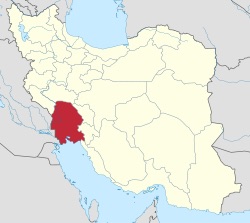
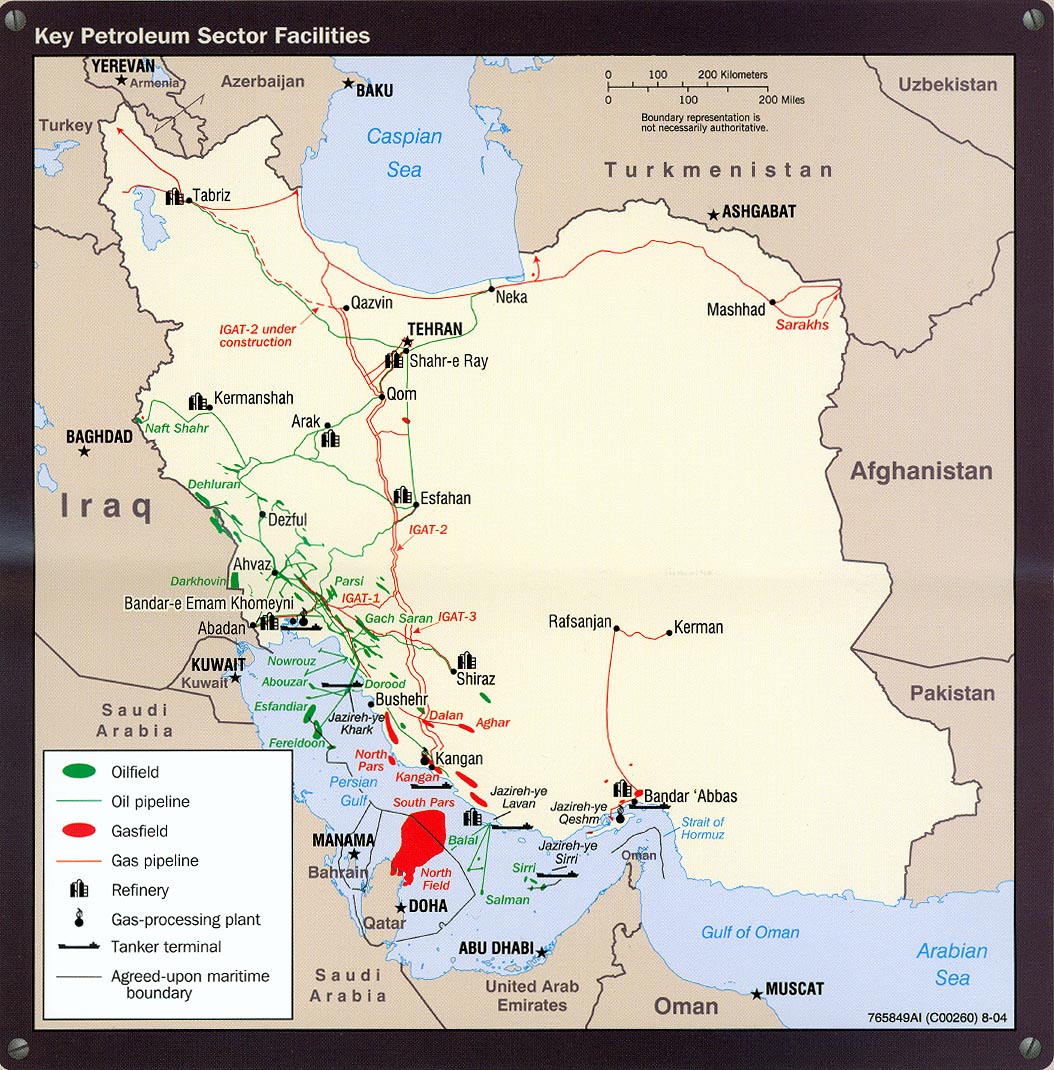
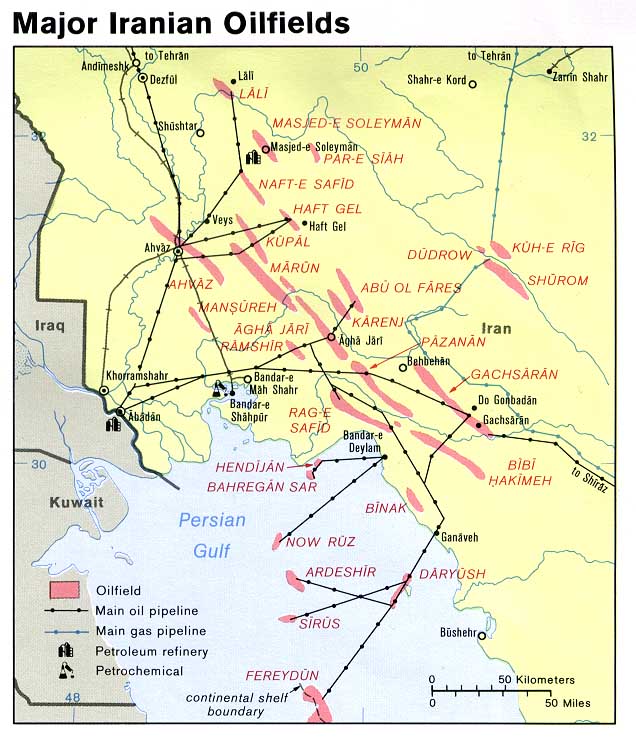
Most of Iran's oil is in Khuzestan, a largely Arab area in western Iran, at the northern tip of the Persian Gulf, bordering southern Iraq.
Many US citizens falsely assume that Iran is an Arab country, but Arabs are a minority, with the primary exception of Khuzestan.
Iran's official language is Persian / Farsi, not Arabic. Farsi and Arabic use different alphabets, but both look like incomprehensible squiggles to most English speakers.
During the Iran-Iraq war, a major focus of Iraq's Saddam Hussein was capturing the oil of Khuzestan.
The "new Middle East map" floated by prominent warmonger Ralph Peters in Armed Forces Journal in June 2006 would separate the coastal, oil rich provinces of Iran from the rest of that country, including the province of Khuzestan.
In 2007, then Senator Joe Biden was the leading promoter in Congress for breaking up Iraq, next door to Iran, into three new countries based on ethnic and religious identities to better control the oil.
www.eia.gov/beta/international/analysis_includes/countries_long/Iran/background.htm [US Energy Information Agency]
BACKGROUND REFERENCE: IRAN
Last Updated: January 7, 2019
Most Iranian reserves are located onshore (about 71%), with the Khuzestan Basin containing roughly 80% of total onshore reserves.
http://lobelog.com/the-khuzestan-factor-in-saudi-iran-relations/
The Khuzestan Factor In Saudi-Iran Relations
NOVEMBER 20, 2017 GIORGIO CAFIERO
Iran's Khuzestan and Saudi Arabia's Eastern Province (EP) mirror each other in the sense that both oil-rich provinces are home to marginalized ethnic/religious minorities who complain of state-sponsored oppression and discrimination. The Arabs in Khuzestan and the Shi'ites in the kingdom's EP both live on top of the majority of their respective countries' oil reserves yet have not reaped the rewards of such petro-wealth.
This map is taken from the BBC's website at
http://news.bbc.co.uk/2/shared/spl/hi/middle_east/06/iran_maps/html/default.stm
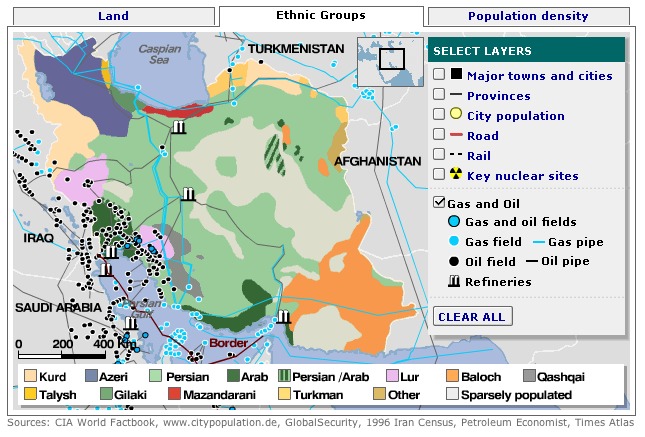
map is public domain, prepared by the CIA for public use
archived at www.lib.utexas.edu/maps/iran.html
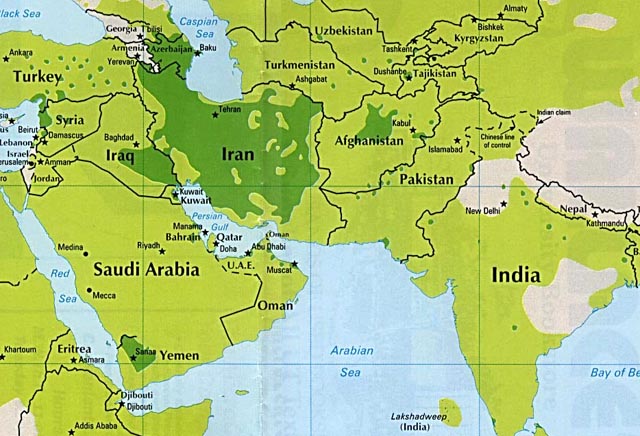
Shia communities in dark green, Sunni in light green
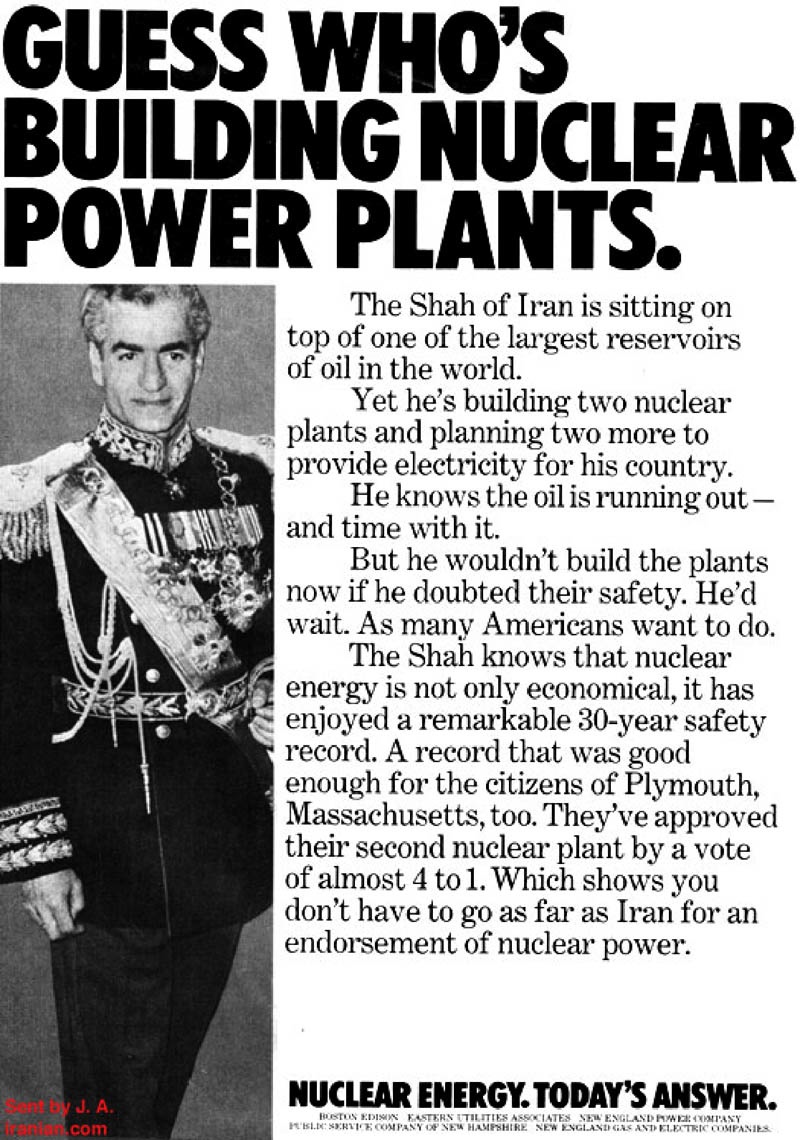 Iran has had a nuclear power and weapons program since the Shah. The power program was public, but the Shah's government was also developing atomic weapons. The Iranians who took over the US embassy released documents - some shredded documents pieced back together - that documented the covert weapons program.
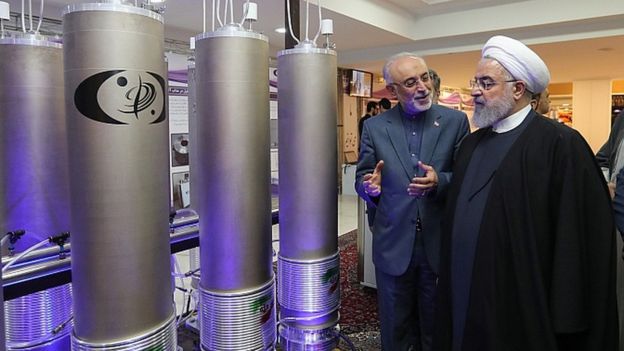
The Islamic Republic of Iran nuclear program is far further developed than the Shah's. The country's first nuclear power reactor is now operational. Iran built an entire fuel cycle to process uranium, including enrichment factories. They may have been the first to build enrichment factories underground, hidden from photoreconnaissance satellites and partially protected from aerial attack by war planes, drones or missiles.
Pakistani nuclear proliferator A. Q. Khan provided Iran with the technology of uranium enrichment centrifuges. Khan's network also provided help to North Korea and Libya. North Korea subsequently acquired The Bomb. Libya, under Gaddafi, bought centrifuges from Khan but the shipment was intercepted by the US Navy. Iran claims their enrichment program is purely for civilian electricity, but that would make them unique among Khan's customers.
Iran is able to enrich uranium to the couple percent required for the Bushehr reactor. Once centrifuges are able to enrich "natural" uranium from 0.7% U-235 to 3% U-235 for a nuclear power reactor, an operator only needs to keep running centrifuges to bring the U-235 up to 90%, weapons grade fissile material that is easily turned into a nuclear weapon. A government - or corporation - that can turn natural uranium into reactor grade has the capability to make weapons grade if they want. It is a choice, not a technological obstacle. Centrifuges are also cheaper than the original gaseous diffusion facilities from the earliest days of the atomic era. Even the US nuclear power program, which used three large diffusion facilities for decades, has shifted over to centrifuges.
The Bush Cheney administration and Israeli Prime Minster Netanyahu crowed about the alleged need to attack Iran before the Islamic Republic went nuclear. It was the height of hypocrisy for nuclear armed America and Israel to threaten war over nuclear proliferation.
Parts of the American and Israeli military establishments were opposed to war on tactical grounds, not morality. They realized that Iran's military could disrupt oil flows, with devastating consequences to the global economy. In some ways, this is a more powerful deterrent than nuclear bombs.
In 2007, the US intelligence community published an estimate contradicting Cheney's statements about Iran's nuclear efforts, stating that Iran stopped its development of weapons in 2003. This helped prevent the attack and ultimately paved the way for the Iranian nuclear deal. It is possible the reason Iran stopped work on weapons is they had finished the research phase. Shifting from experiments to production of nuclear weapons would be easy for this technologically sophisticated country running one of the world's largest oil and gas operations. In case of a major dispute - say, with the Trump administration - converting their stockpile of 3% enriched uranium to weapons grade would not take long.
There have been rumors, impossible to prove, about Iran seeking "loose" nukes from the breakup of the Soviet Union. It is reasonable to assume that a major oil exporting country flush with cash, pressured on all sides by military foes, including several with nuclear weapons, would seek its own arsenal as a deterrent. President George W. Bush denounced Iran along with Iraq and North Korea as an alleged "Axis of Evil." (The fact that Iran and Iraq were then bitter rivals, and North Korea had low to minimal alliance with either, was conveniently ignored by this marketing campaign for more wars.) The Iranians, like the rest of the world, saw that Saddam Hussein's Iraqi nuclear deterrent never went beyond initial research and his country got invaded. North Korea built The Bomb and they have not been invaded.
https://www.bbc.com/news/world-middle-east-51001167
Iran rolls back nuclear deal commitments
January 5, 2020
A statement broadcast on state TV said the country would no longer respect any limits laid down in the 2015 deal.
"Iran will continue its nuclear enrichment with no limitations and based on its technical needs," the statement said.
It did not, however, say that Iran was withdrawing from the agreement and it added that Iran would continue to co-operate with the UN's nuclear watchdog, the IAEA.
The statement added that Iran was ready to return to its commitments once it enjoyed the benefits of the agreement.
Correspondents say this is a reference to its inability to sell oil and have access to its income under US sanctions.
Iran has always insisted that its nuclear programme is entirely peaceful.
Urban Survival website
Tuesday August 24, 2004
We find great irony in the name of the city where the Iranian nuke plant is located: "Bushehr" - pronounced "Bush HERE". Ah, the Universe has its wry sense of humor, does it not?
Abizaid: World Could Abide Nuclear Iran
By Robert Burns
The Associated Press
Monday 17 September 2007
Every effort should be made to stop Iran from obtaining nuclear weapons, but failing that, the world could live with a nuclear-armed regime in Tehran, a recently retired commander of U.S. forces in the Middle East said Monday.
John Abizaid, the retired Army general who headed Central Command for nearly four years, said he was confident that if Iran gained nuclear arms, the United States could deter it from using them.
"Iran is not a suicide nation," he said. "I mean, they may have some people in charge that don't appear to be rational, but I doubt that the Iranians intend to attack us with a nuclear weapon."
www.historycommons.org/context.jsp?item=a76dickrummyiran#a76dickrummyiran
1976: Cheney, Rumsfeld Lobby for Nuclear Power Plant in Iran
Defense Secretary Donald Rumsfeld and White House Chief of Staff Dick Cheney unsuccessfully lobby for the construction of a nuclear reprocessing plant in Iran. The two men devised the scheme because, they say, Iran needs a nuclear power program to meet its future energy needs. This is despite the fact that Iran has considerable oil and gas reserves. The deal would be lucrative for US corporations like Westinghouse and General Electric, which would make $6.4 billion from the project.
During negotiations over Pakistan’s nuclear weapons program, Secretary of State Henry Kissinger offers Pakistan access to this facility for reprocessing of its nuclear fuel. In return, Pakistan would not build its own reprocessing plant, which the US suspects will be used for a nuclear weapons program. However, Pakistani Prime Minister Zulfikar Ali Bhutto rejects the deal, and the plant is not built in Iran anyway. [LEVY AND SCOTT-CLARK, 2007, PP. 46]
from Adrian Levy and Catherine Scott-Clark, "Deception: Pakistan, the United States, and the Secret Trade in Nuclear Weapons."
http://counterpunch.org/fiyouzat09292007.html
September 29 / 30, 2007
An Anti-Imperialist Case Against a Nuclear Iran
Iran's Nuclear Program
By REZA FIYOUZAT
... an attack by the U.S. on Iranian military forces, without sending in any troops (the way Cambodia was destroyed mostly), is a likely scenario. This will naturally lead to increased intensification of the ongoing horrid nightmare not only for the Iranian people but the inhabitants of the whole region, for decades to come. The only winners will be the imperialists and their corporations, whichever local bullies survive this hell, and whatever local lackeys imperialists deem valuable as they do their business.
If, after a disastrous invasion of Iraq and Afghanistan, the ruling elites in the western countries are still talking openly about further military aggressions, this time against Iran, the western leftists have clearly had less than zero effect on the debates that matter most. ....
The Left currently has little impact on the actually existing political reality, so the only things we can bring to the political table are ideas: questions, critiques, persuasive explanations, occasional inspirations, maybe some good suggestions, and if we are spirited enough, some fun and delight; and in all these, we most definitely must stick to our principles. ....
Iran has access to a vast and endless alternative source of power: solar energy. The right engineers can do the rightful calculations, but I am sure cultivating solar panel farms can easily match (if not surpass) the energy needs that a horribly wasteful and waste-producing nuclear industry can never match. ....
A nuclear-free Iran not only removes a clear excuse for the imperialist posturing against Iran, in the long run it guarantees a life there free from toxic threats to the livelihoods of millions of people inhabiting the area in the vicinity of Bushehr's larger region, which includes not only Iranians, but people in all the Arab countries on the southern coast of the Gulf, plus its entire ecosystem; a life free from the potentiality of millions of cases of cancer, birth deformities, and the complete destruction of entire ways of life among the local peoples inhabiting the shores of the Persian-Arabian Gulf and the adjacent regions, and all points downstream.
related pages
the new Middle East map: ethnic and religious conflict to redraw borders to control the oil
the 1980 October Surprise
George H. W. Bush made a deal with Iran to delay the release of US hostages to thwart Carter's
re-election, the hostages were freed immediately after Reagan was inaugurated
Iran-Contra conspiracy began in 1980 with the Bush campaign's October Surprise, not 1985
Petro-Euros vs. Petro-Dollars
Iran wants Euros, not Dollars, for its oil and gas