


Popes
time for Jesus to kick the moneychangers out of the temple
- Cardinal Jorge Bergoglio: Pope Francis I - "Father, what did you do during the 'Dirty War?'" - Church collusion with the military dictatorship in Argentina
- "God's Rottweiler" - the installation of Cardinal Ratzinger (Benedict XVI), a business partner of Neil Bush
- Pope John Paul II vs. George W. Bush
- the poisoning of Pope John Paul the First
- Jorge Bergoglio: Pope Francis I
- God's Rottweiler: Cardinal Ratzinger, Benedict XVI, a Bush business partner
- Peak Oil Pope
- Pope John Paul II vs. George W. Bush
- John Paul I was poisoned in 1978
Andy Borowitz - Vatican Calls White Smoke False Alarm: 'We Were Just Burning Documents'
"I agree with Dante, that the hottest places in hell are reserved for those who, in a period of moral crisis, maintain their neutrality."
-- Martin Luther King
"When I give food to the poor, they call me a saint. When I ask why they are poor, they call me a communist."
-- Hélder Câmara, Roman Catholic Archbishop of Olinda and Recife (Brasil)
www.youtube.com/watch?v=-P9m-3mrflo#!
Sting with Peter Gabriel - "They Dance Alone" - Argentina, 1988
with the mothers of the disappeared - Madres de Plaza de Mayo
consortiumnews.com/2013/03/13/dirty-war-questions-for-pope-francis/
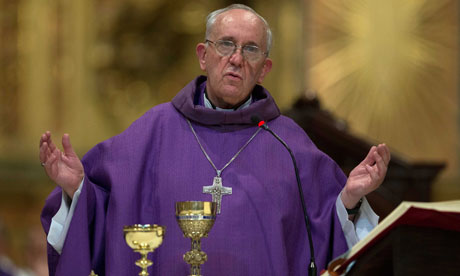 'Dirty War' Questions for Pope Francis
March 13, 2013
Exclusive: The U.S. "news" networks bubbled with excitement over the selection of Argentine Cardinal Jorge Bergoglio to be Pope Francis I. But there was silence on the obvious question that should be asked about any senior cleric from Argentina: What was Bergoglio doing during the "dirty war," writes Robert Parry.
By Robert Parry
If one wonders if the U.S. press corps has learned anything in the decade since the Iraq War – i.e. the need to ask tough question and show honest skepticism – it would appear from the early coverage of the election of Pope Francis I that U.S. journalists haven't changed at all, even at "liberal" outlets like MSNBC.
The first question that a real reporter should ask about an Argentine cleric who lived through the years of grotesque repression, known as the "dirty war," is what did this person do, did he stand up to the murderers and torturers or did he go with the flow. If the likes of Chris Matthews and other commentators on MSNBC had done a simple Google search, they would have found out enough about Cardinal Jorge Bergoglio to slow their bubbling enthusiasm.
Bergoglio, now the new Pope Francis I, has been identified publicly as an ally of Argentine's repressive leaders during the "dirty war" when some 30,000 people were "disappeared" or killed, many stripped naked, chained together, flown out over the River Plate or the Atlantic Ocean and pushed sausage-like out of planes to drown.
The "disappeared" included women who were pregnant at the time of their arrest. In some bizarre nod to Catholic theology, they were kept alive only long enough to give birth before they were murdered and their babies were farmed out to military families, including to people directly involved in the murder of the babies' mothers.
Instead of happy talk about how Bergoglio seems so humble and how he seems so sympathetic to the poor, there might have been a question or two about what he did to stop the brutal repression of poor people and activists who represented the interests of the poor, including "liberation theology" priests and nuns, during the "dirty war."
Here, for instance, is an easily retrievable story from Guardian columnist Hugh O'Shauhnessy from 2011, which states:
"To the judicious and fair-minded outsider it has been clear for years that the upper reaches of the Argentine church contained many 'lost sheep in the wilderness', men who had communed and supported the unspeakably brutal Western-supported military dictatorship which seized power in that country in 1976 and battened on it for years.
"Not only did the generals slaughter thousands unjustly, often dropping them out of aeroplanes over the River Plate and selling off their orphan children to the highest bidder, they also murdered at least two bishops and many priests. Yet even the execution of other men of the cloth did nothing to shake the support of senior clerics, including representatives of the Holy See, for the criminality of their leader General Jorge Rafael Videla and his minions.
"As it happens, in the week before Christmas [2010] in the city of Córdoba Videla and some of his military and police cohorts were convicted by their country's courts of the murder of 31 people between April and October 1976, a small fraction of the killings they were responsible for. The convictions brought life sentences for some of the military.
"These were not to be served, as has often been the case in Argentina and neighbouring Chile, in comfy armed forces retirement homes but in common prisons. Unsurprisingly there was dancing in the city's streets when the judge announced the sentences.
"What one did not hear from any senior member of the Argentine hierarchy was any expression of regret for the church's collaboration and in these crimes. The extent of the church's complicity in the dark deeds was excellently set out by Horacio Verbitsky, one of Argentina's most notable journalists, in his book El Silencio (Silence).
"He recounts how the Argentine navy with the connivance of Cardinal Jorge Bergoglio, now the Jesuit archbishop of Buenos Aires, hid from a visiting delegation of the Inter-American Human Rights Commission the dictatorship's political prisoners. Bergoglio was hiding them in nothing less than his holiday home in an island called El Silencio in the River Plate.
"The most shaming thing for the church is that in such circumstances Bergoglio's name was allowed to go forward in the ballot to chose the successor of John Paul II. What scandal would not have ensued if the first pope ever to be elected from the continent of America had been revealed as an accessory to murder and false imprisonment.
"One would have thought that the Argentine bishops would have seized the opportunity to call for pardon for themselves and put on sackcloth and ashes as the sentences were announced in Córdoba but that has not so far happened.
"But happily Their Eminences have just been given another chance to express contrition. Next month the convicted murderer Videla will be arraigned for his part in the killing of Enrique Angelelli, bishop of the Andean diocese of La Rioja and a supporter of the cause of poorer Argentines. He was run off the highway by a hit squad of the Videla régime and killed on 4th August 1976 shortly after Videla's putsch. …
"Cardinal Bergoglio has plenty of time to be measured for a suit of sackcloth – perhaps tailored in a suitable clerical grey – to be worn when the church authorities are called into the witness box by the investigating judge in the Angelelli case. Ashes will be readily available if the records of the Argentine bishops' many disingenuous and outrightly mendacious statements about Videla and Angelelli are burned."
Now, instead of just putting forward Bergoglio's name as a candidate for Pope, the College of Cardinals has actually elected him. Perhaps the happy-talking correspondents from the U.S. news media will see no choice but to join in the cover-up of what Pope Francis did during the "dirty war." Otherwise, they might offend some people in power and put their careers in jeopardy.
[For a limited time, you can purchase Robert Parry's trilogy on the Bush family for only $34. For details, click here.]
Investigative reporter Robert Parry broke many of the Iran-Contra stories for The Associated Press and Newsweek in the 1980s. You can buy his new book, America's Stolen Narrative, either in print here or as an e-book (from Amazon and barnesandnoble.com).
www.guardian.co.uk/commentisfree/belief/2011/jan/04/argenitina-videla-bergoglio-repentance
The sins of the Argentinian church
The Catholic church was complicit in dreadful crimes in Argentina.
Now it has a chance to repent
Hugh O'Shaughnessy
guardian.co.uk, Tuesday 4 January 2011
Cardinal Jorge Bergoglio, the archbishop of Buenos Aires.
Benedict XVI gave us words of great comfort and encouragement in the message he delivered on Christmas Eve.
"God anticipates us again and again in unexpected ways," the pope said. "He does not cease to search for us, to raise us up as often as we might need. He does not abandon the lost sheep in the wilderness into which it had strayed. God does not allow himself to be confounded by our sin. Again and again he begins afresh with us".
If these words comforted and encouraged me they will surely have done the same for leaders of the church in Argentina, among many others. To the judicious and fair-minded outsider it has been clear for years that the upper reaches of the Argentinian church contained many "lost sheep in the wilderness", men who had communed and supported the unspeakably brutal western-supported military dictatorship that seized power in that country in 1976 and battened on it for years. Not only did the generals slaughter thousands unjustly, often dropping them out of aeroplanes over the River Plate and selling off their orphan children to the highest bidder, they also murdered at least two bishops and many priests. Yet even the execution of other men of the cloth did nothing to shake the support of senior clerics, including representatives of the Holy See, for the criminality of their leader General Jorge Rafael Videla and his minions.
As it happens, in the week before Christmas in the city of Córdoba Videla and some of his military and police cohorts were convicted by their country's courts of the murder of 31 people between April and October 1976, a small fraction of the killings they were responsible for. The convictions brought life sentences for some of the military. These were not to be served, as has often been the case in Argentina and neighbouring Chile, in comfy armed forces retirement homes but in common prisons. Unsurprisingly there was dancing in the city's streets when the judge announced the sentences.
What one did not hear from any senior member of the Argentinian hierarchy was any expression of regret for the church's collaboration and in these crimes. The extent of the church's complicity in the dark deeds was excellently set out by Horacio Verbitsky, one of Argentina's most notable journalists, in his book El Silencio (Silence). He recounts how the Argentinian navy with the connivance of Cardinal Jorge Bergoglio, now the Jesuit archbishop of Buenos Aires, hid from a visiting delegation of the Inter-American Human Rights Commission the dictatorship's political prisoners. Bergoglio was hiding them in nothing less than his holiday home in an island called El Silencio in the River Plate. The most shaming thing for the church is that in such circumstances Bergoglio's name was allowed to go forward in the ballot to chose the successor of John Paul II. What scandal would not have ensued if the first pope ever to be elected from the continent of America had been revealed as an accessory to murder and false imprisonment
One would have thought that the Argentinian bishops would have seized the opportunity to call for pardon for themselves and put on sackcloth and ashes as the sentences were announced in Córdoba but that has not so far happened.
But happily Their Eminences have just been given another chance to express contrition. Next month the convicted murderer Videla will be arraigned for his part in the killing of Enrique Angelelli, bishop of the Andean diocese of La Rioja and a supporter of the cause of poorer Argentinians. He was run off the highway by a hit squad of the Videla régime and killed on 4th August 1976 shortly after Videla's putsch.
Cardinal Bergoglio has plenty of time to be measured for a suit of sackcloth – perhaps tailored in a suitable clerical grey – to be worn when the church authorities are called into the witness box by the investigating judge in the Angelelli case. Ashes will be readily available if the records of the Argentinian bishops' many disingenuous and outrightly mendacious statements about Videla and Angelelli are burned.
note: this article was "amended" immediately after the new Pope assumed office, here is a new disclaimer from The Guardian:
This article was amended on 14 March 2013. The original article, published in 2011, wrongly suggested that Argentinian journalist Horacio Verbitsky claimed that Cardinal Jorge Bergoglio connived with the Argentinian navy to hide political prisoners on an island called El Silencio during an inspection by human rights monitors. Although Verbitsky makes other allegations about Bergoglio's complicity in human rights abuses, he does not make this claim. The original article also wrongly described El Silencio as Bergoglio's "holiday home". This has been corrected.
www.bbc.co.uk/news/world-europe-21802684
15 March 2013 Last updated at 11:01 ET
Vatican denies Dirty War allegations against Pope
Vatican Press Secretary, Fr Tom Rosica, said the accusations must be "firmly and clearly denied" (Photo shows Pope supporters in St Peter's Square)
The Vatican has denied that Pope Francis failed to speak out against human rights abuses during military rule in his native Argentina.
"There has never been a credible, concrete accusation against him," said Vatican spokesman Federico Lombardi, adding he had never been charged.
The spokesman blamed the accusations on "anti-clerical left-wing elements that are used to attack the Church".
Jorge Bergoglio, now Pope Francis, led Argentina's Jesuits under the junta.
Correspondents say that like other Latin American churchmen of the time, he had to contend, on the one hand, with a repressive right-wing regime and, on the other, a wing of his Church leaning towards political activism on the left.
One allegation concerns the abduction in 1976 of two Jesuits by Argentina's military government, suspicious of their work among slum-dwellers.
As the priests' provincial superior at the time, Jorge Bergoglio was accused by some of having failed to shield them from arrest - a charge his office flatly denied.
Judges investigating the arrest and torture of the two men - who were freed after five months - questioned Cardinal Bergoglio as a witness in 2010.
The new Pope's official biographer, Sergio Rubin, argues that the Jesuit leader "took extraordinary, behind-the-scenes action to save them".
Another accusation levelled against him from the Dirty War era is that he failed to follow up a request to help find the baby of a woman kidnapped when five months' pregnant and killed in 1977. It is believed the baby was illegally adopted.
The cardinal testified in 2010 that he had not known about baby thefts until well after the junta fell - a claim relatives dispute.
Turned in?
In his book The Silence, Argentine investigative journalist Horacio Verbitsky says the Jesuit leader withdrew his order's protection from Francisco Jalics and Orlando Yorio after the two priests refused to stop visiting slums.
The journalist is close to Argentine President Cristina Fernandez de Kirchner, who often clashed with Cardinal Bergoglio on social policy.
"He turned priests in during the dictatorship," Verbitsky was quoted as saying by Reuters news agency.
"I warned them to be very careful. They were too exposed to the paranoia of the witch hunt"
Jorge Bergoglio (now Pope Francis)
Interviewed by his biographer
The man who is now Pope once talked about the two priests to his biographer.
"I warned them to be very careful," he told Rubin. "They were too exposed to the paranoia of the witch hunt. Because they stayed in the barrio, Yorio and Jalics were kidnapped.''
Both priests were held inside the feared Navy Mechanics School prison. Finally, drugged and blindfolded, they were left in a field by a helicopter.
Orlando Yorio, who reportedly accused Fr Bergoglio of effectively delivering them to the death squads by declining to publicly endorse their work, is now dead.
AP news agency quoted Francisco Jalics as saying on Friday: "It was only years later that we had the opportunity to talk with Fr Bergoglio... to discuss the events.
"Following that, we celebrated Mass publicly together and hugged solemnly. I am reconciled to the events and consider the matter to be closed."
Adolfo Perez Esquivel, who won the Nobel Peace Prize for defending human rights during the dictatorship, believes Fr Bergoglio "tried to... help where he could" under the junta.
"It's true that he didn't do what very few bishops did in terms of defending the human rights cause, but it's not right to accuse him of being an accomplice," he told Reuters.
"Bergoglio never turned anyone in, neither was he an accomplice of the dictatorship," Mr Esquivel said.
[in other words, he chose neutrality when confronted with evil]
Analysis
Michael Hirst
BBC News, Rome
The fact that the Vatican has come out with such a firm denial shows it understands the damage this story could do to the new Pope's image.
The former head of the Jesuits in Argentina stands accused of failing to confront the country's 1976-1983 military junta as it kidnapped and killed thousands in its "Dirty War" against leftist opponents.
One of two priests kidnapped in 1976 - who has since died - later accused Bergoglio of effectively delivering the men to the death squads by failing to publicly endorse their work.
But some say that in working to remove them from their posts he was trying to save their lives. The surviving kidnap victim, now in his eighties and living in a monastery in Germany, says he became reconciled with the current Pope over the issue more than a decade ago - and now considers it closed.
The Vatican, too, would like to put a lid on the issue. And Friday's denial showed an interesting development in papal communications. This was the Catholic Church trying to get ahead of the story, and thereby nip its potentially harmful impact in the bud. That in itself is new.
Democracy Now
www.democracynow.org/2013/3/14/pope_francis_junta_past_argentine_journalist
Thursday, March 14, 2013
Pope Francis' Junta Past: Argentine Journalist on New Pontiff's Ties to Abduction of Jesuit Priests
While praised for his work with the poor, Cardinal Jorge Mario Bergoglio — now Pope Francis — has long been dogged by accusations of his role during Argentina's military dictatorship. We speak to Horacio Verbitsky, a leading Argentine journalist who exposed Francis' connection to the abduction of two Jesuit priests. Verbitsky is an investigative journalist for the newspaper Página/12, or Page/12, and head of the Center for Legal and Social Studies, an Argentine human rights organization.
Transcript
This is a rush transcript. Copy may not be in its final form.
JUAN GONZÁLEZ: For more on the new pope, we turn now to one of Argentina's leading investigative journalists, Horacio Verbitsky, who has written extensively about the career of Cardinal Bergoglio and his actions during the military dictatorship that ruled Argentina from 1976 to 1983. During that time, up to 30,000 people were kidnapped and killed. A 2005 lawsuit accused Jorge Bergoglio of being connected to the 1976 kidnappings of two Jesuit priests, Orlando Yorio and Francisco Jalics. The lawsuit was filed after the publication of Verbitsky's book, The Silence: From Paul VI to Bergoglio: The Secret Relations Between the Church and the ESMA. ESMA refers to the former navy school that was turned into a detention center where people were tortured by the military dictatorship. The new pope has denied the charges. He twice invoked his right under Argentine law to refuse to appear in open court to testify about the allegations. When he eventually did testify in 2010, human rights activists characterized his answers as evasive.
AMY GOODMAN: Horacio Verbitsky joins us on the phone now from his home in Buenos Aires, an investigative journalist for the newspaper Página/12; Page/12, it's called in English. He is also head of the Center for Legal and Social Studies, an Argentine human rights organization.
We welcome you to Democracy Now! I wanted to just begin by you laying out for us what you believe is important to understand about the new pope, Pope Francis.
HORACIO VERBITSKY: The main thing to understand about Francis I is that he's a conservative populist, in the same style that John Paul II was. He's a man of strong conservative positions in doctrine questions, but with a touch for popular taste. He preaches in rail stations, in the streets. He goes to the quarters, the poor quarters of the city to pray. He doesn't wait the people going into the church; he goes for them. But his message is absolutely conservative. He was opposed to abortion, to the egalitarian matrimony law. He launched a crusade against the evil when Congress was passing this law, and in the very same style that John Paul II. This is what I consider the main feature on the new pope.
JUAN GONZÁLEZ: Well, now, Horacio Verbitsky, that would be true of many of the cardinals elevated during the period of John Paul and now also of Benedict XVI, this basic conservatism. But in the case of Bergoglio, there's also the issue, as you have documented and many—and several other journalists in Argentina, of his particular role or accusations about his involvement in the dirty wars in Argentina. Could you talk about that and some of the things that—because you've been a leading investigative reporter uncovering the relations between the church and the government in terms of the dirty wars?
HORACIO VERBITSKY: Of course. He was accused by two Jesuit priests of having surrendered them to the military. They were a group of Jesuits that were under Bergoglio's direction. He was the provincial superior of the order in Argentina, being very, very young. He was the younger provincial Jesuit in history; at 36 years, he was provincial. During a period of great political activity in the Jesuits' company, he stimulated the social work of the Jesuits. But when the military coup overthrow the Isabel Perón government, he was in touch with the military that ousted this government and asked the Jesuits to stop their social work. And when they refused to do it, he stopped protecting them, and he let the military know that they were not more inside the protection of the Jesuits' company, and they were kidnapped. And they accuse him for this deed. He denies this. He said to me that he tried to get them free, that he talked with the former dictator, Videla, and with former dictator Massera to have them freed.
And during a long period, I heard two versions: the version of the two kidnapped priests that were released after six months of torture and captivity, and the version of Bergoglio. This was an issue divisive in the human rights movement to which I belong, because the president founding of CELS, Center for Legal and Social Studies, Emilio Mignone, said that Bergoglio was a accomplice of the military, and a lawyer of the CELS, Alicia Oliveira, that was a friend of Bergoglio, tell the other part of the story, that Bergoglio helped them. This was the two—the two versions.
But during the research for one of my books, I found documents in the archive of the foreign relations minister in Argentina, which, from my understanding, gave an end to the debate and show the double standard that Bergoglio used. The first document is a note in which Bergoglio asked the ministry to—the renewal of the passport of one of these two Jesuits that, after his releasing, was living in Germany, asking that the passport was renewed without necessity of this priest coming back to Argentina. The second document is a note from the officer that received the petition recommending to his superior, the minister, the refusal of the renewal of the passport. And the third document is a note from the same officer telling that these priests have links with subversion—that was the name that the military gave to all the people involved in opposition to the government, political or armed opposition to the military—and that he was jailed in the mechanics school of the navy, and saying that this information was provided to the officer by Father Jorge Mario Bergoglio, provincial superior of the Jesuit company. This means, to my understanding, a double standard. He asked the passport given to the priest in a formal note with his signature, but under the table he said the opposite and repeated the accusations that produced the kidnapping of these priests.
AMY GOODMAN: And these priests—can you explain, Horacio, what happened to these two priests, Orlando Yorio and Francisco Jalics?
HORACIO VERBITSKY: Yes. Orlando, after his releasing, went to Rome.
AMY GOODMAN: How were they found?
HORACIO VERBITSKY: Sorry?
AMY GOODMAN: How were they found? In what condition were they? What had happened to them?
HORACIO VERBITSKY: Well, he was released—both of them were released, drugged, confused, transported by helicopter to—in the outskirts of Buenos Aires, were abandoned, asleep by drugs, in very bad condition. They were tortured. They were interrogated. One of the interrogators had externally knowings about theological questions, that induced one of them, Orlando Yorio, to think that their own provincial, Bergoglio, had been involved in this interrogatory.
AMY GOODMAN: He said that—he said that Bergoglio himself had been part of the—his own interrogation, this Jesuit priest?
HORACIO VERBITSKY: He told me that he had the impression their own provincial, Bergoglio, was present during the interrogatory, which one of the interrogators had externally knowledge of theological questions. And when released, he went to Rome. He lived seven years in Rome, then come back to Argentina. And when coming back to Argentina, he was incardinated in the Quilmes diocesis in Great Buenos Aires, where the bishop was one of the leaders of the progressive branch of the Argentine church opposite to that of Bergoglio. And Orlando Yorio denounced Bergoglio. I received his testimony when Bergoglio was elected to the archbishop of Buenos Aires. And Bergoglio—I interviewed Bergoglio also, and he denied the charges, and he told me that he had defended them.
And Orlando Yorio got me in touch with Francisco Jalics, that was living in Germany. I talked with him, and he confirmed the story, but he didn't want to be mentioned in my piece, because he told me that he preferred to not remember this sad part of his life and to pardon. And he was for oblivion and pardon. That he was, during a lot of years, very resented against Bergoglio, but that he had decided to forgot and forget. And when I released the book with the story, one Argentine journalist working for a national agency, [inaudible], who has been a disciple of Jalics, talked with him and asked him for the story. And Jalics told him that he would not affirm, not deny the story.
JUAN GONZÁLEZ: Horacio—Horacio Verbitsky, I'd like to ask you about another priest who was involved in the dirty wars, Christian von Wernich, who was a former chaplain of the police department in Argentina and also later was convicted of being involved—
HORACIO VERBITSKY: He was convicted—he was convicted, and he's in jail, in a common jail, but the Argentine church, during the tenure of Bergoglio, hasn't punished him, in canonical terms. He was convicted by the human justice, but by the church standards, he's always a priest. And this tells something about Bergoglio and the Argentine church also.
JUAN GONZÁLEZ: And von Wernich was involved in murders, tortures and kidnappings. Could you detail some of the crimes that he was convicted of committing?
HORACIO VERBITSKY: Bergoglio involved in the crimes of von Wernich?
JUAN GONZÁLEZ: No, no, von Wernich. Von Wernich, I said.
HORACIO VERBITSKY: Oh, von Wernich was part—was active part in torture and killings, and he was convicted not as an accomplice, but as a participant in the crimes. He was present during the torture sessions, von Wernich. And there is not the just one chaplain; there are some others that are under trial in this moment. Chaplain Regueiro is under house arrest because he's an older man. A Chaplain Zitelli in Santa Fe province, for being present during torture sessions. So, there are a lot of them that were part of the dirty war.
AMY GOODMAN: I wanted to read, Horacio, a part of a State Department cable released by WikiLeaks that references, well, the Roman Catholic priest Christian von Wernich, who you were just talking about, convicted in 2007 of being an accomplice in several cases of murder, torture and illegal imprisonment in Argentina during the military dictatorship. It notes the conviction came, quote, "at a time when some observers consider Roman Catholic primate Cardinal Bergoglio to be a leader of the opposition to the Kirchner administration because of his comments about social issues, the Von Wernich case could also have the effect, some believe, of undermining the Church's (and, by extension, Cardinal Bergoglio's) moral authority or capacity to comment on political, social or economic questions," unquote. That was a State Department cable that was released by WikiLeaks. Horacio, could you respond?
HORACIO VERBITSKY: We can go attack this paper by parts. First of all, the State Department considered that Bergoglio was the chief of the position to the Kirchner government. And I agree with this statement. The State Department tells also that the conviction of Father von Wernich can be directed to undermine Bergoglio's position. This is not true, to my understanding. The conviction of Father von Wernich is a consequence of a trial that started much before the Kirchners arriving to power and has its own judicial logic and not a political timetable.
AMY GOODMAN: Horacio, are you still there?
HORACIO VERBITSKY: Sorry?
AMY GOODMAN: Ah, let me ask you a question. We thought we lost you for a minute. We're talking to Horacio Verbitsky, a leading Argentine investigative journalist, well known for his human rights investigations. I wanted to ask you about this issue of hiding political prisoners when a human rights delegation came to Argentina. Can you tell us when this was, what are the allegations, and what was the role, if any, of Bergoglio, now Pope Francis?
HORACIO VERBITSKY: No, in this episode, Bergoglio has no intervention. The intervention was from the cardinal that in that time was the chief of the church in Buenos Aires. That is the position that Bergoglio has in the present. But in that time, he was not archbishop of Buenos Aires. When the Inter-American Commission on Human Rights came into Argentina to investigate allegations of human rights violations, the navy took 60 prisoners out of ESMA and got them to a village that was used by the Cardinal Aramburu to his weekends. And in this weekend property were also the celebration each year of the new seminarians that ended their studies. In this villa in the outskirts of Buenos Aires were the prisoners during the visit of the Inter-American Commission on Human Rights. And when the commission visited ESMA, they did not find the prisoners that were supposed to be there, because they were—
AMY GOODMAN: ESMA being—ESMA being the naval barracks were so many thousands of Argentines were held. So where were they?
HORACIO VERBITSKY: Yes, but Bergoglio has no intervention in this—in this fact. Indeed, he helped me to investigate a case. He gave me the precise information about in which tribunal was the document demonstrating that this villa was owned by the church.
AMY GOODMAN: He said that they were hidden in a villa that was owned by the Catholic Church?
HORACIO VERBITSKY: Yes. And the prisoners were held in a weekend house that was the weekend house of the cardinal archbishop of Buenos Aires in that time. And Bergoglio gave me the precise information about the tribunal in which were the documents affirming this relationship between this property and the archbishop of Buenos Aires.
AMY GOODMAN: We have to break, and then we're going to come back to Horacio Verbitsky, as well as our guest in studio named Ernesto Semán, who is a historian at New York University, former reporter for the Argentine newspaper, both the same as Horacio's newspaper, Página/12, and Clarín, where he reported on politics and human rights, as well as, well, Father Bergoglio, now Pope Francis.
This is Democracy Now! We'll be back in a minute.
Thursday, March 14, 2013
A Social Conservative: Pope Francis Led Effort Against Liberation Theology and Same-Sex Marriage
During the military dictatorship in Argentina, the new pope openly criticized liberation theology's combination of religious teachings and calls for social justice. His social conservative streak continued when he was elevated to cardinal in Argentina. In 2010, he called the Argentine government's legalization of gay marriage "an attempt to destroy God's plan" and opposed adoption by gay couples. We discuss Pope Francis' social conservatism with Ernesto Semán, a historian at New York University and former reporter for two Argentine newspapers, and with Argentine journalist Horacio Verbitsky. [includes rush transcript]
Transcript
This is a rush transcript. Copy may not be in its final form.
AMY GOODMAN: Our guests are Horacio Verbitsky, an Argentine investigative journalist for the newspaper Página/12, or Page/12. He has reported extensively on the church's involvement in Argentina with the military junta that once ruled Argentina, specifically on the role of Father Bergoglio, who is now Father—who is now Pope Francis. Among his books, The Silence: From Paul VI to Bergoglio: The Secret Relations Between the Church and the ESMA. ESMA refers to the former Navy school that was turned into a detention center where people were tortured. Verbitsky also heads the Center for Legal and Social Studies, an Argentine human rights organization. You can also go to our website at democracynow.org, where we broadcast from Buenos Aires several years ago, talking about these issues, including the children who were taken from dissidents who were then killed and handed to military families to be raised, which we'll talk about.
Ernesto Semán is with us, as well. Semán, the historian at New York University, former reporter for the Argentine newspapers Página/12 and Clarín, where he reported on politics and human rights, as well as Father Bergoglio.
As we continue this conversation, Ernesto Semán, can you underscore what Horacio is saying, what you think we know at this point about Pope Francis, what we don't?
ERNESTO SEMÁN: Yeah, I think that what Horacio Verbitsky wrote during these several years is he's tried to uncover what is this kind of social conservatism, that you were trying to describe at the beginning of the program. It's not—in terms of the discourse, it's not the kind of Catholic conservatism that you're going to find in the United States, with this emphasis on the individual salvation, on government crushing individual liberty and economic activity, and because it's much more socially loaded. But the paradox—and I think that that's the most important point of Horacio Verbitsky's work—is how this same discourse, with a lot of emphasis on social justice and on equality, at the same time has worked to undermine the work who had tried to solve those same problems.
The case of this complicity of Bergoglio with human rights violations during the dictatorship is by far the most important episode. But during the last decade, he did, as the State Department implicitly suggests, the opposition to the government, in a decade in which Argentina lived the largest and fastest reduction of poverty and inequality, as in most of all Latin American countries. So that kind of paradox between the kind of social conservatism and an opposition to social agenda that has been pretty successful during the last years is very important.
JUAN GONZÁLEZ: I wanted to ask you about that, precisely, and the parallels, it seems to me, in terms of the cardinals selecting John Paul II, when he was elevated to pope, he coming out of Poland, where there was a Solidarity movement and in opposition to the previous government, that, in essence, his elevation helped to fortify that movement. I'm wondering whether there's some parallel now with the changes in Latin America now to the elevation of a very conservative cardinal from that region, might help to bolster forces that are opposed to continuing this enormous change that's occurring in Latin America.
ERNESTO SEMÁN: You might say so. The problem that you have there is to what extent that's going to make the gap between the church and the Catholic followers even deeper. In the case of Argentina and some of the social issues that happened over the last decade, you see that in a country that 75 percent of people consider themselves Catholic, has been a strong support to some of the social decisions made by the Kirchner administration that Bergoglio opposed. The last and most important one was the same marriage law—that is, matrimonio igualitario in Argentina, egalitarian marriage.
AMY GOODMAN: Yeah, and let's talk about this—
ERNESTO SEMÁN: Sure.
AMY GOODMAN: —because Bergoglio really took on the Argentine president in a major way. This was 2010. Then-Cardinal Jorge Bergoglio led the opposition against Argentina's law that gives same-sex couples the right to marry and adopt children. Before the law passed, Bergoglio wrote a letter, and addressed the monasteries in Argentina, in which he asked monks to pray fervently about a, quote, "situation whose outcome can seriously harm the family. ... At stake are the lives of many children who will be discriminated against in advance, and deprived of their human development given by a father and a mother and willed by God. At stake is the total rejection of God's law engraved in our hearts. ... Let us not be naive: this is not simply a political struggle, but it is an attempt to destroy God's plan," he said—
ERNESTO SEMÁN: Yeah, yeah. I think—yeah, I think [inaudible]—
AMY GOODMAN: —about what President Cristina Kirchner was pushing for, which was—
ERNESTO SEMÁN: Exactly.
AMY GOODMAN: —legalization of gay marriage.
ERNESTO SEMÁN: Cristina—Cristina Kirchner promoted this, but it was a movement by the LGTB movement that had been going on for many years. It's an extensive social movement that the government took and put into law. And after that, Bergoglio called to a holy war, una guerra de Dios, against this evil's move.
AMY GOODMAN: Is he saying that President—
ERNESTO SEMÁN: In the same level.
AMY GOODMAN: —Kirchner represented that evil?
ERNESTO SEMÁN: That the law was an evil's move. So, some degree of ambiguity. But it was clearly that kind of conservative message in relation to a law that, A, was passed overwhelmingly after two months of very open and public debate, and, B, that polls suggested that between 60 and 70 percent of people had no problem whatsoever with this kind of law. So that shows you—and he was personally involved and clearly involved in leading the opposition to this.
It was the last point of several other issues, including abortion and contraception, in which Bergoglio took the side of an opposition to the administration. The most important, one of the most—one of the most famous ones was when the military chaplain in 2005 said that the minister of health, because of the contraception policy, had to be thrown into the sea. And the government—
AMY GOODMAN: Bergoglio said the—
ERNESTO SEMÁN: No, no, no, no, the military chaplain—
AMY GOODMAN: Oh, the military chaplain.
ERNESTO SEMÁN: —said that the government immediately asked for his remotion, and Bergoglio refused to do so and has just waited until the priest had to retire because of his age. But this shows you the kind of—how this emphasis on social justice and equality goes along with the very, very conservative stance in cultural and social issues that makes the work of the church and the relation with the followers much more, much more difficult. And it's a challenge for them in Latin America.
JUAN GONZÁLEZ: Horacio Verbitsky, I'd like to ask you—you've interviewed the former Cardinal Bergoglio many times. You have a sense of him, not only his political role, but his personality. Do you have any expectations that, now that he's been elevated to pope, that he may have some change in his perspectives on some of these issues? Or do you expect him to maintain the same populist conservatism that you say have marked his rise through the church hierarchy?
HORACIO VERBITSKY: I do believe that he is a man—he is the man he is, and he will not change. His first days as a pope show perfectly this attitude of humility. He refused the limousine and took the bus. He asked the people to pray for him, instead of praying him for them. These kind of gestures would be common in his tenure as a pope. And it's possible that he would be revered by the masses because of this different attitude that seems more democratic and less monarchical than that of the former Benedicto XVI.
But in doctrinary questions, he would be tied to conservative, and this is the thing that I wait. And I believe that he can play, concerning Latin America and the populist governments of the region, the same role that Pope John Paul played against East Europe during the first years of his tenure.
AMY GOODMAN: Horacio Verbitsky, do you think that Cardinal Bergoglio would have become Pope Francis if he hadn't played the role he did during the dirty wars, if he had sided with these two Jesuit priests, who were speaking up for the poor at the time and who were great proponents of liberation theology?
HORACIO VERBITSKY: He was against liberation theology. He was a man, during his tenure in the Jesuit company—the publication of the Jesuit company are full of articles, of pieces, against liberation theology. Being among the poor doesn't mean to be for the poor. I remember a very funny thing that happened during the trial to the first military junta in 1985. The French government sent in 1979 an emissar to investigate the disappearance of French citizens in Argentina. This man, François Cherome, talked with Almirante Chamorro that was the chief of the main concentration camp of the navy, ESMA. And this Admiral Chamorro told François Cherome, who told the story to the justices in 1985, that also the church was infiltrated by communism. And as a demonstration, he cited that the new pope was Polish. Well, in the same meaning, Bergoglio is a Third World pope. He comes from the Third World, but he is not a partisan of the liberation theology, in the same sense in which John Paul came from Poland but wasn't communist.
AMY GOODMAN: We are going to have to leave it there. We want to thank Horacio Verbitsky for spending this hour with us, Argentine investigative journalist for Página/12, or Page/12, the newspaper in Argentina, has reported extensively on the church's complicity with the military junta during the dirty wars in Argentina. And Ernesto Semán, historian at New York University, former reporter for the Argentine newspaper Clarín, as well as Página/12, where he reported on politics, human rights, as well as Bergoglio.
The original content of this program is licensed under a Creative Commons Attribution-Noncommercial-No Derivative Works 3.0 United States License. Please attribute legal copies of this work to democracynow.org. Some of the work(s) that this program incorporates, however, may be separately licensed. For further information or additional permissions, contact us.
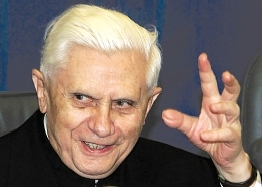
On the 10th anniversary of the Oklahoma City Bombing, the Roman Catholic Church has elected a member of the Hitler Youth and the German military during World War II to serve as Pope. Ladies and gentlemen, I think it's safe to assume that we have just lost cabin pressure.
http://rigorousintuition.blogspot.com/2005/04/white-smoke-dark-skies.html
Tuesday, April 19, 2005
White smoke, dark skies
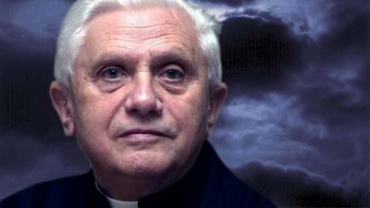
So Opus Dei has its Pope, and St Malachy of Armagh is either right again, or just lucky. Like I've said before about the curse of living in interesting times, at least they're interesting.
I wrote a little here about Opus Dei and why it deserves our distrust. If you don't yet, I suggest familiarizing yourself with the content of the Opus Dei Awareness Network. Opus Dei has been an organ of fascism (by the 1960s Franco's cabinet was stacked with Opusdeistas, and they rose again under the Aznar government), and has amassed for itself a Templar-worthy fortune, and an international network of influence that rivals, or perhaps complements, that of Freemasonry. ("Many of its 85,000 worldwide members work in legal, medical, financial and media professions," according to today's Los Angeles Times. In a post last week I considered the Masonic cultivation of similar segments of society.) Its ritualized mortification of the flesh and psychological self-battery, as well as the inference of unspoken agendas, is highly suggestive of a mind control cult. You don't need to believe The De Vinci Code to believe this bunch deserve a close watch.
While Ratzinger is not a member of Opus Dei, he is its man. He has been a longstanding champion of the Order, and the two Opus Dei cardinals, Julian Herranz of Spain and Juan Luis Cipriani Thorne of Peru, are reported to have been enthusiastic supporters of his candidacy.
It's true, Ratzinger was a Hitler Youth, but I find better reasons to regard him as a discouraging choice. Membership was compulsory after 1941, so his joining wasn't even a "youthful indiscretion" on the order of Robert Byrd's flirtation with the KKK, let alone an act worthy of Kurt Waldheim. The boy was forced to join the Hitler Youth, but no one made the man support Opus Dei.
And it's not what is known about Opus Dei that is the most disturbing, but as with many secret orders, it is what remains unknown, and surmised. Since 1982, it is the Pontiff's "personal prelature" - answerable not to local bishops, but to the Pope alone - so its power and influence, and potential for excess, are certain to increase. (And it's worth noting that the 1982 measure was coincident with the exposure of the Masonic infiltration of the Vatican.)
It's possible the infiltration of Freemasonry into the Vatican was stymied by Pope John Paul II's patronage of Opus Dei. While the two organizations may appear at odds, that may be largely for exoteric consumption. They may be unlikely bedfellows, but bedfellows just the same, if it's possible to speak of unlikely bedfellows and the priestly class without sniggering.
It's my observation that the worst abuses in the Church, even its Luciferian excesses, have been perpetrated under the cloak of conservativism. John Paul II and his "enforcer," Cardinal Ratzinger, targetted liberation theology and the progressive strains of Catholicism, while their coddled "conservative" clergy continued, largely unchecked, in the molestation, rape and ritual abuse of young children. While Ratzinger has condemned gay relationships as "deviant and evil," he has been an enabler of sexual abuse, by "accusing the media of exaggerating the extent of paedophilia in the American Church."
That this man is now Pope, and the secret society Opus Dei his legionaires, I wonder whether our already interesting times are about to become unbearably fascinating.
www.awitness.org/journal/history_pope_benedict.html
A short history of the Popes named Benedict
I was curious as to the symbolic meaning of the term Benedict, and the following is the result of my research. It would appear that the meaning of ‘Benedict' is further consolidation and centralization of power in the office of the Papacy, a continuation of the right wing extremism and authoritarianism characteristic of the previous Pope, and perhaps even an implied threat against any more Priests out there who might be involved in sexual scandals.
There really isn't much to be said for Pope's named ‘Benedict', the majority of them being rapists, murderers, and drunks, in the tradition that characterized the Papacy up until the time of reformation. Given the sordid reputations of Pope's named Benedict, this leads one to conclude that the inspiration for Cardinal Ratzinger's choice of a name could only have been Benedict XIV, whose policies on Papal authority bear a notable similarity to the policies of the previosu Pope, John Paul II. Certainly no one would want to be associated with or named after any of the other Pope's called ‘Benedict', as you can tell by considering the following short biography of a collection of rascals.
www.nynewsday.com/news/nationworld/world/ny-wochar214226829apr21,0,2092802,print.story
NEWSDAY, Thursday, April 21, 2005
THE NEW POPE BENEDICT XVI
Neil Bush, Ratzinger co-founders
President's younger brother served with then-cardinal on board of relatively
unknown ecumenical foundation
BY KNUT ROYCE AND TOM BRUNE
WASHINGTON BUREAU
April 21, 2005
WASHINGTON -- Neil Bush, the president's controversial younger brother, six years ago joined the cardinal who this week became Pope Benedict XVI as a founding board member of a little known Swiss ecumenical foundation.
The charter members of the board were all well-known international religious figures, except for Bush and his close friend and business partner, Jamal Daniel, whose family has extensive holdings in the United States and Switzerland, public records show.
The Foundation for Interreligious and Intercultural Research and Dialogue was founded in Geneva, Switzerland, in 1999 to promote ecumenical understanding and publish original religious texts, said a foundation official.
Besides then-Cardinal Joseph Ratzinger, founding board members included Rene-Samuel Sirat, the former chief rabbi of France; Jordan's Prince Hassan, a Muslim dedicated to religious dialogue; the late Prince Sadruddin Aga Khan, another prominent Muslim; Olivier Fatio, director of the Institute of the History of the Reformation; and foundation president Metropolitan Damaskinos, a Greek Orthodox leader.
Gary Vachicouras, a theologian and foundation official in Geneva, would not explain in a telephone interview yesterday why Bush, who has no clear public connection to religious causes, was on the first board.
"He was interested at that particular time," said Vachicouras of Bush. But like some other initial board members, Bush is no longer involved, Vachicouras said. Ratzinger also left a few years ago and was replaced by Archbishop Michael Fitzgerald, who is responsible for ecumenical relations for the Vatican, said Vachicouras.
Still active is Daniel, a Syrian American who has family active in the Orthodox Church in Geneva, said Vachicouras. "This is an Orthodox lay person," he said.
Neither Bush, now president of the educational software company Ignite! Learning, based in Austin, Texas, nor Daniel returned calls for comment.
In his highly publicized divorce last year, Bush revealed he and Daniel are co-chairs of Texas-based Crest Investment Co., which pays him $60,000 a year for consulting. Recently, Crest Investment officials used Bush's name as a reference in cutting an exclusive deal with Texas officials on construction of a liquid natural gas storage facility that will guarantee Crest payments of at least $2 million a year, according to the Los Angeles Times.
In the divorce proceedings, Bush also revealed that while he was in a hotel in Asia, women on at least three occasions came into his room and had sex with him. Daniel hosted Bush's second wedding at his home.
Daniel reportedly became acquainted with Bush in 1991, the year the federal Office of Thrift Supervision sanctioned Bush for having "multiple conflicts of interest" in his role as a director of Silverado Savings and Loan, a Colorado thrift whose failure cost taxpayers $1.3 billion. Bush paid $50,000 in a settlement.
The foundation, based at the Orthodox Center of the Ecumenical Patriarchate in Geneva, is listed by Dun & Bradstreet business credit reports as a management trust for purposes other than education, religion, charity or research. But Vachicouras said the designation must be a mistake of translation to English because the foundation is a private nonprofit established under Swiss law. He said the foundation is being "relaunched" on its mission to publish the original text of the Bible's Old Testament in Hebrew, its New Testament in Greek and the Quran in Arabic.
Fatio, who left the board three years ago, said the foundation "never had any money." Vachicouras declined to discuss finances.
He said, "We keep a low profile because that makes it easier to get work done."
Copyright © 2005, Newsday, Inc.
http://context.themoscowtimes.com/story/142022/
Global Eye
Buried Treasure
By Chris Floyd
Published: April 29, 2005
It seemed, at first, like nothing more than a novelty item in the news briefs, the kind of odd, meaningless side-fact thrown off by most major stories: "New Pope, President's Brother Had Link in Swiss Group." But a look beneath the surface of this innocuous connection reveals a vast web of sinister alliances -- and moral corruption on a world-shaking scale.
The network links a bewildering line-up of players -- the Bushes, the Vatican, bin Laden, Saddam Hussein and China's Communist overlords, among others -- in a staggering array of crime and turpitude: prostitution, pedophilia, mass death and war profiteering. Yet this is not some grand "conspiracy theory," a serpent's egg hatched in Bilderberg or Bohemian Grove. It's simply the way the Bush boys do business, trawling the globe for sweetheart deals and gushers of blood money from the war and terror they foment.
At the center of this particular nexus is the unlikely figure of Neil Bush, the feckless, fraudulent brother of the current president. Neilsy, as he's known in the family, is most famous for costing American taxpayers $1 billion to bail out a savings-and-loan he had ruined with secret insider loans to his own business partners. For this massive fraud, he was fined -- by his father's administration -- the princely sum of $50,000, which was actually paid by one of his dad's political bagmen, of course.
You see, the Bushes are robber barons, not capitalists: They never risk any of their own money in the competition of the marketplace. Nor do they ever pay the price when their deals go belly-up. Just ask George W., whose first business was jump-started with secret cash from the bin Ladens, laundered through their U.S. frontman, James Bath -- who was also hired by W.'s dad, then-CIA director George Bush Sr., to set up offshore companies for shifting CIA money and aircraft between Texas and Saudi Arabia, the Texas Observer reported.
Neilsy's latest business ventures include a partnership with one of China's own influence-peddling oligarchs: Jiang Mianheng, son of former President Jiang Zemin. He's paying Bush $2 million for "advice" in a field – the semiconductor industry -- which Neilsy cheerfully confesses he knows nothing about. Bush also trousered $1 million for "introductions and advice" from the CP Group, a Bangkok conglomerate spreading bipartisan gravy around Washington. In return for supplying his paymasters with a golden conduit to the White House, Neilsy received a special perk: free prostitutes, served up fresh to his hotel room during business trips to Asia.
But between his sessions of bouncy-bouncy with trafficked women, Neilsy was also sitting down with hard-line cleric Cardinal Joseph Ratzinger, the former soldier for Nazi Germany now translated to glory as Pope Benedict XVI. The two men were board members of an obscure Swiss institute ostensibly devoted to "interfaith dialogue." Although the organization did have some prominent ecumenical figures on the board, none of them could say exactly why pimp-daddy Neilsy was invited to join, Newsday reported.
Perhaps there's a clue in the group's incorporation. Dunn & Bradstreet lists the supposedly nonprofit foundation as a "management trust," designed for "purposes other than education, religion, charity or research." The group's spokesman says this designation was a "mistake," and anyway, the institute is hastily being "re-launched" with a "new focus" on its religious mission. But a cynic -- i.e., anyone with the slightest acquaintance of Bush business practices -- might think that a "management trust" masquerading as a religious charity would be an excellent place to launder money or park assets away from the taxman's prying eyes.
Meanwhile, Ratzinger spent his time on the Swiss board trying to bury the Vatican's massive pedophilia scandal, the London Observer reported this week. In a secret 2001 letter, he ordered Church officials to prevent police from learning about abuse allegations -- a theological innovation more commonly known in the United States as "obstructing justice." Given this criminal high-wire act, perhaps the good cardinal thought it prudent to cultivate some personal ties with a presidential sibling.
Whatever Neilsy and Das Panzerkardinal were up to in Switzerland, Ratzinger repaid their camaraderie with a decisive intervention in brother George's 2004 election, issuing a fatwa that essentially condemned any Catholic voting for John Kerry to eternal hellfire. With the Vatican's iron hand on the scales, Bush reaped an extra six percent of the Catholic vote -- a huge boost in a tight race.
But it's Neilsy's long-time partnership with Syrian-born businessman Jamal Daniel that has provided the true mother lode: war profiteering. Daniel, also a boardmate in the Swiss adventure with Ratzinger, is a principal in New Bridge Strategies, a firm set up by top Bush insiders to steer corporate clients to the fountains of blood money flowing from George W.'s conquest of Iraq. The company makes frequent use of Neilsy's "introductions" and Middle East connections, The Financial Times reported. It also operates a profitable sideline in mercenaries.
Daniel brings his own unique connections to the regional porkfest: His family was instrumental in the creation of the Baath Party in Syria and Iraq, The Financial Times noted. And of course, the Bush Family's covert arm, the CIA -- whose headquarters bears the name of George Sr. -- assisted not one, but two, Baathist coups in Iraq, including the bloody upheaval that brought Saddam Hussein's family faction to power, historian Roger Morris reported. Still later, the CIA would supply Osama bin Laden and his fellow extremists with weapons, money and terrorist training: a shrewd investment whose long-term consequences -- the current "war on terror" -- are still paying fat dividends for Bush coffers.
Sure, thousands die and millions suffer from these dirty deals -- but it's not a "conspiracy." It's just business -- the Bush way.
Annotations
Neil Bush, Ratzinger Co-Founders of Ecumenical Group
Newsday, April 21, 2005Pope 'Obstructed' Sex Abuse Inquiry
The Observer, April 24, 2005New Bridge: New Strategy for GOP Insider's Iraq Development Company
Congressional Quarterly Weekly, Feb. 12, 2005 (subscription required)Neil, Prince of Bush: Why his Latest Outrage Provoked So Little Outrage
Harper's, May 1, 2004The Barrelling Bushes
Los Angeles Times, Jan. 11, 2004President's Brother Helped New Bridge Businessmen
Financial Times, Dec. 12, 2003Neil Bush's Business Dealings
Financial Times, Dec. 12, 2003Ratzinger and the N Word
Max Blumenthal, April 19, 2005With Great Diligence, In Iraq (New Bridge Security Spin-Off)
Haaretz, July 7, 2004A Tyrant 40 Years in the Making
New York Times, March 14, 2003The Bush Family's Favorite Terrorist
Consortiumnews.com, April 24, 2005US Insider's New Firm Consults on Iraq
New York Times, Sept. 30, 2003The Profiteering Bush Brothers
Scoop, Jan. 31, 2005New Pope Intervened Against Kerry in 2004 Election
Agence France Presse, April 19, 2005The Bush-bin Laden Connection
Texas Observer, Nov. 9, 2001The Bush-bin Laden Connection
One Nation, Dec. 7, 2004Influence Peddling, Bush-Style
The Nation, Oct. 23, 2000Ratzinger Defends Violence Against Gays
Americablog, April 19, 2005Priestly Sin, Cover-Up
ABC News, April 26, 2002Copyright © 2005 The Moscow Times. All rights reserved.
http://observer.guardian.co.uk/international/story/0,6903,1469055,00.html
Pope 'obstructed' sex abuse inquiry
Confidential letter reveals Ratzinger ordered bishops to keep allegations secret
Jamie Doward, religious affairs correspondent
Sunday April 24, 2005
The Observer
www.villagevoice.com/blogs/powerplays/archives/000856.php
Tuesday, April 19
Popewatch: Here Comes the 'Enforcer'!
The smoke was white, and so is the winner: Contrary to weeks of speculation,
the princes of the Catholic Church didn't pick an African or Latin American
to head their billion-plus congregants. Nor did they choose a moderate, as some
pope watchers had suggested. Instead, on only their second day of voting, the
cardinals selected Joseph Ratzinger to be the next pontiff.
Ratzinger apparently rallied the scarlet-robed voters with his sermon Monday,
before the first vote, in which he scorched the secular world. "Adult faith
is not one that follows tides of trends and the latest novelties," Ratzinger
said, according to the Daily News. He added: "Relativism, which is
letting oneself be tossed and swept along by every wind of teaching, looks like
the only attitude acceptable by today's standards."
Tough talk from a tough man. For years Ratzinger has been known as the "Enforcer"
for his crusade against Church dissidents, including those who flauted the Church's
rules on ordination of women. And as head of the Congregation for the Doctrine
of Faith, Ratzinger has enacted John Paul II's conservative interpretation of
Catholic doctrine for more than 20 years.
It's not a news flash that the Catholic Church is not a big fan of homos. But
as Sister Miriam at St. Francis of Assissi Middle School used to say, it's not
just what you say, but how you say it. And in his 1986 "Letter To The Bishops
Of The Catholic Church On The Pastoral Care Of Homosexual Persons," Ratzinger
said it like this:
Although the particular inclination of the homosexual person is not a sin, it is a more or less strong tendency ordered toward an intrinsic moral evil; and thus the inclination itself must be seen as an objective disorder.
Hey, they kill evils, don't they? No! That's bad. "It is deplorable
that homosexual persons have been and are the object of violent malice in speech
or in action. Such treatment deserves condemnation from the Church's pastors
wherever it occurs," Ratzinger wrote, sounding very reasonable.
"But," he continued, "the proper reaction to crimes
committed against homosexual persons should not be to claim that the homosexual
condition is not disordered. When such a claim is made and when homosexual activity
is consequently condoned, or when civil legislation is introduced to protect
behavior to which no one has any conceivable right, neither the Church nor society
at large should be surprised when other distorted notions and practices gain
ground, and irrational and violent reactions increase."
Yikes. But 1986 is ancient history, back when the Red Sox were losing
instead of winning World Series. Perhaps Ratzinger mellowed with age.
Uh, no. In a 2004 memo to clergy called "Worthiness to Receive Holy Communion,"
he wrote:
Regarding the grave sin of abortion or euthanasia, when a person's formal cooperation becomes manifest—understood, in the case of a Catholic politician, as his consistently campaigning and voting for permissive abortion and euthanasia laws—his Pastor should meet with him, instructing him about the Church's teaching, informing him that he is not to present himself for Holy Communion until he brings to an end the objective situation of sin, and warning him that he will otherwise be denied the Eucharist.
Well, that's harsh, but at least the Church is consistent on the killing thing:
It's bad, be it a fetus, a brain-damaged invalid, a convicted killer or an enemy
in war. Right?
Wrong. "Not all moral issues have the same moral weight as abortion
and euthanasia," Ratzinger wrote. "For example, if a Catholic
were to be at odds with the Holy Father on the application of capital punishment
or on the decision to wage war, he would not for that reason be considered unworthy
to present himself to receive Holy Communion."
He continued: "There may be a legitimate diversity of opinion even among Catholics about waging war and applying the death penalty, but not however with regard to abortion and euthanasia."
So there you have it: Homosexuality is an inherent evil, war is debatable,
and Joey "the Stinger" Ratzinger is the new pope. Alleluia, alleluia.
Posted by Murphy at 02:07 PM, April 19, 2005
http://nashuaadvocate.blogspot.com/2005/04/former-hitler-youth-nicknamed-gods.html
April 19, 2005
Former Hitler Youth, Nicknamed "God's Rottweiler," Selected As Next Pope, Future of Catholicism Among Members of the Next Generation Gravely in Doubt
According to Conservative Newspaper, Radical Backward-Thinking Theologian Once Called The Enlightenment "A Thorn in Our [The Church's] Side"; Also, Called Protestant Churches "Deficient," Homosexuality a "Disorder," and Said That Humans Have "No Conceivable Right" to Gay Sex Between Consenting Adults; Of Hate Crimes Legislation, Said That "Neither the Church Nor Society at Large Should Be Surprised" When Such Legislation Causes "Violent Reactions [Against Gays to] Increase"
By ADVOCATE STAFF
In a move certain to further alienate and anger non-practicing, lapsed, and semi-practicing Catholics the world over, the Catholic Church--whose pre-1970 history of anti-Semitism is matched in its audacity only by the Church's sorry history of appeasing Hitler--has selected a former member of the World War II-era Hitler Youth to be the next Pope.
Of new Pope Joseph Ratzinger's wartime membership in the fascist organization, the man's biographer could only note that said participation was "brief," "unenthusiastic," and, according to the biography, mandatory. [Article].
This account of Ratzinger's early years is contradicted by at least one of his acquaintances from that time, Elizabeth Lohner, 84, of Traunstein, who told The Sunday Times recently that "[i]t was possible to resist [entering the Hitler Youth], and those people set an example for others. The Ratzingers were young and they had made a different choice." According to The Guardian, the Sunday Times of London said prior to the conclave that "Ratzinger's wartime past 'may return to haunt him.'" [Article].
[EDITOR'S NOTE I (4/19/05): Ratzinger also fought briefly for the Nazis as part of an anti-aircraft unit charged with killing Allied pilots, leading at least this observer to note that while wartime is always a time of confusion and strange bedfellows, it is quite rarely the case that any one of these bedfellows ends up as God's representative on Earth. As least not when all of the said bedfellows are Nazis, and the papal candidate in question is occasionally referred to by his peers (albeit behind his back) as "The Enforcer" and "Panzerkardinal," a reference to the infamous Nazi-era tank].
While such a history presents little obstacle to minority outreach for a man such as, say, former Klansman Senator Robert Byrd (D-WV)--because Byrd's politics are now identifiably progressive and minority-friendly--the same cannot be said for Ratzinger, who has taken the name Benedict XVI.
Indeed, Benedict, for his part, has a history of rhetoric, policy, and dogma roughly consistent with the hard-line past which now haunts him as Pope, acting as "the driving force behind crackdowns on liberation theology, religious pluralism, challenges to traditional moral teachings on issues such as homosexuality, and dissent on such issues as women's ordination." [See here for more].
Ratzinger angered Jews worldwide as recently as 1987, when he stated that Jewish history and scripture reach fulfillment only in Christ, a statement many Jews received as anti-Semitic. [Article].
In 2000, Ratzinger managed to insult several hundred million Protestants by publicly calling their churches "deficient." [Article].
One of the new Pope's most bizarre obsessions is the (to his mind) dangerous and disruptive notion of "relativism," a meaningless term which is largely used, both in religious and secular walks, as a code for opposing any and all human progress, whether it be moral, legal, scientific, ethical, political, spiritual, biological, medical, or philosophical.
Said Ratzinger at the recent funeral of Pope John Paul II, "Relativism...is letting oneself be tossed and 'swept along by every wind of teaching,' [and] looks like the only attitude acceptable to today's standards....We are moving toward a dictatorship of relativism which does not recognize anything as for certain and which has as its highest goal one's own ego and one's own desires."
In fact, the sort of "relativism" now decried and derided by Benedict XVI was the same Enlightenment-spurred, ever-questioning "wind of teaching" which brought mankind Darwinism, the combustion engine, pasteurization, robotics, space travel, penicillin, and potty-training, as well as an end to religious witch-burnings, the Crusades, professional exorcists, and medical-care-by-leech.
But who's keeping track?
Should the world really be so concerned that the planet's most prominent Catholic once called The Enlightenment--the dawn of science and reason among humans--"a thorn in our [the Church's] side?"
In a word, "yes."
Like many ardent, unapologetic conservatives, Ratzinger "shifted to the right after the student revolutions of 1968," one presumes because they represented a legal positivist view of both morality and the law, as opposed to a perverse form of natural law in which some persons (women, gays, those needing stem-cell cures, and at various points in history blacks, Jews, and all non-Christians) are irretrievably screwed.
In a recent speech at Monday's public mass, Ratzinger issued this thinly-veiled middle finger to the forces of progressivism in the Church: "Having a clear faith, based on the creed of the church, is often labeled today as a fundamentalism."
The presumption that Catholics who (like, say, our born-again Protestant President) oppose religious "fundamentalism" somehow do not have a "clear faith" or a strong belief in the "creed of the church" is as archaic, insulting, and downright backward as it is preposterous. Indeed, the notion that the Catholic Church, via Benedict XVI, will now continue to offer the women of the world nothing more than salvation at death, and disrespect and disregard in life, bodes ill for the future of one of the world's greatest and most-admired religions.
On the bright side, conservatives, finally recognizing one of their own in the Vatican, may actually begin liberally quoting this new Pope in support of their draconian foreign and domestic policies, with the obvious exception, of course, of the death penalty, an issue on which the Right has been urinating on the walls of the Vatican for almost eighty years now.
The selection of Ratzinger reifies the substantial disconnect, however, between moderate Catholics (particularly in the U.S.) and the Vatican, suggesting that the gathered cardinals who elevated Ratzinger had no earthly clue (no pun intended) how to drive the Church forward, rather than into the ground, when they made their impossibly wrong-headed decision. Unlike their hard-Right superiors in Rome, American Catholics overwhelmingly supported the selection of a Pope more progressive than John Paul II as opposed to one more conservative (33% to 4%), and currently support the use of birth control (78%), allowing priests to marry (63%), a progressive stance on stem-cell research (59%), allowing women into the clergy (55%), the right of Catholics to divorce (by a plurality of 49%), and did support--prior to the Vatican bombshell announced today which rendered such support irrelevant--the idea that the next Holy Father might come from Latin America (85%), Africa (80%), or Asia (78%).
Instead, it's a Rightist hard-liner from Germany, which undoubtedly puts most Jews, women, gays, and moderate Catholics more in mind of the 20th Century than the 21st Century, a fact which Ratzinger's dubious and poorly-explained history--coupled with an adulthood of dogmatic radicalism--does absolutely nothing to mitigate.
While The Nashua Advocate is not so unreasonable as to presume Benedict's participation in the Hitler Youth was entirely due to any like-mindedness between Benedict and the Nazis--nor that said participation is an automatic disqualifier to being Pope--The Advocate must wonder, however, how the Church's sordid history of anti-Semitism (recently, but only imperfectly remedied) could possibly justify a finding that the best selection among scores of potential papal candidates was an individual who not only joined Hitler's youth army in his childhood and actually fought in the Nazi infantry but who has, since that time, perpetrated a relentless and unyielding right-wing dogma upon his followers and his Church, earning him Nazi-related epithets even within that ecclesiastical cloister.
Was breaking with the past so difficult for the Conclave of Cardinals?
Was seeking a connection with the future--the hundreds of millions of Catholics under thirty who are substantially more progressive than their parents--so devastatingly complicated that the conclave charged with doing so should fail in its task this miserably?
Religious Catholics may find the title of this article alarming, even inflammatory--what they must realize, however, is that whatever the pragmatic reality of having a new, hard-line, Rightist Pope in the Vatican, the sound which echoes today in the ears of women, of Jews, of gays, of progressives, of non-practicing Catholics, of lapsed Catholics, of progressive Catholics, of dissident theologians, of semi-practicing Catholics, of married priests, of anyone who ever saw religion as something more of a prescription for living than a proscription against living (Ratzinger is also variously called "The Grand Inquisitor" and "Cardinal No"), is precisely as alarmed as The Advocate has implied with its bold, blunt, and unyielding tag-line above:
"Former Hitler Youth, Nicknamed 'God's Rottweiler,' Selected As Next Pope, Future of Catholicism Among Members of the Next Generation Gravely in Doubt."
[EDITOR'S NOTE II (4/19/05): How long before even moderate Catholics begin referring to Benedict XVI as "the B-16 [bomber]" which levelled the Church? Even staunch conservative Andrew Sullivan is predicting that Ratzinger's elevation is the harbinger of "a coming civil war within Catholicism." Says the widely-published Sullivan, "[t]he space for dissidence [in the Church], previously tiny, is now extinct. And the attack on individual political freedom is just beginning." Predictably, conservatives' cannabalistic, vaguely homophobic assault on Sullivan has already begun].
posted by News Editor at 4/19/2005 07:09:00 AM
http://beta.news.yahoo.com/s/afp/20050419/pl_afp/vaticanpopeus
New pope intervened against Kerry in US 2004 election campaign
Tue Apr 19, 6:20 PM ET
German Cardinal Joseph Ratzinger, the Vatican theologian who was elected Pope
Benedict XVI, intervened in the 2004 US election campaign ordering bishops to
deny communion to abortion rights supporters including presidential candidate
John Kerry.
In a June 2004 letter to US bishops enunciating principles of worthiness for communion recipients, Ratzinger specified that strong and open supporters of abortion should be denied the Catholic sacrament, for being guilty of a "grave sin."
He specifically mentioned "the case of a Catholic politician consistently campaigning and voting for permissive abortion and euthanasia laws," a reference widely understood to mean Democratic candidate Kerry, a Catholic who has defended abortion rights.
The letter said a priest confronted with such a person seeking communion "must refuse to distribute it."
A footnote to the letter also condemned any Catholic who votes specifically for a candidate because the candidate holds a pro-abortion position. Such a voter "would be guilty of formal cooperation in evil, and so unworthy to present himself for holy communion," the letter read.
The letter, which was revealed in the Italian magazine L'Espresso last year, was reportedly only sent to US Catholic bishops, who discussed it in their convocation in Denver, Colorado, in mid-June.
Sharply divided on the issue, the bishops decided to leave the decision on granting or denying communion to the individual priest. Kerry later received communion several times from sympathetic priests.
Nevertheless, in the November election, a majority of Catholic voters, who traditionally supported Democratic Party candidates, shifted their votes to Republican and eventual winner George W. Bush.
www.tikkun.org/rabbi_lerner/news_item.2005-04-19.4230239892
The New Pope is a Disaster for the World and for the Jews
Since the days in which he served in the Nazi army in Germany, to his role as the leader of the forces that suppressed the liberatory aspects of Vatican II and purged the most creative leaders of the Catholic Church, Joseph Ratzinger has distinguished himself as a man who disrespects other religions and sides with the most repressive elements in the Catholic world.
Jewish Leader Denounces Selection of Cardinal Ratzinger as New Pope
Rabbi Michael Lerner, editor of the world's largest circulation progressive Jewish magazine, TIKKUN, and rabbi of Beyt Tikkun Synagogue in San Francisco, took the unusual step of criticizing the choice made by the Catholic Church for its new Pope, Cardinal Joseph Ratzinger. Lerner was careful to make clear that he was NOT speaking as leader of The Tikkun Community, the interfaith organization whch he co-chairs, which has NOT taken a stand on these issues, but only as editor of TIKKUN magazine.
"Since the days in which he served in the Nazi army in Germany to his role as the leader of the forces that suppressed the liberatory aspects of Vatican II and purged or silenced the Church of its most creative leadership (including German Catholic theologians Eugene Drewermann and Hans Kung, Brazilian theologian Leonardo Boff, and several prominent American Catholic thinkers), to the present moment in which he is recognized as the leader most identified with the forces of reaction and suppression of dissent within the Church, Cardinal Joseph Ratzinger has distinguished himself as a man who can be counted on to side with the most anti-humane and repressive forces, in opposition to those who seek to give primacy to a world of peace and justice, " said Rabbi Lerner.
"Although normally Jews would welcome any choice of leadership by our sister religion, we have particular reason to comment on this choice.
"Jews have a powerful stake and commitment in ending global poverty and oppression. We fully well understand that in a world filled with pain and cruelty, the resulting anger is often channeled in racist, sexist and homophobic directions. Both as a matter of principle, based on our commitment to a prophetic vision, and as a matter of self-interest, Jews have disproportionately supported liberal and progressive social change movements seeking to end war and poverty.
"So it was with great distress that we watched as Cardinal Ratzinger led the Vatican in the past twenty-five years on a path that opposed providing birth control information to the poor of the world, thereby ensuring that AIDS would spread and kill millions in Africa."
And we watched with even greater distress as this Cardinal supported efforts to involve the Church in distancing itself from political candidates or leaders who did not agree with the Church's teachings on abortion and gay rights, prioritizing these issues over whether that candidate agreed with the Church on issues of peace and social justice. As a result, Cardinal Ratzinger has led the Church away from its natural alliance with Jews in fighting for peace and social justice and toward a stance which in effect allies the Church with the most reactionary politicians whose policies are militaristic and offer a preferential option for the rich.
"We can't help but notice that under Cardinal Ratzinger's tutelage, the Church began moves to elevate the infamous Pope Pius XII to the status of saint. Instead of repenting for the failure of the Church to give unequivocal messages telling all Catholics that they would be prevented from receiving communion for collaborating or cooperating in any way with Nazi rule, or for failing to hide and protect Jews who were marked for extermination, Ratzinger has sought to whitewash this disgraceful moment in Church history. Many Jews are outraged at a Church that denies communion to those who have remarried or those who oppose making abortion illegal but that did not similarly deny communion to those who participate in crimes against humanity."
In fact, Cardinal Ratzinger publicly praised the fascist movement in the Church known as Opes Dei and supported canonization of Josemaria Escriva, the founder of Opus Dei, an open fascist who served in the government of Spain's dictator Franco, and who publicly praised Hitler."While many of us agree with Ratzinger's critique of moral relativism, he extends that critique in illegitimate and dangerous ways, equating secularism with moral relativism and suggesting that secularism is now repressing religion. Ratzinger also publicly critiques all those inside the Church who are tolerant enough to think that other religions may have equal validity as a path to God. This is a slippery slope toward anti-Semitism and a return to the chauvinistic and triumphalist views that led the Church, when it had the power to do so, to develop its infamous crusades and inquisitions. In 1997 Ratzinger called Buddhism an "autoerotic spirituality" that offers "transcendence without imposing concrete religious obligations." Hindusim, he said, offers "false hope," in that it guarantees "purification" based on a "morally cruel" concept of reincarnation resembling "a continuous circle of hell." At the time, Cardinal Ratzinger predicted that Buddhism would replace Marxism as the Catholic church's main enemy.
"Ratzinger is being falsely described as a conservative, when in fact he, despite his publicly genteel manner, is a raging reactionary. Unlike many American conservatives who oppose gay sexual practices but not their legal rights, Ratzinger in 1992 argued against human rights for gays, stressing that their civil liberties could be "legitimately limited."
"Those of us in the Jewish world who have enormous respect for Christianity and for the wisdom and beauty of the Catholic tradition are in mourning today that the Church has confirmed for itself a destructive direction that will hurt not only Catholics but all those who seek peace and justice in the world."
"We remain hopeful that the new Pope may return to his original more progressive positions (pre-1968) and realize that the world needs a church that can respond compassionately and wisely to what is needed rather than remain wedded to dogma that is so destructive. In a statement that Ratzinger made a few years ago, he seemed deeply aligned with TIKKUN's critique of the selfishness and materialism of the contemporary world. We hope that he stops blaming that on secularists and comes to understand that secularists too, as well as people from other faiths, can be allies in the struggle for a new ethos of love and generosity. We pray that he may find a way to bring a better, kinder, more loving and compassionate agenda to the Catholic Church. It is precisely because we continue to feel allied with the Church.
Meanwhile, we reaffirm our solidarity with the many millions of Catholics who had hoped for a very different kind of Pope who would make the Church more open to women's leadership, to prioritizing social justice, and to returning to the hopeful spirit of Vatican II. We can say publicly what many of you can only say privately-that this new Pope does not represent what is most beautiful and sacred in the teachings of Jesus."
Rabbi Michael Lerner is editor of TIKKUN and author of ten books, including
Healing Israel/Palestine (North Atlantic Books, 2003) and Jewish Renewal (Harper
Perennial, 1995).
www.365gay.com/newscon05/04/041905newPope.htm
Extreme Homophobe Ratzinger Elected New Pope
by Malcolm Thornberry 365Gay.com European Bureau Chief
Posted: April 19, 2005
(Vatican City) Joseph Ratzinger one of the most conservative Cardinals in the Catholic Church was elected Pope on Tuesday.
Ratzinger was John Paul's deputy for theology as head of the powerful Congregation for the Doctrine of the Faith. The Congregation was the same organization responsible for the Spanish Inquisition.
The election of the 78-year old Ratzinger is seen as a desire by cardinals to have a caretaker pope.
Cardinals had faced a choice over whether to seek an older, skilled administrator to serve in this role while the church absorbs John Paul's legacy, or a younger dynamic pastor and communicator - perhaps from Latin America or elsewhere in the developing world where the church is growing.
Cardinal Ratzinger was the author of the a 2003 Vatican directive to priests around the world calling for a proactive stand to stop governments from legalizing same-sex marriage and for a repeal of those those already on the books that give rights, including adoption, to gay couples. (story)
The 12 page document called on Catholic bishops and lawmakers to oppose the legalization of same-sex unions.
Ratzinger opposes contraception and the use of condoms to combat HIV/AIDS. He advocates a diminished role for women in the Church and has called for mandatory celibacy for priests.
A nun who was ordered by Ratzinger to stop ministering to gays and lesbians called his election to pope "devastating" for those who believe the Catholic Church needs to be more tolerant on social issues such as homosexuality.
Sister Jeannine Gramick said the choice of Ratzinger, who as the Vatican's guardian of doctrine silenced her and Father Robert Nugent in a 1999 order, will likely prevent the church from "moving into the 21st century and out of the Middle Ages."
"It does not bode well for people who are concerned for lesbian and gay people in the church," she said.
Gramick was a co-founder of New Ways Ministry in 1977 to provide educational programs for gay and lesbian Catholics nationwide.
She is no longer associated with the group, but its executive director, Francis DeBernardo, said Ratzinger "is the lightening rod for anger at the church by gay and lesbian people."
"Today, the princes of the Roman Catholic Church elected as Pope a man whose record has been one of unrelenting, venomous hatred for gay people," said National Gay and Lesbian Task Force executive director Matt Foreman.
"As a long-time Catholic from a staunchly Catholic family, I know that the history of the church is full of shameful, centuries-long chapters involving vilification, persecution, and violence against others. Someday, the church will apologize to gay people as it has to others it has oppressed in the past. I very much doubt that this day will come during this Pope's reign. In fact, it seems inevitable that this Pope will cause even more pain and give his successors even more for which to seek atonement."
Chiming bells and white smoke from a chimney atop the Sistine Chapel announced Ratzinger's election. Tens of thousands of people on St. Peter's Square erupted in cheers and applause.
Ratzinger will take the name Pope Benedict XVI.
Going into the conclave he was the favorite but the speed at which he was chosen took even Vatican Radio by surprise, and it is only the third time in a century that a pope had been chosen on the second day of a conclave.
Ratzinger was born in Marktl Am Inn, Germany but his father, a policeman, frequently moved the family.
In his memoirs, Ratzinger wrote that he was enrolled in the Nazi youth movement against his will when he was 14 in 1941, when membership was compulsory. He said he was soon let out because of his studies for the priesthood.
An accomplished pianist who loves Mozart, Ratzinger is said to have enjoyed playing the piano as a seminarian.
Two years later he was drafted into a Nazi anti-aircraft unit as a helper, a common task for teenage boys too young to be soldiers. A year later he was released, only to be sent to the Austrian-Hungarian border to construct tank barriers.
He deserted the Germany army in May 1945. When he arrived home, U.S. soldiers took him prisoner and held him in a POW camp for several weeks. Upon his release, he re-entered the seminary.
©365Gay.com 2005
April 19, 2005
SELECTING A NEW POPE
Controversial Opus Dei Has Stake in Papal Vote
By Larry B. Stammer and Tracy Wilkinson, Times Staff Writers
ROME — When Pope John Paul II arrived at Opus Dei headquarters one March day 11 years ago, even members of the ultraconservative lay religious movement long accustomed to Vatican favor saw the visit as a singular moment in the group's ascendancy within the Roman Catholic Church.
The pope had come to pay his respects to Bishop Alvaro del Portillo, the prelate of Opus Dei, who had died that day.
"He came over to pray before the body of Don Alvaro, which is a very unusual thing, to have a pope come over to your house to pray," said Father John Wauck, a professor at the Pontifical University of the Holy Cross, an Opus Dei institution in Rome.
Now with its papal benefactor gone, Opus Dei's influence under the next pope — and its role in choosing the new pontiff — have become hot topics in a city awash in speculation as the world's cardinals meet behind the closed doors of the Sistine Chapel to elect John Paul's successor.
Opus Dei, or "Work of God," was founded in Spain in 1928. It is based on the idea that Catholics, male and female, can live a sanctified life without being priests or nuns. Many of its 85,000 worldwide members work in legal, medical, financial and media professions and profess unquestioning fidelity to the church's teachings and loyalty to the pope. But critics have called the group elitist, and it was depicted as a villainous secret society in Dan Brown's bestselling novel, "The Da Vinci Code."
Officially, Opus Dei has stressed that it is above the fray. Its prelate, Bishop Javier Echevarria, has called for prayer, not politicking. He has also pledged the group's loyalty to whomever the cardinals elect.
"We already love with our whole soul the successor of John Paul II, whoever he may be," Echevarria wrote to the organization's members. "Let us renew our desire to serve the pope, for it was only to serve the church that God wanted Opus Dei."
Others note that for the first time, two of the 115 voting cardinals — Julian Herranz of Spain and Juan Luis Cipriani Thorne of Peru — are members of Opus Dei, giving the group the ability to work inside the conclave.
"They have a chance to lobby the other cardinals from an inside position," said an official with a lay organization that has close ties to the Vatican. "Opus Dei has international connections, they know many cardinals, are appreciated by some. They are entitled to talk to cardinals, to invite them to dinner, all with authority."
Several European cardinals are sympathetic to Opus Dei, among them Cardinal Camillo Ruini, the Italian prelate who runs the Diocese of Rome on behalf of the pope, and a contender to succeed John Paul. Ruini last year opened proceedings to declare Opus Dei's Del Portillo a saint.
But recently, several Italian newspapers breathlessly reported that the two Opus Dei cardinals were throwing their support behind the candidacy of Cardinal Joseph Ratzinger, a German-born traditionalist who has served as chief enforcer of church doctrine for two decades.
Opus Dei flourished during John Paul's pontificate. In 1982, he took the unprecedented step of making Opus Dei a personal prelature of the church, answerable not to local bishops in the dioceses where it operated, but to the pope alone.
In another sign of the group's influence, the pope placed Opus Dei's founder, the Spanish priest Josemaria Escriva de Balaguer, on the fast track to sainthood in 1992, leapfrogging over Pope John XXIII. In 2002, Escriva was canonized before a crowd of 300,000 in St. Peter's Square, becoming St. Josemaria a mere 27 years after he died.
Father James Martin, a Jesuit priest and associate editor of his religious order's magazine, America, says it is undeniable that Opus Dei has a stake in the election of the new pope.
"They would not have grown so quickly and have gained the influence they have were it not for John Paul," he said. "Given that they're … responsible only to the pope, that is a sword that cuts both ways. If you have a pope who is favorable to you, that's terrific. If you have a pope who does not see things the way Opus Dei does, that's more problematic."
Opus Dei officials have greeted the speculation about its role in choosing a new pope with a mixture of political realism and amusement.
"Opus Dei has no candidate," Wauck said in an interview in the subdued light of an anteroom at the group's headquarters here. He said that he thought the interest had been due in no small part to "The Da Vinci Code," whose depiction of Opus Dei is disputed by the group as inaccurate and misleading.
In an interview before the pope's death, Herranz, one of the Opus Dei cardinals, was asked whether an Opus Dei member could become pope, given its negative reputation in some quarters. Herranz said the organization had been subjected to bad publicity, but that such attacks are attacks on Christianity as a whole, not just Opus Dei.
"Opus Dei has become a victim of Christian-phobia," Herranz said. But in fact, he said, "more people today love Opus Dei than don't. And we have a saint now, our founder Escriva, so more people understand the good works and spiritual doctrine of Opus Dei."
Critics of the movement have said the church's decision to make Escriva a saint was disturbing in view of his friendship with Spain's late fascist dictator, Francisco Franco. Opus Dei spokesman Brian Finnerty said that members of Opus Dei included both backers and opponents of Franco.
Escriva hewed to the theologically conservative stance shared by John Paul II, including strict adherence to the church's teaching on sexual and moral issues. He also spoke out against "godless" communism.
Seventy percent of Opus Dei members are married men and women. Known as supernumeraries, they commit to be guided by spiritual disciplines such as prayer, reciting the rosary, and attending Mass.
Single members are known as numeraries. Most live in gender-segregated Opus Dei residences. They practice celibacy, but do not take a vow.
Some members wear a cilice, which can range from a belt of prickly cloth to a band with dull spikes, around their thighs as a reminder of Christ's sufferings, just as saints and monks often did in the past. They contribute all their income to Opus Dei beyond what they need for their immediate living expenses.
The group has 1,875 priests, according to a Vatican report this year. Nineteen of its priests have been ordained as bishops.
About 3,000 of the group's 85,000 members live in the U.S. It has 1,875 priests worldwide, according to a Vatican report this year. One of its bishops, Jose H. Gomez, now heads the Diocese of San Antonio. Opus Dei has opened a $42-million, 17-story headquarters in Manhattan, and operates student outreach centers throughout the country, including one near UCLA.
In 1998, John Paul granted the title "university" to Opus Dei's athenaeum in Rome, making it the Pontifical University of the Holy Cross, one of six such institutions in the city.
As for the future, Opus Dei officials said they were not worried. Their status in the church as a personal prelature is cast in canon law. To alter Opus Dei's status, a new pope would have to change the canon law, and that is not expected.
"From the pope's vantage point, what's not to like?" Martin, the Jesuit priest, asked. "First, you have all these dedicated lay Catholics. Secondly, you have Opus Dei's affluent members donating money to the Vatican. And you have Opus Dei members adhering to the magisterium [official church teachings] as strictly as possible."
HUGO YOUNG, GUARDIAN
The disasters John Paul II has inflicted on the Catholic church over 20 years in the Vatican would be hard to exaggerate. His record is such an offence against elementary tenets of liberal decency that even a Catholic who has not entirely lost his ability to submit to the church's teaching finds certain particulars intolerable. This papacy has devoted itself to undoing much of the work of the Second Vatican Council, held in the 1960s, and reclaiming for the iron authority of Rome what the council, initiated by a much wiser pope, had begun to yield to wider discourse and less centralized decision.
The repudiations have been numerous. High on my list of them is the church's treatment of women. In his compelling new book, Hans Kung summarizes the story: "This pope has waged an almost spooky battle against modern women who seek a contemporary form of life, prohibiting birth control and abortion (even in the case of incest or rape), divorce, the ordination of women and the modernization of women's religious orders." As a result, writes Kung, countless women have tacitly turned their backs on a church that no longer understands them.This has happened simultaneously with a fearsome crusade against free speech. Vatican II opened up the possibility of discussion, which the Roman curia, encouraged by the Pope, now ruthlessly suppresses. Liberal theologians, Kung among them, have had their teaching faculties withdrawn.
North America and Europe, Latin America and Asia, are littered with priests and thinkers terrorized by secret process into remaining silent under pain of excommunication. Such is the secrecy that nobody is permitted to know who exactly these are or what is their offence. . .
This performance is as unsuccessful as it has been, in the wider liberal world, aberrant. It has not done the church much good. Not merely is church attendance falling and the priesthood shrinking in Europe and North America, but Rome's former authority is being quietly rejected. Even 23 years of John Paul II have not been enough to install in every diocese in every country bishops who are prepared to be Rome's mouthpiece. The doctrine of papal infallibility, as propounded by Ratzinger, is widely rejected. In some places, including Britain and the US, only the political cunning of key bishops has preserved the local church from Rome's imperious edicts and thereby retained a core of the faithful.
So the balance-sheet on John Paul's era will, I think, be as red as a cardinal's
hat. It looks, functionally and philosophically, doomed. It proposes a degree
of absolutism that even Catholics of impeccable loyalty and goodwill cannot
reconcile with the modern world. Hans Kung is very likely right when he ends
his book by calling for Vatican III, a new council, to lead the church back
towards a simpler, more generous, more authentic Christianity, away from the
deadly power-hunger of the Roman bureaucracy, whose control mechanisms put those
of all other political organisations to shame.
http://www.guardian.co.uk/comment/story/0,3604,473936,00.html
www.truthout.org/docs_2005/041905A.shtml
Arch-Conservative German Elected Pope
By Philip Pullella and Crispian Balmer
Reuters
Tuesday 19 April 2005
Vatican City - Arch-conservative German cardinal Joseph
Ratzinger was elected Pope on Tuesday in a surprise choice that delighted traditionalist
Roman Catholics but stunned moderates hoping for a more liberal papacy.
Ratzinger, 78, the Church's 265th pontiff, will take
the name of Benedict XVI. He is expected to defend Pope John Paul's strict orthodox
legacy and reject changes in Catholic doctrine. He is the oldest man to be elected
pope for three centuries and the first German pontiff for a millennium.
The speed of the election, on only the second day of
a secret cardinals conclave, and its result were both a surprise.
Many Vatican experts had said Ratzinger, John Paul's
tough doctrinal watchdog for 23 years, was too divisive and too old to become
pope.
They had predicted he would have to cede to a more conciliatory
compromise figure during the conclave, although John Paul had appointed all
but two of the cardinal electors and one of those two was Ratzinger himself.
The white-haired new Pope appeared on the balcony of
St Peter's Basilica soon after his election, smiling broadly and greeting tens
of thousands of cheering faithful.
"I entrust myself to your prayers," he said
as the crowd chanted "Papa! Papa! Papa!" and waved umbrellas and flags.
Some climbed lamp posts and fountains in the cobblestone square for a better
view.
Benedict was showered with congratulations from foreign
and religious leaders but the election was greeted with consternation by those
hoping for a relaxation in John Paul's strict rule over the world's 1.1 billion
Catholics.
"We consider the election of Ratzinger is a catastrophe
... We can expect no reform from him in coming years ... I think even more people
will turn their back on the Church," said Bernd Goehring, of the German
ecumenical group Kirche von Unten.
Even in St Peter's Square, some of the celebrations
were tempered by fear of widening divisions in the Church.
"It's a historic moment, but a very sad one. He
is even more conservative than John Paul II. All he knows to do is condemn,
condemn, condemn," said Agusti Capdevila from Barcelona.
Benedict's election by a conclave meeting in the Vatican's
frescoed Sistine Chapel was signaled by white smoke from the chapel chimney
and the tolling of the bells of St. Peter's.
New Pope Dominated Vatican after John Paul's Death
The election indicated both that the cardinals wanted
to maintain John Paul's strict Church orthodoxy and also to have a short, transitional
papacy after the Polish pope's 26-year reign -- the third longest in Church
history.
"I was surprised for a couple of reasons. One is
his age ... The second is that I thought he might have been too much of a polarising
person. But that may not be the perception that was shared by the cardinals,"
said Lawrence Cunningham, theology professor at the University of Notre Dame
in Indiana.
Ratzinger, dean of the cardinals, had dominated the
Vatican since the death of Pope John Paul on April 2. He presided over the funeral
Mass and daily meetings of cardinals since then.
He used a homily at a Mass before the conclave to issue
a stern warning that godless modern trends must be rejected. The address was
widely seen as promoting his candidacy.
He was expected to take a tough line against reformist
trends in Europe and North America. In a Good Friday Mass this year he said:
"How much filth there is in the Church, even among those who, in the priesthood,
should belong entirely to Him."
Ratzinger's stern leadership of the Congregation of
the Doctrine of the Faith, the modern successor to the Inquisition, delighted
conservative Catholics but upset moderates and other Christians whose churches
he described as deficient.
Before St. Peter's bells confirmed Benedict's election,
there were 10 minutes of confusion over the color of the smoke, which initially
seemed grey.
But even before the bells pealed, thousands of faithful
in the square cheered and applauded, yelling "A pope, a pope!"
It was only the third time in a century that a pope
had been chosen on the second day of a conclave. The new Pope had to win a two-thirds
majority of the 115 red-robed cardinals.
New Pope Tough Disciplinarian
In Germany, church bells rang out and Catholics streamed
into churches to celebrate Benedict's election.
The choice of Ratzinger dashed hopes of a pope from
the developing world, where two thirds of Catholics now live. He is expected
to pay particular attention to the decline of faith and spread of secularism
in Europe.
As John Paul's doctrinal overseer, Ratzinger disciplined
Latin American "liberation theology" theologians, denounced homosexuality
and gay marriage and pressured Asian priests who saw non-Christian religions
as part of God's plan for humanity.
Matt Foreman, of the U.S. National Gay and Lesbian Task
Force said: "Today the princes of the Roman Catholic Church elected as
Pope a man whose record has been one of unrelenting, venomous hatred for gay
people."
In a document in 2000, Ratzinger branded other Christian
churches as deficient -- shocking Anglicans, Lutherans and other Protestants
in ecumenical dialogue with Rome for years.
Ratzinger was the oldest cardinal to be named pope since
Clement XII, who was also 78 when he became pope in 1730. He is the first German
pope since Victor II (1055-1057).
Before the conclave door shut on Monday, Ratzinger made
a final appeal to his fellow electors to protect traditional teachings and to
shun modern trends.
He made no mention of the challenges that other cardinals
and ordinary Catholics say should top the agenda such as poverty, Islam, science,
sexual morality and Church reform.
Born in Bavaria on April 16, 1927, the son of a police
chief, he served in the Hitler Youth during World War II when membership was
compulsory, according to his autobiography.
But he was never a member of the Nazi party and his
family opposed Adolf Hitler's regime, biographers have said.
Ratzinger later became a leading theology professor
and then archbishop of Munich before taking over the Congregation for the Doctrine
of the Faith in 1981.
www.peakoil.net/Newsletter/NL53/newsletter53.pdf
546 Mystical Peak Oil forecasts
Brian Regan takes a look at the etymological origins of oil, drawing attention to religious hints of Peak Oil and the ensuing Apocalypse. Perhaps the Holy Grail, when finally located, will prove to be a Hubbert Curve.The word "oil" (Öl/huile/oleo, etc.) derives originally from the early Greek root "elaiw-," meaning "olive tree, olive" - a root itself borrowed from an unknown Aegean language, perhaps Cretan. A feminine (nominative singular -a) or neuter (-on) ending added to this stem specified whether, respectively, the olive tree (or "berry" - our "olive"), or its oily juice ("olive oil") was meant. In the most prominent dialects, the "w" (Greek letter "F," called "digamma") slowly disappeared from the root.
With some modifications, this feminine-neuter doublet was borrowed into Latin twice, once early and once late: feminine "elaí(w)a" ("olive") became, depending on the time of the borrowing, either Latin "oliva" or "olea," while the neuter "élai(w)on" ("oil") turned into "olivum" or "oleum." (The Latin "v" - semi-vocalic "u" - was originally pronounced like English "w" and hence reflects the time of the borrowings by its presence or absence.) In the classical world, "oil" normally meant olive oil, so this etymological development was quite natural. As for the word forms, eventually only "oliva" and "oleum" survived into later Latin, and thence into modern Western languages. "Petr-oleum" (i.e., oleum from rock, Greek-Latin "petra," whence also the name "Peter") had to wait a long time yet before acquiring a distinct and scientific name.
Connected with this linguistic history is a quasi-religious curiosity. It appears in an old list of papal labels called the "Prophecies of Saint Malachy" (Prophetiae Sancti Malachiae), a catalogue of slogans in Latin which purport to allude to the reigns of Popes from 1143 until "the end of time." According to this list, the new Pope, Benedict XVI, elected on 2005 April 19, is the penultimate pontiff, after whom will come the last Pope, coincidentally named "Peter," a Roman (Petrus Romanus), in a time of persecution and a dreadful apocalypse of some undefined sort which will include the destruction of the "seven-hilled city" (usually thought of as Rome, but perhaps, with "Romanus," a metaphor for the West generally as opposed to the Greek East).
The "Prophecies" assign to Benedict XVI the quizzical label "Gloria olivae," normally translated literally as "Glory of the olive." If one were to interpret the Latin in an updated manner appropriate for today, however, one might go back to the ancient root of "oliva" and understand the word as a metaphor for oil - specifically, petroleum.
"Gloria" (literally, "glory," "fame") might then be viewed as the "height of popularity" - connoting, essentially, the cresting of oil's use by mankind. In other words, the phrase "Gloria olivae" could be interpreted as a reference to the Pope of the time of Peak Oil: the Pope who is here, now.
It is curious that the mainstream media increased their coverage of the pedophile priest scandals around the time the Catholic Church opposed Bush the Lesser's crusade on Iraq. The scandals are certainly an enormous, systemic crime, but it's not a new story, and there are many other huge stories that receive no coverage by the media establishment. It is merely media reflecting on the growing organization of the many victims of abuse by the Church, a war establishment seeking to discredit one of its more powerful critics, or a combination of the two?
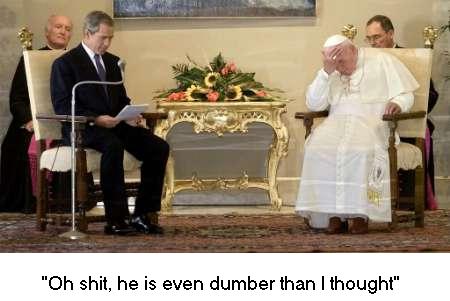
"The choice between Peace and War in the context of the current international situation is also the choice between Good and Evil which calls all Christians, now in the Lent Season, to reject Satan's temptations, the same way Jesus rejected them in the desert." - V.I.S., Città del Vaticano - 9 March 2003
www.repubblica.it/news/ired/ultimora/rep_nazionale_n_344708.html
The October 2004 lunar eclipse over North America was the night that the Boston Red Sox won the World Series in Busch Stadium. For those who have read about rigging of "sports" events, it seemed like an inside joke - Boston beating Bush under the full moon eclipse. While Kerry did win the real contest (not baseball), he wasn't allowed to become President by the secret, actual government. Hopefully, future historians (if we survive) will be able to fully describe all of the behind-the-scenes discussions, negotiations and threats that kept the Kerry campaign from protesting about vote fraud that flipped the election from Kerry to Bush.
www.news24.com/News24/Technology/News/0,,2-13-1443_1685635,00.html
Eclipse on pope's funeral
06/04/2005 07:53 - (SA)
Paris - Those who say eclipses herald history-shaping events will find support for their superstition when, on Friday, the sun will be briefly plunged into darkness on the day of Pope John Paul II's funeral.
Astronomers, though, say the eclipse, while of a rare and intriguing type, was calculated long ago and is simply part of a ballet in celestial physics between the sun, earth and moon.
It will be visible on Friday along an arc ranging from the southwestern Pacific to South America, at a time it will already be night in Rome.
The event will be a rare type called a "hybrid eclipse", expert Fred Espenak says on his website sunearth.gsfc.nasa.gov.
Along the central part of its path, some sections will have a total eclipse, in which the moon will completely obscure the sun.
On other sections of the track, though, it will be an annular eclipse - the moon will appear to have a brilliant, blazing ring around it.
Curvature of the earth
Total eclipses occur when the moon comes between the earth and the sun, completely obscuring the solar disk for a few minutes and illuminating the landscape in an eerie light. The eclipse follows a West-to-East track that lasts several hours until the alignment ends.
Hybrid eclipses occur because of the curvature of the earth, says Espenak.
Sometimes the moon's shadow touches the earth's surface, while at others it falls just short, thus providing the "ring" effect.
Friday's event will last three hours and 24 minutes, according to Espenak's calculations.
It begins at 18:54 GMT southeast of New Zealand, then races eastwards on a line north of the Galapagos Islands, Costa Rica, Panama, Colombia and finally Venezuela, where there will be a 33-second annular eclipse at sunset at 22:18.
People living in New Zealand and to the north and south of this central line, including most of the southern US, will see a partial eclipse - the sun will appear to have had a "bite" taken out of it.
Astronomical proof
Total eclipses were often seen as the harbingers of great events, from droughts and floods to failed harvests and the downfall of kings.
In ancient China, the belief was that an eclipse was caused when the gods dispatched a dragon to eat the sun. The monster then had to be chased away with dances, incantations, the clashing of cymbals and the unleashing of arrows and fireworks.
Even the word "eclipse" comes from a Greek word, "ekleipsis", which means to fail or be abandoned.
"The sun has perished out of heaven and an evil mist hovers over all," was Homer's horrified account of an eclipse in The Odyssey.
Two eclipses occurred near Palestine in AD29 and AD33 - events that, for some Christians, give astronomical proof to the biblical account that the sky darkened at Jesus' death on the cross.
Total solar eclipses happen about once every 18 months or so, although two partial eclipses occur somewhere on earth each year. The next hybrid eclipse will take place on April 20 2023.
www.namebase.org/sources/HN.html
Yallop, David A. In God's Name: An Investigation into the Murder of Pope John Paul I. New York: Bantam Books, 1985. 388 pages.
David Yallop, a British author with four previous crime investigations to his credit, came to the attention of "highly-placed, secret sources within the Vatican" who convinced him to look into the September 1978 death of John Paul I. During his 33 days as pope, Albino Luciani's leadership and incorruptibility threatened certain interests in the Vatican. These interests were connected with Licio Gelli's P2 network, Michele Sindona, Roberto Calvi and the emerging Banco Ambrosiano scandal, the Mafia, Italian intelligence, and Freemasonry. It was becoming clear to Luciani that a major housecleaning was in order.
Yallop believes there was a plot, but after three years of investigation his evidence is still circumstantial. Security was minimal, access to the pope or to his food or medicine would not have been difficult, and it was a good bet that there would be no autopsy. The cause of death was reported as acute myocardial infarction, but Luciani's medical history makes this difficult to accept. Death was so sudden that the pope didn't even have time to press the alarm button a few inches from his hand, which seems unlikely. When Karol Wojtyla was elected pope the Vatican returned to business as usual. With John Paul II in control, even the Italian government was unable to get the Vatican to come clean on its role in the Banco Ambrosiano scandal.
ISBN 0-553-24855-3
http://rigorousintuition.blogspot.com/2005/02/my-god-they-killed-him.html
Thursday, February 03, 2005
"My God - they killed him!"
The streets are filled with vipers who've lost all ray of hope
You know it ain't even safe no more in the palace of the Pope
- Bob DylanIs everything a conspiracy? No. Just the important stuff.
Since there's a lot of speculation these days about who will succeed Pope John Paul II, it seems a good time to recall the circumstances of the last papal succession. Because Luciani Albini, Pope John Paul I, was almost certainly murdered, by an international network of fascists and money launderers, with ties to far-right elements within military and intelligence agencies. (And isn't it just amazing, how often we find that convergence?)
He only served 33 days; what could he have done in that short time to deserve death? What kind of Pope was he becoming?
To the second question, there's the suggestion of an answer in this passage from David Yallop's In God's Name:On August 28, the beginning of his papal revolution was announced. It took the form of a Vatican statement that there was to be no coronation, that the new pope refused to be crowned. There would be no sedia gestatoria, the chair used to carry the pope, no tiara encrusted with emeralds, rubies, sapphires, and diamonds. No ostrich feathers, no six-hour ceremony.... Luciani, who never once used the royal "we," was determined that the royal papacy with its appurtenances of worldly grandeur should be replaced by a Church that resembled the concepts of its founder. The "coronation" became a simple Mass. The spectacle of a pontiff carried in a chair...was supplanted by the sight of a supreme pastor quietly walking up the steps of the altar. With that gesture Luciani abolished a thousand years of history.... The era of the poor Church had officially begun.That right there would have been enough to make the Vatican's power elite nervous, but surely not enough to seek the Pope's death. Not even his expressed interest in reconsidering the Church's position on birth control would have been enough for that. What was enough, was his intent to overturn the tables of the corrupt Vatican Bank, and purge the Vatican of the P2 Lodge.
This is one of those things that make being a "conspiracy theorist" seem entirely superfluous. Just try imagining P2: an elite, ultra-secretive, neo-fascist, Masonic cabal, involved in money laundering, assassination and false-flag terrorism. (The "Strategy of Tension," to discredit Italy's Communist Party. For instance, the engineering of Aldo Moro's kidnapping and murder, and the Bologna train bombing.) P2 counted among its members the future Italian President Silvio Berlusconi, and reputedly boasted honourary members like Henry Kissinger, George HW Bush and arch-neocon, Michael Ledeen.
I mentioned P2 last August, with regard to Ledeen's long history with the Italian far right and the linchpin of Italian military intelligence to the Niger "Yellow Cake" forgery. [For more on the significance of P2 to US intelligence and the "Octopus," refer to David Guyatt's excellent articles "Operation Gladio", "Holy Smoke and Mirrors" and "The Money Fountain."]
http://rigorousintuition.blogspot.com/2004/08/yellow-cake-and-black-shirts.html
http://www.deepblacklies.co.uk/operation_gladio.htmLicio Gelli was P2's Grandmaster, and can't even be called a neo-fascist. He was Old School: a member of the Italian Black Shirt Brigade which fought for Franco in the Spanish Civil War. During World War II, he spied on partisans in his native Italy for the Nazis, and obtained the SS rank of Oberleutenant. This same Gelli was a honoured guest of George HW Bush after the 1980 inauguration, and there is evidence that Gelli and P2 played a role in the October Surprise; even that Swedish Prime Minister Olof Palme was murdered on Gelli's orders because he'd refused to provide Swedish cover for the covert transfer of money and arms. In her October Surprise, Barbara Honegger writes that a P2 informant claimed to her that before Palme's death, Gelli sent a message to former Republican National Committee advisor (and also alleged "honourary" P2 member) Philip Guarino, assuring him that "the Swedish tree will be felled," and to "tell our good friend Bush."
Your head exploding yet? There's more. GHW Bush's reputed code name for October Surprise was "The White Rose," which was also the name of a far-right Cuban exile group with which the CIA's Bush was reportedly engaged during the ramp-up to the Bay of Pigs. Honneger reports that when Italian police uncovered the P2 control cell responsible for terrorism in Italy, they learned that its code name was "The Rose of Twenty." Gelli seems to have had a weakness for the flower.
And this may mean nothing, or I know what you did: in 1988, on the 25th anniversary of John F Kennedy's murder, Ted Kennedy marked the occasion in Runnymede England by placing, at the foot of his brother's memorial, a single white rose.
Gelli's network financed itself in part by purchasing and plundering banks, thanks to the likes of P2 brothers Michele Sindona and "God's Banker," Roberto Calvi. Mafioso Sindona, in 1968, had become a financial advisor to Pope Paul VI; Calvi was running Banco Ambrosiano; and another P2 member, American Bishop Paul "You can't run the Church on Hail Marys" Marcinkus, who bore the nickname "the Gorilla," was heading the Vatican Bank. For a while, it was a sweet operation.
As cardinal of Venice, Albini had butted heads with the bankers. As Pope, he could finally do something more. Most revelatory, he became privy to the secret list of Freemasons in the Vatican. For the first time, he learned of P2's penetration of the Church.
Yallop again:If the information was authentic, then it meant Luciani was virtually surrounded by Masons.... The secretary of state, Cardinal Villot, Masonic name Jeanni, lodge number 041/3, enrolled in a Zurich lodge on August 6, 1966. The foreign minister, Monsignor Agnostino Casaroli. The cardinal vicar of Rome, Ugo Poletti. Cardinal Baggio. Bishop Paul Marcinkus and Monsignor Donato de Bonis of the Vatican Bank. The disconcerted pope read a list that seemed like a Who's Who of Vatican City.
Here's a good summation of what happened next:
With his bright intelligence and naive fearlessness, John Paul I penetrated to the heart of this maze of corruption within weeks of his coronation. On the evening of September 28, 1978, he called Cardinal Villot, the leader of the powerful Curia, to his private study to discuss certain changes that the Pope proposed to make public the next day.... Among those whose "resignations" would be accepted by the Pontiff the following day were the head of the Vatican Bank, and several members of the Curia who were implicated in the activities of Sindona and P2, and Villot himself. Moreover, Villot was told that John Paul I would also announce plans for a meeting on October 24 with an American delegation to discuss a reconsideration of the Church's position on birth control.
When Pope John Paul I retired to his bedroom on the evening of September 28, clutching the paperwork that would expose the Vatican's financial dealings with the Mafia and purge the Curia of those responsible, a number of very ruthless individuals had a great interest in seeing to it that he would never awaken to issue these directives.
When the Pope's housekeeper knocked at his door at 4:30 a.m., she heard no response. Leaving a cup of coffee, she returned fifteen minutes later to find the Pope still not stirring. She entered the bed chamber and gasped when she saw the Pope propped up in bed, still holding papers from the night before, his face contorted in a grimace. On the night table beside him lay an opened bottle of Effortil, a medication for his low blood pressure. The housekeeper immediately notified Cardinal Villot, whose first response to the news was to summon the papal morticians even before verifying the death himself or calling the Vatican physician to examine the body. Villot arrived in the Pope's room at 5:00 a.m. and gathered the crucial papers, the Effortil bottle, and several personal items which were soiled with vomit. None of these articles were ever seen again.
Although the Vatican claimed that its house physician had determined myocardial infarction as the cause of death, to this day no death certificate for Pope John Paul I has been made public. Although Italian law requires a waiting period of at least 24 hours before a body may be embalmed, Cardinal Villot had the body of Albino Luciani prepared for within 12 hours of his death. Although the Vatican refused to allow an autopsy on the basis of an alleged prohibition against it in canon law, the Italian press verified that an autopsy had in fact been performed on one of the Pope's predecessors, Pius VIII. Although the conventional procedure for embalming a body requires that the blood first be drained and certain internal organs removed, neither blood nor tissue was removed from the corpse; hence, none was available to assay for the presence of poison.There's an old Kris Kristofferson song, entitled "They Killed Him." I learned it from a Dylan cover, on almost certainly his weakest album, Knocked Out Loaded. To be honest, it's pretty lousy. (If you haven't heard it, all you need to know is it has a children's chorus.) And yet, it chills me.
A verse:
Another man from Atlanta, Georgia
By name of Martin Luther King
He shook the land like the rolling thunder
And made the bells of freedom ring today
With a dream of beauty that they could not burn away
Just another holy man who dared to make a stand:
My God, they killed him!My point here hasn't been to rehash the case for assassination. My point, I suppose, is simply my exasperation: that My God - they killed him, too!
This material can lead to despair. If they can whack the Pope, and get away with it, what hope do we have? I don't find it consoling to know of what they're capable; that they are, as Dylan sang in another song, "bound and determined to destroy all the gentle." That's not about justice. That's about being forewarned, and forearmed. And these days, that's almost as important as justice.
But it is a consolation of sorts to remember that these people are flesh, just as we are. Gelli is still alive, but since his extradition from France in 1998, he has been serving a 12-year sentence for his role in the Banco Ambrosiano affair. Marcinkus received Vatican immunity from Pope John Paul II, when it became apparent Italian authorities intended to prosecute him for his criminal stewardship of the Vatican Bank, and eventually left Rome for Sun City, Arizona. (A fascinating glimpse of Marcinkus today, here. http://www.phoenixnewtimes.com/issues/2003-02-13/news/nelson.html ) Sindona died in prison drinking poison coffee, possibly the same administered to the Pope. Calvi, after his string played out, met a peculiarly Masonic fate, hanging from a rope beneath London's Blackfriar's Bridge, his hands tied behind his back and 12 pounds of bricks stuffed in his pockets. (Naturally, originally deemed a "suicide.")
Our advantage is that there are more of us than there are of them.
Our greatest disadvantage: most of us still can't admit there is a them.
other links about the poisoning of the Pope:
www.yallop.co.uk/in_god's_name.htm
http://users.crocker.com/~acacia/text_ign.html
www.prose-n-poetry.com/display_work/10583/
The Mysterious Death of Pope John Paul I [A Treatise]
www.crc-internet.org/oct84a.htm
The Murder of John Paul I
2013-03-21