




Abiotic Oil
Wishful thinking and other "snooze buttons" to delay the alarms about Peak Oil and other resource limits
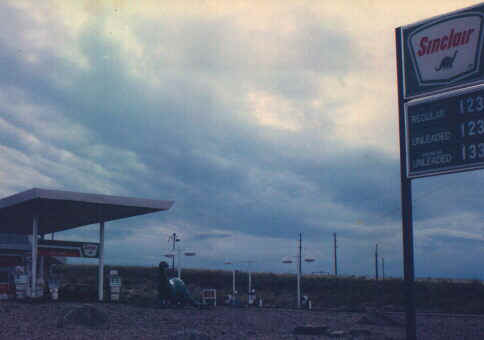
Sinclair is the world's most honest gasoline company (note their dinosaur mascot - oil wasn't really made
from dinosaurs |
The easiest to get petroleum has been gotten. Now comes the more difficult to extract oil which is harder to process.
Those who think Peak Oil is not real rarely address the reason why the oil industry ended in northwest Pennsylvania. Hint: It's the same reason why 200 foot tall trees aren't being cut down in New England any more and why gold mining is essentially ended in California.
Claims that oil is infinite are either a psychological blockage that makes it difficult to accept a round (ie. finite) planet or disinformation to distract people from demanding that the rest of the oil should be used in a humane and sane manner (solar panels, not battleships).
The real Peak Oil conspiracy is that the public is not allowed to be part of the decisions about how to cope with the environmental crisis.
Are there any disbelievers in Peak Oil who talk about the need for energy efficiency, to stop petroleum pollution that causes cancer and fouls the atmosphere, to reduce consumption, improve Amtrak, relocalize food production or other steps to reduce dependence on oil. Selfishness is not a great approach for figuring out how to have a sustainable civilization.
There's also peak natural gas, peak mineral resources (they can only be mined once!), peak fish, peak forests, peak soil, peak food, peak water and many other limits to endless growth. We have only one Earth, but most Americans (and others who aspire to live like Americans) act as if we'll just grab some more planets when we strip the resources from this one. That's the real issue and it's not solved by name calling, appeals for false unity, or various distractions that avoid the core problem of a round planet.
Abiotic oil is to geology what creationism is to biology.
Scientists identify vast underground ecosystem containing billions of micro-organisms
Global team of scientists find ecosystem below earth that is twice the size of world's oceans
Jonathan Watts
Mon 10 Dec 2018 10.00 EST Last modified on Tue 11 Dec 2018 05.08 EST
[a finding that shows the biotic zone is deeper than previously thought, something abiotic theorists claim cannot be true so therefore petroleum does not have a biological origin]
http://energyskeptic.com/2016/abiotic-oil-theory-and-its-implications-for-peak-oil/
Abiotic oil theory and its implications for peak oil
Posted on November 2, 2016 by energyskeptic
[This is most, but not all of the paper, which you can read here. Abiotic proponents believe that the earth is always producing fossil fuels so we don’t need to worry about peak oil (peak production) or running out of oil and natural gas. This is the best paper I know of that soundly refutes this notion.
And even if abiotic oil existed, it doesn’t matter, because we’re using 4 times more oil than we’re finding, and:
Conventional oil, where 90% of our oil comes from, peaked in 2005
Conventional is declining at a rate of 6% a year, reaching 9% a year by 2030, which means replacing half to two-thirds with unconventional oil in 13 years, from 2017 to 2030
It will be hard for unconventional oil to fill in that gap because it’s difficult, distant, nasty, and expensive both money and energy-wise. Even if the oil is there, the FLOW RATE will slow way down to a trickle instead of the Niagara Falls we have now
Fracked oil (and natural gas) was expected to peak in 2019 but maybe already have due to low oil prices.
Since the 1960s the world has been consuming more oil than what was discovered. Most of the world’s 500 largest oil fields were discovered over 50 years ago, and they are still the source of 60 % of our oil. The world burns 30 billion barrels of oil a year, but in 2015 only 2.7 billion barrels of oil were found, and likely even less will be found in 2016.
Alice Friedemann www.energyskeptic.com author of “When Trucks Stop Running: Energy and the Future of Transportation”, 2015, Springer and “Crunch! Whole Grain Artisan Chips and Crackers”. Podcasts: KunstlerCast 253, KunstlerCast278, Peak Prosperity , XX2 report ]
Höök, M., Bardi, U., Feng, L. & Pang, X. October 2010. Development of oil formation theories and their importance for peak oil. Marine and Petroleum Geology, Vol. 27, Issue 9: 1995-2004
Abstract
This paper reviews the historical development of both biogenic and non-biogenic petroleum formation. It also examines the recent claim that the so-called “abiotic” oil formation theory undermines the concept of ”peak oil,” i.e. the notion that world oil production is destined to reach a maximum that will be followed by an irreversible decline. We show that peak oil is first and foremost a matter of production flows. Consequently, the mechanism of oil formation does not strongly affect depletion.
We would need to revise the theory beyond peak oil only for the extreme — and unlikely— hypothesis of strong abiotic petroleum formation.
Oil companies deny Peak Oil (in public, anyway)
www.energybulletin.net/18111.html
Published on 13 Jul 2006 by Energy Bulletin. Archived on 13 Jul 2006.
Daniel Yergin Day, July 13, 2006
by Jeffrey J. Brown
CERA:
Rather than a 'peak,' we should expect an 'undulating plateau' perhaps three or four decades from now.
Mr. Robert Esser
Senior Consultant and Director, Global Oil and Gas Resources
Cambridge Energy Research Associates
Huntington, NY,
Understanding the Peak Oil Theory
Subcommittee on Energy and Air Quality
December 7, 2005
energycommerce.house.gov
EXXONMOBIL:
Contrary to the theory, oil production shows no signs of a peak... Oil is a finite resource, but because it is so incredibly large, a peak will not occur this year, next year, or for decades to come
ExxonMobil Advertisement in New York Times, June 2, 2006
www.exxonmobil.com
OPEC:
We in Opec do not subscribe to the peak-oil theory.
Acting Secretary General of Opec, Mohammed Barkindo
July 11, 2006
www.mg.co.za
| Greg Palast vs. Peak Oil |
Journalist Greg Palast has become perhaps the most prominent advocate of the view that Peak Oil is just an oil company conspiracy to hike the price of petroleum. While there are some kernels of truth in his analysis, Palast badly misunderstands the issues.
Peak Oil doesn't fit into a rigid ideology. Yes, the oil companies are profiteering, but oil is also finite and production is maxxed out. It's revealing that few of those complaining about Exxon profits or $3 per gallon gas mention conservation, Amtrak, and the insanity of the illusion of the goddess given right of every 'merican to use as much energy as they want. How many people upset at rising oil prices recommend nationalization of the oil companies as part of a policy to mitigate the impact of expensive oil on the most economically vulnerable part of the population?
The confluence of Peak Oil and climate change is very interesting - Peak Oil may mitigate the impact of climate change, since most climate scenarios assume constant increase in combustion, which is unlikely to be possible (even with coal and tar sands).
Palast is also on record claiming there was not any foreknowledge of 9/11 (he even said this in 2003, after numerous revelations that there was in fact foreknowledge). See the Complete 9/11 Timeline at www.cooperativeresearch.org -- now at historycommons.org -- for a good rebuttal to Palast's self-imposed blindness. (Palast's assistant admitted at a September 2005 conference in Portland, Oregon on vote fraud that he had a copy of Paul Thompson's "The Terror Timeline," a book version of the 9/11 Timeline.)
Palast did great work on the voter lists in Florida, but that doesn't make him an expert on everything. No one is that.
Hopefully, Palast is sincere in his ignorance, but there are many voices who are trying to get people to avoid looking at the reality of Peak. The real scam of Peak Oil is that the public is excluded from decisions about how to cope with it (and with climate change).
An excellent rebuttal of Greg Palast's blindness about ecological limits was written by Richard Heinberg, author of "The Party's Over" and "Powerdown."
energybulletin.net/17914.html
An Open Letter to Greg Palast
by Richard Heinberg
| abiotic disinformation |
It is interesting to see how disinformation about 9/11 and Peak Oil increased as "Crossing the Rubicon" neared publication, the 2004 election got closer, and consciousness about 9/11 and Peak Oil spreads into the mass media all over the world.
Many of the sites pushing 9/11 hoaxes such as "no planes on 9/11" are also pushing the "abiotic oil" claims that distract and disrupt understanding of the Bush regime's Peak Oil motivation for allowing - and facilitating - 9/11.
The "peak oil is a distraction from 9/11" meme has become especially loud now that Michael Ruppert's book "Crossing the Rubicon" has been published -- perhaps this meme is the response from the government to the charges in "Rubicon" but run through a variety of fringe websites instead of a direct response from administration officials to the allegations. Some of the "no planers" (promoting various disinfo claims on 9/11 complicity) also push abiotism, which is probably a coordinated strategy to discredit the 911/Peak connection made most famously by Crossing the Rubicon.
Abiotic oil is a theory that predates the discovery of plate tectonics. It was given a new round of promotion in the months before the 2004 "election" to distract from understanding the motivations of the Bush/Cheney regime in seizing Middle East oil fields. that has been revived to discredit conclusions that 9/11 was permitted partly to prepare the US for Peak Oil (to get the pretext to seize the Middle East oil fields and to impose a domestic "Homeland Security" police state to muzzle dissent). Some of the people promoting abiotic oil are among those pushing some of the other fake issues of 9/11 complicity.
Abiotic oil disinformation distracts from the connections between 9/11 and Peak Oil. The "debate" is used to keep the public from insisting the remaining oil be used to benefit as many people as possible through global relocalization of production and manufacture of renewable energy equipment. The debate about how to use the remaining oil for the transition toward a sustainable civilization.
Even if abiotic oil were true and the core of the Earth was a creamy nuggat of petroleum, mineral deposits are finite (the best iron ores are gone, for example), fisheries are overfished, forests overcut, soils, etc etc etc. Walter Youngquist's book Geodestinies makes the "peak minerals" argument very well, one not given enough discussion in Peak Oil circles. Many of the ore deposits mined today require very high tech to process - not charcoal from forests around the Mediterranean. The Bronze Age would not have been Bronze if they had to do mountain top removal or similar techniques to get at the ores.
www.urbansurvival.com/week.htm
George Ure's Urban Survival Newsletter
Friday August 27, 2004
The Peak Oil Concept Attacked
With a major Peak Oil conference underway in Europe this week, we have been receiving a number of emails expressing the notion that Peak Oil is nothing but a speculators pipedream, designed to drive up prices. We find it an interesting coincidence that articles like this one at the "Center for an Informed America" http://davesweb.cnchost.com/nwsltr64.html questions the reality of Peak Oil. Other sites go further with one claiming, in part, that Peak Oil is a "Zionist Scam" http://www.joevialls.co.uk
What's at the heart of many such attempts to "debunk" Peak Oil is the fact that once an oil well is pumped dry. it tends to recover some capacity over a period of time. Whether the "recovery" is caused by residual oil slowly percolating into the recoverable area of a well, or whether there's some yet-to-be-understood way that the earth perpetually makes oil is open to debate.
Unfortunately, a simple thought exercise demonstrates the problem clearly enough. Suppose you have a water well that can at maximum, produce enough water for 10 people. Everything is fine and the well provides for the whole community. But then two children are born. Suddenly, the well is no longer sufficient and depending on the well's capacity, it will decline over time until two users are eliminated through natural means or death from dehydration.
That's the reality of Peak Oil. It isn't that there isn't oil in the ground. It's that we are, as in the example above, far beyond the carrying capacity of wells to recover. It takes some precision of thought, but when you read about "peak oil" and ask "Why are we still pumping", remember the example of the village and the water well. They reached "peak water" when the new users were born and started making systemic demands. That "peak water" would not become visible to them until the well was pumping mud is a problem of limited perception. That's the reality of Peak Oil as far as we can judge it, regardless of whether the earth might be making more petroleum every day.
What we note, most importantly, is the timing of these attacks: They coming during a major peak oil conference and in close proximity to American elections which feature an incumbent president from the oil patch.
[note: the "Dave's Web" site was an accurate site for 9/11 complicity information within days of the attacks, but more recently has been pushing the "no plane hit Pentagon" hoax and is relentlessly attacking the concept of natural limits to industrial overdevelopment. Perhaps it is an example of a site that established its "bona fides" and then spouted nonsense to discredit serious work. Dave's Web issue 38 - June 4, 2003 - Of Myths and Monsters is an effort seemingly aimed at making Stalin seem less odious, and cites notorious neo-Nazi David Irving as merely a writer trying to present a balanced view of Hitler. Is this a subtle effort to smear 9/11 skeptics by association with this stuff seeking to downplay some of the worst crimes against humanity in history -- since "Dave's Web" has been a consistent voice saying "inside job" since the week of the attack?]
| paranoia manipulated to confuse anti-war efforts |
THE ASSOCIATION
FOR THE STUDY OF PEAK OIL AND GAS
“ASPO”
NEWSLETTER No. 60 – DECEMBER 2005
647. Vituperation
The following website alleges dishonesty and incompetence by the Editor of this Newsletter along with schizophrenic and Fascist tendencies.
http://peakoildebunked.blogspot.com/2005/10/122-colin-campbell-wrong-again.htmlThis avalanche of abuse was apparently triggered by reporting a reassessment that moved the peak date from 2007 to 2010. The word Peak possibly confuses those ignorant of the subject. It is not a Mount Everest but merely the maximum value on a gentle curve. Additional confusion is introduced by the several categories of oil, each depleting at different rates. The present assessment indicates that Regular Conventional Oil was at peak in 2004, whereas the profile for “all liquids”, as compiled from individual country evaluations (excluding refinery gains), is as follows:
2000 74.2 Mb/d 2006 81.7 Mb/d 2012 82.3 Mb/d 2018 71.9 Mb/d
2002 73.4 2008 83.6 2014 79.4 2020 68.6
2004 79.6 2010 84.5 2016 75.9 2022 65.0It is obvious that a fairly minor change in the input, or the modelling assumptions, can shift the maximum value (Peak) by a year or two, one way or the other, while the general position remains clear. We know that the estimates are wrong, given the appallingly unreliable public data. The questions are By How Much? and On What Evidence? If we have missed the impact of the Cretaceous in the Sudan or the delta fronts of Sumatra, please let us know. It is worth noting in passing that were Middle East production to rise higher than presently forecast, it would simply give a higher and possibly earlier peak followed by a steeper subsequent decline.
In a separate incident, Jack Zagar, giving a talk on Peak Oil to the Society of Petroleum Engineers in Geneva, found himself facing a member of the audience who accused ASPO of being a political conspiracy to justify the invasion of Iraq.
www.theoildrum.com/story/2005/11/15/32834/429
The Swift-Boating of Peak Oil
Posted by Stuart Staniford on Tue Nov 15 at 6:32 AM EST
Part of Dr Corsi's agenda seems to be to suggest that Peak Oil is a left wing movement (a point he expanded on last night). This simply is not the case. While there certainly are left wing peak oilers such as Richard Heinberg, believers in peak oil include the conservative republican Roscoe Bartlett, good capitalist economists such as James Hamilton, republican investment banker Matt Simmons, and that's not to even start on the neofascists. Peak Oil totally crosses the political spectrum, and I don't think Dr Corsi is going to make that particular framing of the debate stick, though I think we can expect him and whoever his allies turn out to be to make a vigorous effort.
If indeed the Swiftboating of Peak Oil is beginning, it is striking that the arguments are so very weak, and the champion so lacking in credibility. Is this really the best they can do? If so, it suggests things might be about to get very ugly, as mud is thrown in all directions in a desperate attempt to disguise the paucity of their position.
GeoPoet on Tue Nov 15 at 11:12 AM EST
In the end, it doesn't matter if oil is abiotic or biogenic in origin. What we look for is accumulations. These are found in structural trapping mechanisms, and discovered using gravimetric surveys, seismic surveys, and other technologies.
Sedimentary rock is far away the best rock type for migrating oil, accumulating it and trapping it. There are some exceptions, but 99.99% of the time, even these igneous traps have their fractures filled with sand (sedimentary) or other rock.
Most igneous rock is incapable of developing sufficient sealing mechanisms to trap large accumulations. Outside of cracks, there is very little permeability to igneous rocks. Volcanic breccia and pumice have porosity, but little permeability unless incorporated into some type of metamorphic. Sedimentary rock, with it's planar nature, is much more effective at generating traps and allowing accumulation of oil or gas.
We WISH that oil and gas were abiotic - that would mean we have only scratched the surface. But the weight of science, in particular respects Shell's success at generating oil in-situ from source rocks, is behind a biogenic origin for both oil and gas. The inability of igneous rock to retain hydrocarbons or allow migration without loss points to sedimentary basins as the best prospecting zones, regardless of origin.
| weaving together 9/11 "no planes" and "no Peak Oil" disinformation |
A number of the loudest voices pushing the (discredited) claim that some (or all) of the planes on 9/11 did not actually crash into their targets have taken up the claims that Peak Oil is merely oil company propaganda used to justify wars in the oil fields and profiteering. (The fact that the real scam is that the oil companies and financial elites have excluded the public from participating in decisions about how to use the remaining oil - for solar panels or battleships - is lost on these advocates.)
Here is a representative sample of this propaganda campaign, posted as a comment on the Rigorous Intuition blog:
http://rigint.blogspot.com/2006/07/justice-can-wait.html#comments
Anonymous said...
All you idiots attempting to sell Michael Ruppert just seem so contrived I'll have to say. Take it elsewhere, eh?
Ruppert as some sort of 9-11 truth leader is a lie.[note: a considerable part of the earliest, best research on what happened on 9/11 was published by Ruppert's From the Wilderness publication. Crossing the Rubicon, published in 2004, is still the best work on the mechanics of how 9/11 was facilitated and why. It's not perfect, but it's better than anything else out there - which is why it attracts these anonymous smear campaigns.]
Ruppert's ego loves to think he has a final say on truth and lies--and he spends more time attacking 9-11 truth movement people who disagree with him, with his belitting statements and hostile court suit threats, that in my opinion with this (and his selective non-analysis of WTC7 or the controlled demolitions of the WTCs) there's much too much that is fishy about Ruppert to be truly trustworthy.
[note: this contains several errors and innuendos that distract from the facts -- there are some incompetents and some bad actors spreading nonsense that is not fact checked or has been debunked by a variety of sources. As for the "physical evidence" claims, they are largely inferential at best, and put the truth seekers on the defensive - precisely the reason why the mainstream media defenders of the official story focus on the "physical evidence" claims and avoid any mention of suppressed warnings, wargames, how Flight 77 was steered into the Pentagon's nearly empty sector, and other evidence that has abundant evidence drawn from the official record and the mainstream media.]
I think he's spot on, on some things (like the opening chapters of his book on the U.S. as a completely irredeemable corporate criminal regime of financiers running the country from the secret services and intelligence services simply in the name of global piracy and espionage; or his analysis of the treasonous behavior of Bush, Cheney, and others on 9-11), though to ignore statements of admitted guilt from Silverstein or to address the whole controlled demolition thing is a huge attempt to steer away from the most obvious evidece of guilt of all involved. Particularly when Silverstein admits performing a controlled demolition on his WTC7 building later in the day of 9-11.
[note: the "Silverstein" quote is bait for the 9/11 skeptics - "pull it" is not a demolition industry term, Silverstein is merely toying with the "truth activists"]
Don't defend Ruppert's dictatorial attitude. It's uncalled for.
Second, despite no evidence, he keeps selling the snake oil lie of peak oil.more on that:
newswire article commentary portland metro 05.Jul.2006 22:43
energy & nuclearGreg Palast says Oil Empire aimed at NOT producing oil--Peak Oil Theory trumped by liberal
author: Dr. Know
Peak Oil people claim that Peak Oil is around the corner. They base their theory largely on the same people who have been stalwarts of the conventional energy industry since the days of Standard Oil. Yet Greg Palast, in his recent speech in Portland and in his new book, Armed Madhouse, debunks those theories (as he did less explicitly in his book, The Best Democracy Money Can Buy) by revealing that the actual conspiracy has been to constrain oil production and boost the prices realized by the oil industry....
So how do the Peak Oil fanatics reconcile the fact that one of the Left's most prominant investigative reporters has produced documented proof that Big Oil has been actually trying to limit availability of "proven reserves" for the last 80 years? Well, they can't. Palast's book, Armed Madhouse, has without really aiming to do so, proven that conventional theories of "peak oil" are Big Oil originated and aimed at formulating public opinion.[note: Palast's "facts" in his attempt to debunk the reality of natural limits to resources are flawed. Palast did great work on the vote fraud in Florida in 2000 and several other scandals, but that does not mean his expertise is endless or that his work is beyond scrutiny. It's also ironic that an anonymous internet troll promoting "no planes on 9/11" would cite Palast as an impeccable source, since Palast claims that 9/11 was a surprise attack even though there's lots of solid evidence that it was not.]
and see the comments:
article is hereSoon as he drops his spiel on the lies of peak oil as something behind 9-11 (which he with incredible hostility peddles everywhere), he can move on toward what is really going on.
McGowan's, Palast's, and other's information has completely made that peak oil assumption seem like the PR psyop it is.
You don't require a potential government spook (who was dating a corrupt CIA officer running drugs into the U.S, through New Orleans, as per his admittals!) as a hero, when there is so much overflowing truth out there that Ruppert looks more like a tiny spigot now.[note: this is an example of "snitch jacketing" -- falsely accusing a social change activist of working for the government as an agent provocateur. Anyone who bothers to read Ruppert's account of how covert forces tried to recruit him and then hounded him when he refused will see through this nasty smear. Furthermore, there is an "overflowing" of 9/11 information that markets itself as "truth," but there have been very few verifiable facts in 2005 and 2006 that actually add to the understanding of what happened on 9/11 and why. It seems obvious that the perpetrators have spread increasingly silly and rabid lies to distract from the best evidence. Some of this material has snared unwitting "truth" activists, much of it is used by the media to paint "9/11 truth" as a lunatic cause lacking any veracity.]
And see 9-11 Loose Change while you're at it if you have yet to do so.
[Note: for the coup de grace, a promotion of a clever, but mostly false film that is loose with truth - it used fake evidence (no planes) to pollute the real conclusion (inside job).]
| plate tectonics, chemistry and geology debunk abiotic claims |
Abiotic oil is a "theory" that predates the understanding of plate tectonics. "Hubbert's Peak" by geologist Kenneth Deffeyes is a wonderful, short book that concisely explains how plate tectonics formed oil and natural gas.
www.peakoil.com/contentid-25.html
Abiotic Oil
An ExplanationSince we have new members and visitors joining us constantly, I decided to re-post my response from an earlier thread. I emailed this information to Richard Heinberg, and he said that it is the best short rebuttal to the abiotic oil theory that he's seen anywhere. Dave van HarnI did some web searching for information on Dr. Gold and the abiotic theory of hydrocarbon creation. I noticed that most of the sites backing the abiotic theory were non-scientific. The best rebuttals to the abiogenic theory that I came up with were from the American Association of Petroleum Geologists at this web site:
http://www.aapg.org/explorer/2002/11nov/abiogenic.cfm
and Dr. John Clarke, a geologist and astrobiologist from Australia (his bio is at this link:
http://aca.mq.edu.au/People/jclarke.htm
I e-mailed Dr. Clark and received permission to post a rebuttal he posted in another forum to the theory of abundant abiotic oil:
Quote:
The fact remains that the abiotic theory of petroleum genesis has zero credibility for economically interesting accumulations. 99.9999% of the world's liquid hydrocarbons are produced by maturation of organic matter derived from organisms. To deny this means you have to come up with good explanations for the following observations.
1) The almost universal association of petroleum with sedimentary rocks.
2) The close link between petroleum reservoirs and source rocks as shown by biomarkers (the source rocks contain the same organic markers as the petroleum, essentially chemically fingerprinting the two).
3) The consistent variation of biomarkers in petroleum in accordance with the history of life on earth (biomarkers indicative of land plants are found only in Devonian and younger rocks, that formed by marine plankton only in Neoproterozoic and younger rocks, the oldest oils containing only biomarkers of bacteria).
3) The close link between the biomarkers in source rock and depositional environment (source rocks containing biomarkers of land plants are found only in terrestrial and shallow marine sediments, those indicating marine conditions only in marine sediments, those from hypersaline lakes containing only bacterial biomarkers).
4) Progressive destruction of oil when heated to over 100 degrees (precluding formation and/or migration at high temperatures as implied by the abiogenic postulate).
5) The generation of petroleum from kerogen on heating in the laboratory (complete with biomarkers), as suggested by the biogenic theory.
6) The strong enrichment in C12 of petroleum indicative of biological fractionation (no inorganic process can cause anything like the fractionation of light carbon that is seen in petroleum).
7) The location of petroleum reservoirs down the hydraulic gradient from the source rocks in many cases (those which are not are in areas where there is clear evidence of post migration tectonism).
8 ) The almost complete absence of significant petroleum occurrences in igneous and metamorphic rocks (the rare exceptions discussed below).
The evidence usually cited in favour of abiogenic petroleum can all be better explained by the biogenic hypothesis e.g.:
9) Rare traces of cooked pyrobitumens in igneous rocks (better explained by reaction with organic rich country rocks, with which the pyrobitumens can usually be tied).
10) Rare traces of cooked pyrobitumens in metamorphic rocks (better explained by metamorphism of residual hydrocarbons in the protolith).
11) The very rare occurrence of small hydrocarbon accumulations in igneous or metamorphic rocks (in every case these are adjacent to organic rich sedimentary rocks to which the hydrocarbons can be tied via biomarkers).
12) The presence of undoubted mantle derived gases (such as He and some CO2) in some natural gas (there is no reason why gas accumulations must be all from one source, given that some petroleum fields are of mixed provenance it is inevitable that some mantle gas contamination of biogenic hydrocarbons will occur under some circumstances).
13) The presence of traces of hydrocarbons in deep wells in crystalline rock (these can be formed by a range of processes, including metamorphic synthesis by the fischer-tropsch reaction, or from residual organic matter as in 10).
14) Traces of hydrocarbon gases in magma volatiles (in most cases magmas ascend through sedimentary succession, any organic matter present will be thermally cracked and some will be incorporated into the volatile phase, some fischer-tropsch synthesis can also occur).
15) Traces of hydrocarbon gases at mid ocean ridges (such traces are not surprising given that the upper mantle has been contaminated with biogenic organic matter through several billion years of subduction, the answer to 14 may be applicable also).
The geological evidence is utterly against the abiogenic postulate.
Cheers
Jon Clarke
www.peakoil.com/fortopic3968.html
Dec 13, 2004
Not this abiotic oil nonsense again.
What I would really love to see proponents of abiotic oil theory explain away are biomarkers. Any attempt would be tantamount to trying to rationalize away guilt for murder when you have your bloody fingerprints on the weapon, your skin under the victim's fingernails, your hair on their garments, and your semen in their body. Everything we would expect to find if the parsimonious hypothesis that fits the evidence was true, and evidence that can't exist if the alternate theory was true. If any attempt to explain that is forthcoming, it will be apologetic ad-hoc ill contrived nonsense at best. Abiotic oil does exist, but it is in insignifigantly miniscule, noncommercially viable quantities, and the rate at which is produced hasn't shown to be any faster than biotic oil, which is around 20 million years.
Most of the time when people really dig into the chemical composition of crude oils, they find biomarkers. Things called hopanes and phytanes and such. These chemicals can be traced directly to, say, the lipids that make up cyanobacterial cell membranes (and only those membranes), or to the wax that coats the leaves of some extinct tree from Tasmania - and fossils of the same leaves are found 100 km away in coal of the same age.
The oil we've been using to power our world is a fossil fuel. While an indigenous origin has been proposed by several notable geologists, there are things that make this unlikely.
The first clue we find is, of course, that oil is carbon-based, much like life. The second is that nitrogen and porphyrins, found in living things, are found in many petroleum deposits as well. Porphyrins, FYI, cannot survive temperatures of more than around 200 degrees Celsius, common deep below the earth's surface.
A very important clue is the fact most oil occurs in or near sedimentary rocks of marine origin--if oil was leaking up from deep within the crust, we would expect most of it to occur in assorted rock near fault lines instead.
Coastal upwelling, a phenomenon associated with much of the hypothesized formation of organic oil, embeds larger amounts of phosphorus in the layers of dead marine plankton it creates, than the ocean at large. And what do we find in places like California and Montana, which were formerly coastal and possess oil deposits? Petroleum with much phosphorus content...
The carbon-12 / carbon-13 isotope ratio in oil deposits is a nice approximation to that in known living things.
Finally, and this is pretty much decisive, the molecular structure of hydrocarbons can often be directly linked to pigments, chlorophyll, leaf waxes, etc. of species that biology and paleontology tells us were dominant at those places during times when oil formed. (Source)
[Information about the various types of identifiable oil kerogens and the organisms they derive from]
This is not all of the evidence for a biological origin of oil, but it should be enough. Any of it can be explained with an appropriate ad-hoc rationalization, but this practice can weaken its explanatory power compared to the mainstream view.
Now, oil can be formed naturally. This is no secret to geologists. There are a few known examples of this phenomenon, most notably a few Russian oil fields. But this oil (1) tends to differ in identifiable ways from the usual variety, and (2) is by far miniscule compared to our oil needs and reservoirs of organic origin.
As in any other field, there have been other challenges to mainstream views on the formation of oil, with various levels of incompetency. Among the most hilarious are young-earth creationist claims that oil and coal are a result of Noah's flood. But these minority viewpoints are less successful when trying to predict which areas and/or rocks have most chance of yielding oil, the key test of any such hypothesis.
Peer-review in a prestigious journal does not entail accuracy; merely the lack of utterly newbie scientific errors. And then, there have been rare examples of those in peer-reviewed journals, too.
Basically, the hypothesis that oil is formed abiotically:
- Cannot readily account for the geology or chemistry of known oil deposits, both of which render the indigenous origin implausible;
- Is true on a micro level, since small amounts of various hydrocarbons, and methane, are demonstrably formed by non-organic geologic processes;
- Does not, as of yet at least, match the predictive power of mainstream geology, which consistently and successfully tells us, in advance, which rocks are most likely to contain oil. In other words, the fact that oil is produced by non-organic processes deep within the earth's crust in miniscule quantities is something no geologist will debate. Sure, they exist, but they are infintessimally minute and null for all practical intents and purposes reguarding future sustainability.
The theory of all petroleum being abiotic, or even a large quantity of it, is not well-established and is currently considered inferior to the mainstream view for obvious reasons. It's ideologically-sponsored and demonstrably "crank" science like many such "alternative theories" ("HIV doesn't cause AIDS," "global warming isn't happening," various forms of creationism, etc.). Confidently asserting commercial reserves of oil aren't fossil fuels is as ridiculous as it gets.
The "Abiotic Oil" Controversy
Richard Heinberg explains why this theory is nonsense at best, delusional thinking at worse.Abiotic Oil: Science or Politics?
Professor of Chemistry Ugo Bardi offers a simple assessment of the abiotic theory. His logic is so clear, and the culmination of his argument is so cogent, that even a child could understand it. The conclusion is inescapable one to any honest enquiry - abiotic theory is false, or at best irrelevant.A Challenge to the Flat-Earth, Abiotic Oil Advocates and Cornucopian Economists - It's Now or Never
Quote:
The G7 has just admitted that the world economy is threatened today, not tomorrow. How does it benefit oil companies or markets if no one can buy their goods and services, or if there is no power to use them with? Now is the time for these critics to produce their vast limitless energy resources, because the G7 has just admitted that everything's falling apart. (As if we hadn't noticed.) That's what these "critics" argued would happen when the time came: there would be some magic switcheroo, and a new energy source would be unveiled.Quote: One cannot materialize a hot dog in a bank vault no matter how much money is there. The earth is a bank vault and we are all collectively locked inside it.
Show us the oil! People are dying now. The G7 has done everything but state that this is just the beginning unless more oil is found. Remember that it can take three years to bring a new oil field (once found) online. Don't attack us anymore. You have said there is an easy solution. Produce it for us all, even for yourselves. For you are not immune to what is coming. We have tried to warn even you. As FTW's energy editor Dale Allen Pfeiffer once wrote to me, "Peak Oil will defend itself quite nicely."
Put up or shut up.It's unquestionably apparent that this delusional fantasy of abiotic oil has been put to rest once and for all, so "nuff' said" on that.
www.fromthewilderness.com/free/ww3/102104_no_free_pt1.shtml
No Free Lunch, Part 1:
A Critique of Thomas Gold's Claims for Abiotic Oil by Jean Laherrere edited by Dale Allen Pfeiffer
www.fromthewilderness.com/free/ww3/011205_no_free_pt2.shtml
No Free Lunch, Part 2:If abiotic oil exists, where is it?
by Dale Allen Pfeiffer
www.fromthewilderness.com/free/ww3/012805_no_free_pt3.shtml
No Free Lunch, Part 3 of 3: Proof by Ugo Bardi & Dale Allen Pfeiffer
www.fromthewilderness.com/free/ww3/100404_abiotic_oil.shtml
Abiotic Oil: Science or Politics? By Ugo Bardi
www.fromthewilderness.com/free/ww3/04_04_02_oil_recession.html
Column: Oil Prices and Recession
by Dale Allen Pfeiffer, FTW Contributing Editor for Energy
excerpt
A WORD ABOUT ABIOTIC OIL
There is some speculation that oil is abiotic in origin -- generally asserting that oil is formed from magma instead of an organic origin. These ideas are really groundless. All unrefined oil carries microscopic evidence of the organisms from which it was formed. These organisms can be traced through the fossil record to specific time periods when quantities of oil were formed. Likewise, there are two primal energy forces operating on this planet, and all forms of energy descend from one of these two. The first is the internal form of energy heating the Earth's interior. This primal energy comes from radioactive decay and from the heat energy originally generated during accretion of the planet some 4.6 billion years ago. There are no known mechanisms for transferring this internal energy into any secondary energy source. And the chemistry of magma does not compare to the chemistry of hydrocarbons. Magma is lacking in carbon compounds, and hydrocarbons are lacking in silicates. If hydrocarbons were generated from magma, then you would expect to see some closer kinship in their chemistry. The second primal energy source is light and heat generated by our sun. It is the sun's energy that powers all energy processes on the Earth's surface, and which provides the very energy for life itself. Photosynthesis is the miraculous process by which the sun's energy is converted into forms available to the life processes of living matter. Following biological, geological and chemical processes, a line can be drawn from photosynthesis to the formation of hydrocarbon deposits. Likewise, both living matter and hydrocarbons are carbon based. Finally, because oil generation is in part a geological process, it proceeds at an extremely slow rate from our human perspective. Geological processes take place over a different frame of time than human events. It is for this reason that when geologists say that the San Andreas fault is due for a powerful earthquake, they mean any time in the next million years -- probably less. Geological processes move exceedingly slow. After organic matter has accumulated on the sea floor, it must be buried by the process of deposition. In geological time, in order for this matter to be a likely prospect for hydrocarbon generation, the rate of deposition must be quick. Here is an experiment you can conduct to get an idea how slow the rates of deposition are. Place a small stone on the bottom of a motionless pond. Take another stone of about the same size and place it at the mouth of a small stream, a stream where the current is not so great that it will sweep the stone away. Check both of these stones yearly until they have been buried by deposition. You might see the stone at the mouth of the stream covered over within a few years, but it is unlikely that you will see the stone in the pond buried within your lifetime. It is a simple geological fact that the oil we are using up at an alarming rate today will not be replaced within our lifetime -- or within many lifetimes. That is why hydrocarbons are called non-renewable resources. Capped wells may appear to refill after a few years, but they are not regenerating. It is simply an effect of oil slowly migrating through pore spaces from areas of high pressure to the low-pressure area of the drill hole. If this oil is drawn out, it will take even longer for the hole to refill again. Oil is a non-renewable resource generated and deposited under special biological and geological conditions.
[emphases added]
From: "Mike Ruppert"
Date: Sun, 15 Feb 2004 16:52:01 -0800
Subject: RE: [911truthalliance] Ice Age anyone?
More unfounded bs.
I will give $1,000 cash money to anyone who can show me one oil field that is today producing oil from abiotic sources. Thomas Gold's 1980s nonsense discovery in the Gulf of Mexico is today a dry hole. He is laughed at by everyone in the industry, not the financiers, but the geologists (both private and from universities) and the actual drillers.
All that happened in the 1980s was that oil which had been pushed into interstitial spaces by secondary recovery (steam injection) slowly seeped back into the vacuum left by pumping. The well went dry in a few years. This is a common occurrence for anyone who's worked in the industry. Thomas Gold was an astronomer who foolishly decided to leave his field of study and he is a standing joke throughout the industry.
Ethanol is an absolute waste of time and money as demonstrated by the French government who decried it as nothing more than a subsidiary to agribiz. The French minister of Energy spoke to us in Paris last May and laughed about how much more energy went into ethanol than was produced by burning it.
Again, a $1,000 cash offer to anyone who can demonstrate numerically, in terms of net energy, land area and productivity that US transportation needs can be met with ethanol.
I will hold claimants to the same scientific standards of proof that FTW has used for three years. And, as part of that bet, I will demand that each claimant pay me $50 for my time when I prove them wrong. That's 20 to 1 odds. Just throwing a bs article at me won't qualify. You have to show me a hard scientific paper from a university or a producing well where it has been demonstrated that the oil is abiotic and that reserves are refilling.
But before you do, please see (It might save you some money):
www.fromthewilderness.com/free/ww3/062102_gascliff.html
www.fromthewilderness.com/free/ww3/052703_9_questions.html
www.fromthewilderness.com/free/ww3/053103_aspo.html
www.fromthewilderness.com/free/ww3/04_04_02_oil_recession.html
www.fromthewilderness.com/free/ww3/102302_campbell.html
www.fromthewilderness.com/free/ww3/081803_hydrogen_answers.html
www.fromthewilderness.com/free/ww3/012805_no_free_pt3.shtml
No Free Lunch, Part 3 of 3: Proof
by Ugo Bardi & Dale Allen Pfeiffer
www.fromthewilderness.com/free/ww3/100404_abiotic_oil.shtml
Copyright 2004, From The Wilderness Publications, www.fromthewilderness.com.
All Rights Reserved. May be reprinted, distributed or posted on an Internet
web site for non-profit purposes only.
Abiotic Oil: Science or Politics?
By
Ugo Bardi
www.aspoitalia.net
[Ugo Bardi is professor of Chemistry at the University of Florence, Italy.
He is also member of the ASPO (Association for the study of peak oil).
He is the author of the book "La Fine del Petrolio" (the end
of oil) and of several studies on oil depletion.
Ugo Bardi offers a simple assessment of the abiotic theory. His logic
is so clear, and the culmination of his argument is so cogent, that even
a child could understand it. And the conclusion is inescapable - at least
to honest enquiry - abiotic theory is false, or at best irrelevant. -DAP]
OCTOBER 4, 2004: 1300 PDT (FTW) -- For the past century or so, the biological origin of oil seemed to be the accepted norm. However, there remained a small group of critics who pushed the idea that, instead, oil is generated from inorganic matter within the earth's mantle.
The question might have remained within the limits of a specialized debate among geologists, as it has been until not long ago. However, the recent supply problems have pushed crude oil to the center stage of international news. This interest has sparked a heated debate on the concept of the "production peak" of crude oil. According to the calculations of several experts, oil production may reach a maximum within a few years and start a gradual decline afterwards.
The concept of "oil peak" is strictly linked to a view that sees oil as a finite resource. Several economists have never accepted this view, arguing that resource availability is determined by price and not by physical factors. Recently, others have been arguing a more extreme view: that oil is not even physically limited. According to some versions of the abiotic oil theory, oil is continuously created in the Earth's mantle in such amounts that the very concept of "depletion" is to be abandoned and, by consequence, that there will never be an "oil peak."
The debate has become highly politicized and has spilled over from geology journals to the mainstream press and to the fora and mailing lists on the internet. The proponents of the abiotic oil theory are often very aggressive in their arguments. Some of them go so far as to accuse those who claim that oil production is going to peak of pursuing a hidden political agenda designed to provide Bush with a convenient excuse for invading Iraq and the whole Middle East.
Normally, the discussion of abiotic oil oscillates between the scientifically arcane and the politically nasty. Even supposing that the political nastiness can be detected and removed, there remains the problem that the average non-specialist in petroleum geology can't hope to wade through the arcane scientific details of the theory (isotopic ratios, biomarkers, sedimentary layers and all that) without getting lost.
Here, I will try to discuss the origin of oil without going into these details. I will do this by taking a more general approach. Supposing that the abiogenic theory is right, then what are the consequences for us and for the whole biosphere? If we find that the consequences do not correspond to what we see, then we can safely drop the abiotic theory without the need of worrying about having to take a course in advanced geology. We may also find that the consequences are so small as to be irrelevant; in this case also we needn't worry about arcane geological details.
In order to discuss this point, the first task is to be clear about what we are discussing. There are, really, two versions of the abiotic oil theory, the "weak" and the "strong":
- The "weak" abiotic oil theory: oil is abiotically formed, but at rates not higher than those that petroleum geologists assume for oil formation according to the conventional theory. (This version has little or no political consequences).
- The "strong" abiotic theory: oil is formed at a speed sufficient to replace the oil reservoirs as we deplete them, that is, at a rate something like 10,000 times faster than known in petroleum geology. (This one has strong political implications).
Both versions state that petroleum is formed from the reaction of carbonates with iron oxide and water in the region called "mantle," deep in the Earth. Furthermore, it is assumed (see Gold's 1993 paper) that the mantle is such a huge reservoir that the amount of reactants consumed in the reaction hasn't depleted it over a few billion years (this is not unreasonable, since the mantle is indeed huge).
Now, the main consequence of this mechanism is that it promises a large amount of hydrocarbons that seep out to the surface from the mantle. Eventually, these hydrocarbons would be metabolized by bacteria and transformed into CO2. This would have an effect on the temperature of the atmosphere, which is strongly affected by the amount of carbon dioxide (CO2) in it. The concentration of carbon dioxide in the atmosphere is regulated by at least two biological cycles; the photosynthetic cycle and the silicate weathering cycle. Both these cycles have a built-in negative feedback which keeps (in the long run) the CO2 within concentrations such that the right range of temperatures for living creatures is maintained (this is the Gaia model).
The abiotic oil-if it existed in large amounts-would wreak havoc with these cycles. In the "weak" abiotic oil version, it may just be that the amount of carbon that seeps out from the mantle is small enough for the biological cycles to cope and still maintain control over the CO2 concentration. However, in the "strong" version, this is unthinkable. Over billions of years of seepage in the amounts considered, we would be swimming in oil, drowned in oil.
Indeed, it seems that the serious proponents of the abiotic theory all go for the "weak" version. Gold, for instance, never says in his 1993 paper that oil wells are supposed to replenish themselves.1 As a theory, the weak abiotic one still fails to explain a lot of phenomena, principally (and, I think, terminally): how is it that oil deposits are almost always associated to anoxic periods of high biological sedimentation rate? However, the theory is not completely unthinkable.
At this point, we can arrive at a conclusion. What is the relevance of the abiotic theory in practice? The answer is "none." The "strong" version is false, so it is irrelevant by definition. The "weak" version, instead, would be irrelevant in practice, even if it were true. It would change a number of chapters of geology textbooks, but it would have no effect on the impending oil peak.
To be sure, Gold and others argue that even the weak version has consequences on petroleum prospecting and extraction. Drilling deeper and drilling in areas where people don't usually drill, Gold says, you have a chance to find oil and gas. This is a very, very weak position for two reasons.
First, digging is more expensive the deeper you go, and in practice it is nearly impossible to dig a commercial well deeper than the depth to which wells are drilled nowadays, that is, more than 10 km.
Secondly, petroleum geology is an empirical field which has evolved largely by trial and error. Petroleum geologists have learned the hard way where to drill (and where not to drill); in the process they have developed a theoretical model that WORKS. It is somewhat difficult to believe that generations of smart petroleum geologists missed huge amounts of oil. Gold tried to demonstrate just that, and all that he managed to do was to recover 80 barrels of oil in total, oil that was later shown to be most likely the result of contamination of the drilling mud. Nothing prevents others from trying again, but so far the results are not encouraging.
So, the abiotic oil theory is irrelevant to the debate about peak oil and it would not be worth discussing were it not for its political aspects. If people start with the intention of demonstrating that the concept of "peak oil" was created by a "Zionist conspiracy" or something like that, anything goes. In this case, however, the debate is no longer a scientific one. Fortunately, as Colin Campbell said, "Oil is ultimately controlled by events in the geological past which are immune to politics."
1 Thomas Gold, of Cornell University, has been one of the leading proponents of the abiotic oil theory in the West. The theory, actually, had its origin in the work of a group of Ukrainian and Russian scientists.
| abiotic distraction from petrocollapse |
http://ranprieur.com/crash/abiotic.html
If it's true that there's plenty more oil, it just changes the character of the coming crash -- it will be through toxicity or ecological catastrophe instead of lack of energy, it will take longer, and the earth is a lot more likely to die. Here's an excerpt from William Kotke's summary of the 1972 "Limits To Growth" study:
The scholars programmed the computers so as to double the estimated resource base, they created a model that assumed "unlimited" resources, pollution controls, increased agricultural productivity and "perfect" birth control. None of these or other aversion strategies could take the world system past 2100.
The reason that the world system cannot go on with unlimited growth is because each of the five factors is interactive. If we assume unlimited fuels such as a simple fusion process, this simply drives the growth curves faster. There is more cheap fuel so the wheels of industry churn faster and resource exhaustion comes more quickly, population continues to climb and pollution climbs. If there is more food production, then population climbs and resources are exhausted more rapidly. If population is stabilized, resources still continue to decline and pollution increases because of increased consumption. If the factors of resources, food, and industrial output grow then population grows but the resulting pollution creates the negative feedback of having to maintain cancer hospitals and institutions for the birth defected and mutations caused by pollution as well as pollution damage to factors such as farm crops.
As of October 2004, the peak oil writers are finally posting some strong critiques of the abiotic oil position. Here's one from Richard Heinberg, who hits a few points but says the issues are so complex that you'd need a whole book to cover it properly. And here's one from Ugo Bardi, who argues that the abiotic generation rates would have to be so small as to be politically insignificant. The consensus is that there might be abiotic oil, but that it's not going to delay the crash.
| Alex Jones and Abiotic Oil |
oilcrash.com/articles/ulsak_03.htm
WILL THE SO-CALLED "TRUTH MOVEMENT" HELP US AVOID A NEW STONE
AGE?
by Tate Ulsaker
[a good rebuttal to Alex Jones]
A fairly comprehensive list of links to the "pro-abiotic" side are in the following article (with some rebuttals in bold)
www.prisonplanet.com/archives/peak_oil/index.htm
The Myth Of Peak Oil
Paul Joseph Watson & Alex Jones | October 12 2005
Peak oil is a scam designed to create artificial scarcity and jack up prices while giving the state an excuse to invade our lives and order us to sacrifice our hard-earned living standards.
Note: The real scam of Peak Oil is that a tiny elite is going to decide how humanity will cope with declining resources caused by a variety of overconsumptive practices. Anyone with any clue can see how rapacious greed and out-of-control economic systems are outstripping the capacity of the natural systems of the planet to restore the biosphere.
Jones and other abiotic enthusiasts confuse the very real reality of price gouging and other forms of manipulation with a blind faith that oil supplies are essentially endless. Their wishful thinking also obscures many other forms of overshoot: declining natural gas, desertification, climate change, deforestation, species extinction, overfishing, minerals depletion, soil degradation, declining grain production, toxic and nuclear wastes, and other limits to growth.
The existence of self-renewing oil fields shatters the peak oil myth. If oil is a naturally replenishing inorganic substance then how can it possibly run out?
There are two factors that must be considered regarding this claim. First, and most important, it is true that removing oil from part of an oil field can cause nearby oil deposits to migrate (slowly) toward the depleted areas. That is not evidence that deeper layers in the Earth are constantly creating vast amounts of oil. Second, the abiotic advocates rarely mention the issue of rate of production. Assume that their claims of new oil being made are true -- what is the rate that this new oil is made? It is similar to claims by timber companies that their clearcutting of ancient forests is acceptable because forests grow back - claims that ignore the fact that they are cutting much faster than forests grow. (There's also the issue of what happens to the atmosphere if we keep accelerating our overconsumption of oil, but that is not part of Jones's concern.)
Earlier this year Saudi Arabia reportedly increased its crude reserves by around 200 billion barrels. Saudi oil Is secure and plentiful, say officials.
Those claims have not been subjected to any outside peer review, and the Saudis have not made substantial increases in their daily exports of petroleum. They have increased their export of "sour crude" that has lots of embedded sulfur, but not the export of the better grades of crude oil that are more desirable for making gasoline and jet fuel. It is interesting that Watson and Jones are trusting pronouncements from the Saudi royal family without making any effort in their reporting to verify whether these statements are true or false.
There is a clear contradiction between the peak oil theory and the continual increase in oil reserves and production.
New untapped oil sources are being discovered everywhere on earth.
If Watson and Jones know of large discoveries in recent years, they should let the world know about them, since the oil companies, financial institutions and the world press are not aware of anything on the scale needed to shift the timing of Peak Oil by more than a couple of years. Citing articles in "conspiracy planet" and similar sources is not journalism.
| Richard Heinberg shows why "abiotic oil" is a myth |
www.altpr.org/modules.php?
op=modload&name=News&file=article&sid=331&mode=thread&order=0&thold=0
The “Abiotic Oil” Controversy
Posted by: APR on Oct 07, 2004 - 01:13 PM
By Richard Heinberg
In recent months a few of the many web sites that challenge the official account of the events of 9/11/2001 have also attacked the idea of peak oil. I would prefer to ignore this controversy--and there are good reasons for doing so, as some of these web sites lack credibility on other counts; nevertheless, as these sites are magnets for large numbers of people who are just beginning to find their way out of the consensus societal trance, they appear to be doing some palpable harm. I have received at least a couple of dozen e-mails from sincere people wanting to know my response to claims that “peak oil” is a scam, and that oil is actually an inexhaustible resource.
So, once and for all, here is my take on the abiotic oil controversy.The Gist of the Situation
The debate over oil’s origin has been going on since the 19th century. From the start, there were those who contended that oil is primordial--that it dates back to Earth’s origin--or that it is made through an inorganic process, while others argued that it was produced from the decay of living organisms (primarily oceanic plankton) that proliferated millions of years ago during relatively brief periods of global warming and were buried under ocean sediment under fortuitous circumstances.
During the latter half of the 20th century, with advances in geophysics and geochemistry, the vast majority of scientists lined up on the side of the biotic theory. A small group of mostly Russian scientists--but including a tiny handful Western scientists, among them the late Cornell University physicist Thomas Gold--have held out for an abiotic (also called abiogenic or inorganic) theory. While some of the Russians appear to regard Gold as a plagiarist of their ideas, the latter’s book The Deep Hot Biosphere (1998) stirred considerable controversy among the public on the questions of where oil comes from and how much of it there is. Gold argued that hydrocarbons existed at the time of the solar system’s formation, and are known to be abundant on other planets (Jupiter, Saturn, Uranus, and some of their moons) where no life is presumed to have flourished in the past.
The abiotic theory holds that there must therefore be nearly limitless pools of liquid primordial hydrocarbons at great depths on Earth, pools that slowly replenish the reservoirs that conventional oil drillers tap.
Meanwhile, however, the oil companies have used the biotic theory as the practical basis for their successful exploration efforts over the past few decades. If there are in fact vast untapped deep pools of hydrocarbons refilling the reservoirs that oil producers drill into, it appears to make little difference to actual production, as tens of thousands of oil and gas fields around the world are observed to deplete, and refilling (which is indeed very rarely observed) is not occurring at a commercially significant scale or rate except in one minor and controversial instance discussed below.
The abiotic theorists also hold that conventional drillers, constrained by an incorrect theory, ignore many sites where deep, primordial pools of oil accumulate; if only they would drill in the right places, they would discover much more oil than they are finding now. However, the tests of this claim are so far inconclusive: the best-documented “abiotic” test well was a commercial failure.
Thus even if the abiotic theory does eventually prove to be partially or wholly scientifically valid (and that is a rather big “if”), it might have little or no practical consequence in terms of oil depletion and the imminent global oil production peak. That is the situation in a nutshell, as I understand it, and it is probably as much information as most readers will need or want on this subject. However, as this summary contradicts some of the more ambitious claims of the abiotic theorists, it may be helpful to present in more detail some of the evidence and arguments on both sides of the debate.Oil at the Core?
Gold is right: there are hydrocarbons on other planets, even in deep space. Why shouldn’t we expect to find primordial hydrocarbons on Earth?
This is a question whose answer is only partly understood, and it is a complicated one. The planets known to have primordial hydrocarbons (mostly in the form of methane, the simplest hydrocarbon) lie in the further reaches of the solar system; there is little evidence of primordial hydrocarbons on the rocky inner planets (Mercury, Venus, Earth, and Mars). On the latter, possibly the hydrocarbons either volatized and escaped into space early in the history of the solar system, or--as Gold theorizes--they migrated to the inner depths. (Note: very recent evidence of methane in the atmosphere of Mars is being viewed as evidence of biological activity, probably in the distant past. (1)) There is indeed evidence for deep methane on Earth: it vents from the mid-oceanic ridges, presumably arising from the mantle, though the amount vented is relatively small—less than the amount emitted annually in cow farts (incidentally, there are persuasive biotic explanations for the origin of this vented methane).
A new study by the US Department of Energy and Lawrence Livermore Lab suggests that there may be huge methane deposits in Earth’s mantle, 60 to 120 miles deep. (2) But today oil companies are capable of drilling only as deep as six miles, and this in sedimentary rock; in igneous and metamorphic rock, drill bits have so far penetrated only two miles. (3) In any attempt to drill to a depth remotely approaching the mantle, well casings would be thoroughly crushed and melted by the pressures and temperatures encountered along the way. Moreover, the DOE study attributes the methane deposits it hypothesizes to an origin different from the one Gold described.
More to the point, Gold also claimed the existence of liquid hydrocarbons—oil—at great depths. But there is a problem with this: the temperatures at depths below about 15,000 feet are high enough (above 275 degrees F) to break hydrocarbon bonds. What remains after these molecular bonds are severed is methane, whose molecule contains only a single carbon atom. For petroleum geologists this is not just a matter of theory, but of repeated and sometimes costly experience: they speak of an oil “window” that exists from roughly 7,500 feet to 15,000 feet, within which temperatures are appropriate for oil formation; look far outside the window, and you will most likely come up with a dry hole or, at best, natural gas only. The rare exceptions serve to prove the rule: they are invariably associated with strata that are rapidly (in geological terms) migrating upward or downward. (4)
The conventional theory of petroleum formation connects oil with the process of sedimentation. And, indeed, nearly all of the oil that has been discovered over the past century-and-a-half is associated with sedimentary rocks. On the other hand, it isn’t difficult to find rocks that once existed at great depths where, according the theories of Gold and the Russians, conditions should have been perfect for abiotic oil formation or the accumulation of primordial petroleum—but such rocks typically contain no traces of hydrocarbons. In the very rare instances where small amounts of hydrocarbons are seen in igneous or metamorphic rocks, the latter are invariably found near hydrocarbon-bearing sedimentary rocks, and the hydrocarbons in both types of rock contain identical biomarkers (more on that subject below); the simplest explanation in those cases is that the hydrocarbons migrated from the sedimentary rocks to the igneous-metamorphic rocks.
Years ago Thomas Gold recognized that the best test of the abiotic theory would be to drill into the crystalline basement rock underlying later sedimentary accumulations to see if there is indeed oil there. He persuaded the government of Sweden in 1988 to drill 4.5 miles down into granite that had been fractured by a meteorite strike (the fracturing is what permitted drillers to go so deep). The borehole, which cost millions to drill, yielded 80 barrels of oil. Even though the project (briefly re-started in 1991) was a commercial failure, Gold maintained that his ideas had been vindicated. Most geologists remained skeptical, however, suggesting that the recovered oil likely came from drilling mud.
The Russians (I must remind the reader that I am actually talking about a minority even with the community of Russian geologists) claim successes in drilling in basement rock in the Dneiper-Donets Basin in the Ukraine. Professor Vladilen A. Krayushkin, Chairman of the Department of Petroleum Exploration, Institute of Geological Sciences, Ukrainian Academy of Sciences, Kiev, and leader of the exploration project, wrote:The eleven major and one giant oil and gas fields here described have been discovered in a region which had, forty years ago, been condemned as possessing no potential for petroleum production. The exploration for these fields was conducted entirely according to the perspective of the modern Russian-Ukrainian theory of abyssal, abiotic petroleum origins. The drilling which resulted in these discoveries was extended purposely deep into the crystalline basement rock, and it is in that basement where the greatest part of the reserves exist. These reserves amount to at least 8,200 M metric tons [65 billion barrels] of recoverable oil and 100 B cubic meters of recoverable gas, and are thereby comparable to those of the North Slope of Alaska. (5)
However, independent assessments of the situation do not support these claims. First, the US Geological Survey does not agree that the Dneiper-Donets reserves are that large (it cites 2.7 billion barrels for total oil endowment). Second, the appearance of oil in basement rocks is unusual but not unheard of, and there are various ways in which oil can appear in basement rock. In the process of drilling through overlying sedimentary rock, oil can be expelled downward so that it appears to come from below. Then there are situations where igneous or metamorphic rocks have migrated upward, or sedimentary rocks have migrated downward, so that basement rock covers sedimentary rock (in some cases, the overthrust may be hundreds of square kilometers in extent). In his paper “Oil Production from Basement Reservoirs—Examples from USA and Venezuela,” Tako Koning of Texaco Angola, Inc., cites source rocks such as marine shales in nearly all instances. (6) More to the point, numerous studies cite the existence of sedimentary source rocks in the Dneiper-Donets region. (7)
Refilling Fields?
Abiotic theorists often point out evidence of fields refilling. The most-cited example is Eugene Island, the tip of a mostly submerged mountain that lies approximately 80 miles off of the coast of Louisiana. Here is the story as related by Chris Bennett in his article “Sustainable Oil?” on WorldNetDaily.com:A significant reservoir of crude oil was discovered nearby in the late ’60s, and by 1970, a platform named Eugene 330 was busily producing about 15,000 barrels a day of high-quality crude oil. By the late ’80s, the platform’s production had slipped to less than 4,000 barrels per day, and was considered pumped out. Done. Suddenly, in 1990, production soared back to 15,000 barrels a day, and the reserves which had been estimated at 60 million barrels in the ’70s, were recalculated at 400 million barrels. Interestingly, the measured geological age of the new oil was quantifiably different than the oil pumped in the ’70s. Analysis of seismic recordings revealed the presence of a “deep fault” at the base of the Eugene Island reservoir which was gushing up a river of oil from some deeper and previously unknown source. (8)
A “river of oil” from an unassociated deep source? This does sound promising. But closer examination yields more prosaic descriptions and explanations.
According to David S. Holland, et al., in Search and Discovery, the reservoir is characterized by1. Structural features dominated by growth faults, salt domes, and salt-related faulting.
2. Thick accumulations of predominantly deltaic deposits of alternating sand and shale.
3. Young reservoirs (less than 2.5 m.y. old) with migrated hydrocarbons whose origins are in deeper, organic-rich marine shales.
4. Rapidly changing stratigraphy, due to deposition and subsequent reworking.
5. Numerous oil and gas fields with stacked reservoirs, long hydrocarbon columns, and high producing rates. (9)While it is true that the estimated oil reserves of Eugene have increased, the numbers are not extraordinary. The authors note that “From 1978 to 1988, these operations, activities, and natural factors [including better exploration and recovery technology] have increased ultimate recoverable reserves from 225 million bbl to 307 million bbl of hydrocarbon liquids and from 950 bcf to 1.65 tcf of gas.” Other estimates now put the estimate of total recoverable oil as high as 400 Mb.
None of this is especially unusual for a North American oil field: most fields report reserve growth over time as a consequence of Securities and Exchange Commission reporting rules that require reserves to be booked yearly according to what portion of the resource is actually able to be extracted with current equipment in place. As more wells are drilled into the same reservoir, the reserves “grow.” Then, as they are pumped out, reserves decline and production rates dwindle. No magic there.
Production from Eugene Island had achieved 20,000 barrels per day by 1989; by 1992 it had slipped to 15,000 b/d, but recovered to reach a peak of 30,000 b/d in 1996. Production from the reservoir has dropped steadily since then.
The evidence at Eugene Island suggests the existence of deep source rocks from which the reservoir is indeed very slowly refilling—but geologists working there do not hypothesize a primordial origin for the oil. In “Oil and Gas—‘Renewable Resources’?” Kathy Blanchard of PNL writes, “Recent geochemical research at Woods Hole Oceanographic Institution has demonstrated that the wide range in composition of the oils in different reservoirs of the Eugene Island 330 field can be related to one another and to a deeper source rock of Jurassic-Early Cretaceous age.” (10) Her article explains that this kind of migration from nearby source rocks is hardly unique, and discusses it in the context of conventional biotic theory. A technical paper by David S. Holland et al., “Eugene Island Block 330 Field—U.S.A. Offshore Louisiana,” published by AAPG, notes that the Eugene Island oils show abundant evidence of long-distance vertical migration. Based on a variety of biomarker and gasoline-range maturity indicators, these oils are estimated to have been generated at depths of 4572 to 4877 m (15,000 to 16,000 ft) at vitrinite reflectance maturities of 0.08 to 1.0% and temperatures of 150 to 170°C (300 to 340°F). Their presence in shallow, thermally immature reservoirs requires significant vertical migration. This is illustrated on Figure 36, which represents a burial and maturation history for the field at the time of petroleum migration, that is, at the end of Trimosina “A” time approximately 500,000 years ago. A plot of the present measured maturity values versus depth is superimposed on the calculated maturity profile for Trimosina “A” time to illustrate the close agreement between measured and predicted maturity profiles. The clear discrepancy between reservoir maturity and oil maturity is striking and suggests that the oil migrated more than 3650 m (12,000 ft) from a deep, possibly upper Miocene, source facies. Petroleum migration along faults is indicated based on the observed temperature and hydrocarbon anomalies at the surface and the distribution of pay in the subsurface. These results are consistent with those of Young et al. (1977), who concluded that most Gulf of Mexico oils originated 2438 to 3350 m (8000 to 11,000 ft) deeper than their reservoirs, from source beds 5 to 9 million years older than the reservoirs. (11)Biomarkers
The claims for the abiotic theory often seem overstated in other ways. J. F. Kenney of Gas Resources Corporations, Houston, Texas, who is one of the very few Western geologists to argue for the abiotic theory, writes, “competent physicists, chemists, chemical engineers and men knowledgeable of thermodynamics have known that natural petroleum does not evolve from biological materials since the last quarter of the 19th century.” (12) Reading this sentence, one might assume that only a few isolated troglodyte pseudoscientists would still be living under the outworn and discredited misconception that oil can be formed from biological materials. However, in fact universities and oil companies are staffed with thousands of “competent physicists, chemists, chemical engineers and men knowledgeable of thermodynamics” who not only subscribe to the biogenic theory, but use it every day as the basis for successful oil exploration. And laboratory experiments have shown repeatedly that petroleum is in fact produced from organic matter under the conditions to which it is assumed to have been subjected over geological time. The situation is actually the reverse of the one Kenny implies: most geologists assume that the Russian abiotic oil hypothesis, which dates to the era prior to the advent of modern plate tectonics theory, is an anachronism. Tectonic movements are now known to be able to radically reshuffle rock strata, leaving younger sedimentary oil- or gas-bearing rock beneath basement rock, leading in some cases to the appearance that oil has its source in Precambrian crystalline basement, when this is not actually the case.
Geologists trace the source of the carbon in hydrocarbons through analysis of its isotopic balance. Natural carbon is nearly all isotope 12, with 1.11 percent being isotope 13. Organic material, however, usually contains less C-13, because photosynthesis in plants preferentially selects C-12 over C-13. Oil and natural gas typically show a C-12 to C-13 ratio similar to that of the biological materials from which they are assumed to have originated. The C-12 to C-13 ratio is a generally observed property of petroleum and is predicted by the biotic theory; it is not merely an occasional aberration. (13)
In addition, oil typically contains biomarkers—porphyrins, isoprenoids, pristane, phytane, cholestane, terpines, and clorins—which are related to biochemicals such as chlorophyll and hemoglobin. The chemical fingerprint of oil assumed to have been formed from, for example, algae is different from that of oil formed from plankton. Thus geochemists can (and routinely do) use biomarkers to trace oil samples to specific source rocks.
Abiotic theorists hypothesize that oil picks up its chemical biomarkers through contamination from bacteria living deep in the Earth’s crust (Gold’s “deep, hot biosphere”) or from other buried bio-remnants. However, the observed correspondences between biomarkers and source materials are not haphazard, but instead systematic and predictable on the basis of the biotic theory. For example, biomarkers in source rock can be linked with the depositional environment; that is, source rocks with biomarkers characteristic of land plants are found only in terrestrial and shallow marine sediments, while petroleum biomarkers associated with marine organisms are found only in marine sediments.The Bottom Line
The points discussed above represent a mere sampling of the issues; it would be difficult if not impossible for me to address all of the arguments put forward by the abiotic theorists in a brief essay of this nature. I circulated a draft of this essay on two energy-related email newsgroups and received about a dozen thoughtful comments, some defending the abiotic theory but most critiquing it. About half of the comments were from physicists, geophysicists, or geologists. It quickly became apparent to me that a book-length treatment of the subject is called for.
J. F. Kenney has put forward a succinct and persuasive paper arguing for the abiotic theory (5), but there is no prominently published rebuttal piece that systematically discusses or attempts to refute his assertions. A reader of Kenney’s web site might find fault with some of my statements in this essay (for example, as a counter to my description of the depth “window” of oil formation, a reader might refer to Kenney’s discussion of Russian experiments that have shown that oil can be formed at high temperatures and high pressures—conditions similar to those that must exist in the Earth’s mantle). Yet among the draft comments I received from scientists were convincing criticisms of Kenney’s claims (returning to my example: even if oil were formed in the mantle, as more than one commenter pointed out, abiotic theorists have suggested no plausible means by which it could rise to the depths at which we find it without passing through intermediary regions in which the temperature would be too high and pressure too low for liquid hydrocarbons to survive). Many other assertions by Kenney and critiqued by the experts are more technical in nature and more difficult to summarize.
So, rather than continuing along these lines, I would prefer now to pull back from a focus on details and again emphasize the bigger picture.
There is no way to conclusively prove that no petroleum is of abiotic origin. Science is an ongoing search for truth, and theories are continually being altered or scrapped as new evidence appears. However, the assertion that all oil is abiotic requires extraordinary support, because it must overcome abundant evidence, already cited, to tie specific oil accumulations to specific biological origins through a chain of well-understood processes that have been demonstrated, in principle, under laboratory conditions.
Now, I like scientific mavericks; I tend to cheer for the underdog. Peak oil is itself a maverick position, and for the past several years I have been promoting a view that the Wall Street Journal recently described as “crackpot.” (14) So I feel a bit unaccustomed and even uncomfortable now to be on the side of the scientific “establishment” in arguing against the abiotic oil theorists. The latter certainly deserve their day in the court of scientific debate.
Perhaps one day there will be general agreement that at least some oil is indeed abiotic. Maybe there are indeed deep methane belts twenty miles below the Earth’s surface. But the important question to keep in mind is: What are the practical consequences of this discussion now for the problem of global oil depletion?
I have not personally inspected the oil wells in Saudi Arabia or even those in Texas. But nearly every credible report that I have seen—whether from the industry or from an independent scientist—describes essentially the same reality: discoveries are declining, and have been since the 1960s. Spare production capacity is practically gone. And the old, super-giant oil fields that the world depends upon for the majority of its production are nearing or past their all-time production peaks. Not even the Russian fields cited by the abiotic theorists as evidence for their views are immune: in June the head of Russia’s Federal Energy Agency said that production for 2005 is likely to remain flat or even drop, while other officials in that country have said that growth in Russian production cannot be sustained for more than another few years. (15)
What if oil were in fact virtually inexhaustible—would this be good news? Not in my view. It is my opinion that the discovery of oil was the greatest tragedy (in terms of its long-term consequences) in human history. Finding a limitless supply of oil might forestall nasty price increases and catastrophic withdrawal symptoms, but it would only exacerbate all of the other problems that flow from oil dependency—our use of it to accelerate the extraction of all other resources, the venting of CO2 into the atmosphere, and related problems such as loss of biodiversity. Oil depletion is bad news, but it is no worse than that of oil abundance.
Given the ongoing runup in global petroleum prices, the notion of peak oil hardly needs defending these days. We are seeing the phenomenon unfold before our eyes as one nation after another moves from the column of “oil exporters” to that of “oil importers” (Great Britain made the leap this year). At some point in the very near future the remaining nations in column A will simply be unable to supply all of the nations in column B.
In short, the global energy crisis is coming upon us very quickly, so that more time spent debating highly speculative theories can only distract us from exploring, and applying ourselves to, the practical strategies that might preserve more of nature, culture, and human life under the conditions that are rapidly developing.Footnotes
1. See New Scientist www.newscientist.com/news/news.jsp?id=ns99996425
2. www.eurekalert.org/pub_releases/2004-09/dlnl-mid091304.php
3. http://wow.osu.edu/Geology/ebmf.htm
4. See Kenneth Deffeyes, Hubbert’s Peak, pp. 21-22, 171; Walter Youngquist, Geodestinies, p. 114.
5. www.gasresources.net/energy_resources.htm
6. www.dur.ac.uk/react.res/RRG_web/hydrocarbons_meet.htm
7. www.911-strike.com/pfeiffer.htm (link expired; click on “cached”)
8. www.wnd.com/news/article.asp?ARTICLE_ID=38645
9. #20003, 1999, www.searchanddiscovery.com/documents/97015/eugene.htm
10. www.pnl.gov/er_news/08_95/er_news/oil1.kb.html
11. www.datapages.com/97015/eugene.htm
12. See footnote 9.
13. www.giss.nasa.gov/gpol/abstracts/1997/FungFieldB.html
14. “As Prices Soar, Doomsayers Provoke Debate on Oil’s Future,” 9/21/2004
15. www.mosnews.com/money/2004/06/17/oilproduction.shtmlRichard Heinberg is the author of Powerdown: Options and Actions for a Post-Carbon World