




Climate Chaos: Inconvenient Truths
Elites want us to focus on Climate but not Depletion
Carbon reduction through demand destruction
 related pages:
- Triple Crisis: Peak Oil, Climate Change, Overshoot
- Gore's Inconvenient Truth: he sabotaged environmentalism while Vice-President
- Peak Fascism: civil liberties and climate change
- water wars
- weather warfare
- "carbon neutral" isn't
- sustain-a-bull
- Greenwash: Orwellian Environmentalism
"To me the question of the environment is more ominous than that of peace and war." -- Hans Blix, UN weapons inspector
"We do need to cut global carbon dioxide emissions by at least the 50% to 70% recommended by the United Nation Intergovernmental Panel on Climate Change. The Bush administration understands that this means the end of economic prosperity and industrial civilization as we know it. That is why Bush refuses to even acknowledge that global warming exists."
-- Dale Allen Pfeiffer, From the Wilderness, www.fromthewilderness.com/free/ww3/021705_world_stories.shtml"it’s probably too late for pro-active measures on climate change now anyhow. A thorough collapse of the US economy, with people no longer able to afford cars and gas to drive them, might do more to slow the global heating cycle than any measures that a Democratic Congress and administration might pass."
-- Dave Lindorff, Why Not Let the Republicans Deal with This Mess?, August 23 / 4, 2008
www.counterpunch.org/lindorff08232008.html"It seems to be increasingly recognized that Peak Oil and Climate Change are the two greatest challenges facing modern man. They may be intimately related insofar as the abundant supply of cheap oil-based energy led to the rapid expansion of industry, transport, trade and agriculture allowing the population to expand six-fold in parallel. It would be surprising if this sudden explosion of population did not have some environmental impact as forests were cut, cities expanded and industrial smoke filled the air. The atmosphere is, after all, no more than a thin skin, a few kilometers thick, protecting life on earth from excessive radiation.
"The climate has of course changed many times in the geological past. Indeed every bedding plane seen on outcropping rocks reflects some climate change, whether between winter and summer or longer cycles. There have also been some extreme events, possibly prompted by massive volcanic eruptions, which led to mass extinctions. They incidentally provided the conditions for oil formation as algae proliferated in the warm sunlit waters and their remains were preserved in the stagnant depths."
-- Colin Campbell, February 2008 issue of ASPO Ireland www.aspo-ireland.org/contentFiles/newsletterPDFs/newsletter86_200802.pdf"Today, there is evidence that severe change can take less than a decade. A committee of the National Academy of Sciences (NAS) has called this reorientation in the thinking of scientists a veritable 'paradigm shift.' The new paradigm of abrupt global climate change, the committee reported in 2002, 'has been well established by research over the last decade, but this new thinking is little known and scarcely appreciated in the wider community of natural and social scientists and policymakers.' "
-- Spencer Weart. "The Discovery of Rapid Climate Change."
Physics Today (American Institute of Physics), August 2003
http://scitation.aip.org/journals/doc/PHTOAD-ft/vol_56/iss_8/30_1.shtml
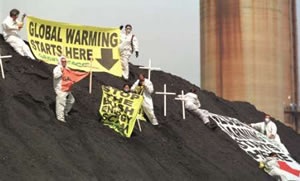
Greenpeace protest at
coal burning center
"global warming starts here"
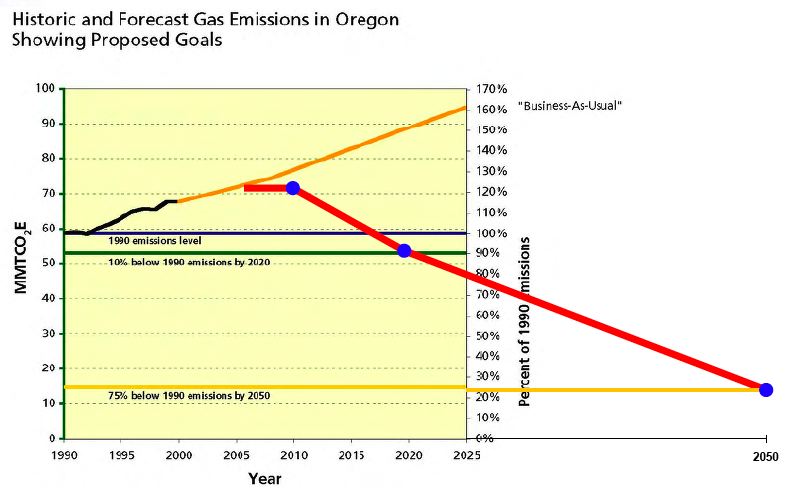
A chart from the Oregon Department of Transportation showing a proposal for a steep reduction in greenhouse gas emissions over the next several decades looks remarkably similar to the famous Hubbert Curve of oil depletion.
Rising seas will be a permanent tsunami or Katrina sized storm surge
Climate Change is a permanent tsunami, a permanent Katrina sized storm surge.
The 2004 Indian Ocean tsunami was roughly the inundation level that moderate amounts of climate change would (will) cause to coastlines worldwide.
The Katrina storm surge in Mississippi was almost 10 meters high in places. If the Greenland ice cap slides into the sea the worldwide rise in ocean level would be almost this much - but on a permanent basis.
As with Katrina, the poor are going to be left to drown even though the resources to mitigate the problem exist and are accessible - but they are decentralized, require elites to share power, and would have to address the economic, monetary, political and psychological reasons why the crisis has been willfully ignored for decades.
No Control Planet for the Climate Experiment
Nearly all of the climatologists on Earth are convinced through peer reviewed science that burning petroleum, coal and natural gas, and other human activities are definitely having an impact on the stability of the planet's climate. There are very few bioregions anywhere that are not now having substantial changes in temperature and precipitation extremes. Even many indigenous cultures that are unaware of the scientific method, petroleum companies and other inventions of industrial society report that they understand that "modern" man is changing the future of life on Earth (generally speaking, most of them would like us to stop what we are doing -- see in particular, a film called "The Elder Brothers" and book by the same name about the Kogi people of South America for a particularly poignant view of this). Not all climate alteration is from burning carbon based fuels -- clearcut deforestation is also causing shifts on rainfall patterns. And there are military programs researching "weather warfare," but the precise contribution those efforts have toward these changes is probably impossible to prove.
To quote Bob Dylan, "you don't need a weatherman to know which way the wind blows." And you don't need to read scientific reports to realize: most of the world's glaciers are in retreat, the polar ice caps are melting, the Alaskan permafrost is melting, many places on Earth have increasing water availability problems, deserts are expanding, forests are being clearcut, animal migrations are changing, plant communities are shifting, record heat is being recorded in countless places, and many other indicators of climatological change.
Articles that claim that the "global warming theory" is not proven are essentially a "snooze button" urging the citizens of Earth to go back to sleep, and let the polluters off the hook for the damage they are doing. Many of the writers and propagandists loudly denying climate change in the media are paid by polluters. These commentaries that claim climate change isn't real are about as helpful as those that prefer an end-of-the-world "rapture" perspective (that these changes are really indicators that God is going to physically lift a chosen few into heaven as the rest of us suffer).
In science, a "control" group is usually involved when studying an impact -- but there is no "control" planet unaffected by toxic combustion and habitat alteration if the naysayers turn out to be wrong. Mars is too cold, and Venus is too hot.
There are too many variables to know precisely what impacts digging up hundreds of millions of years of stored energy will do to the biosphere, but I've never met anyone who thinks the impact could be moderate or beneficial who has any experience gardening of farming. Agriculture requires a stable, predictable climate. The disconnection with the "natural" world is the sickness of our time, and this is the underlying problem, not 9/11 or Iraq or rigged elections, those are merely (important) symptoms.
Anyone who has grown food in a temperate climate probably understands that having earlier warm spells before the date of "last frost" risks damage to fruit crops - the premature warming causes early budding or flowering that is then zapped by normal frost (which previously happened before the budding or flowering).
Fossil fuels should be left in the ground, parking lots torn up for gardens, money for missiles redirected to trains, and solar panels put up on every roof top. It's a nice fantasy, but part of the practical steps that would be needed to mitigate the crisis.
the Peak Oil / Climate connection
www.energybulletin.net/36739.html
Published on 4 Nov 2007 by Museletter / Global Public Media. Archived on 4 Nov 2007.
Big melt meets big empty: Rethinking the implications of climate change and peak oil
by Richard Heinberg
www.energybulletin.net/24529.html
Published on 9 Jan 2007 by Energy Bulletin. Archived on 9 Jan 2007.
Bridging Peak Oil and Climate Change Activism
by Richard Heinberg
The problems of Climate Change and Peak Oil both result from societal dependence on fossil fuels. But just how the impacts of these two problems relate to one another, and how policies to address them should differ or overlap, are questions that have so far not been adequately discussed.
www.oildepletion.org/roger/Solutions/solutions.htm
All industries will be affected, beginning with air transport and related sectors, including tourism which, taken as a whole, is, surprisingly, the world's biggest employer. Transport in all its forms is also in the front line of risk; massive fuel price increases, and actual interruptions in supply would threaten a breakdown of distribution systems and have economic consequences far in excess of any experienced in the developed economies in modern times. These consequences would include high unemployment and inflation.
Secondly, there are implications for the costs, and perhaps even availability, of food. The food chain is massively hydrocarbon-dependent at every stage: fertilisers, chemicals, equipment, transport and processing. A rise in the price of oil will knock-on immediately to a comparable rise in the price of food. Political and social instability as a consequence cannot be ruled out.
Thirdly, the coming oil shock transforms the climate-change agenda. The Kyoto process has been built on the assumption that oil supplies will not be the constraint that will limit carbon emissions in the future, and that if the latter are to be reduced, this will have to be through deliberate limitations on demand. In this new situation, however, the problem is transformed: reductions in affordable oil may turn out to be faster than the most ambitious targets that have been conceived in the context of climate change. The CO2 implications of reduced conventional oil use, vs. the increased use of gas, non-conventional oils, coal, and perhaps nuclear, need examination.
www.theoildrum.com/node/2239
Noisette on February 2, 2007 - 11:54am
Global warming is a comfortable matter for the public to worry about. Its reported effects tend to be ‘away’ (polar bears scrabbling on ice islets), far off into the future (rising sea level), impenetrable (dying species, new plant and animal life), scientifically disputable as claimed (see de-bunker shills), hard to grasp (so what if the temp rises one degree?), welcomed by many: .. Putin could open up Siberia; cool, no more long lasting ice in the winter on my steps! My heating bill is way down!- and, last but not least, raises the specter of world ‘Gvmt.’ or world legislation / collaboration, which is anathema to many and in any case almost impossible to either understand or imagine managing.
Most people’s daily lives are not impacted at all, the change is extremely gradual, and while in many places noticeable by the individual senses and brain, has a kind of inevitability about it - the Cosmos, Rays, Sunspots, warmer water, CO2, God, horrid humans, Weird Stuff! and only requires, it is thought, that people adapt to changes in the ‘weather’ as they have done for millenia, by growing other crops, moving north or inland, etc. etc. All together, it becomes a vehicle for smug catastrophism - exotic examples are thrilling - Tuvalu under water, wow! But who cares?
Climate Change denial:
This blog explores the topic of the psychology of climate change denial - with observations and anecdotes about our weird and disturbed response to the problem. It seeks to answer a question that has puzzled me for years: why, when the evidence is so strong, and so many agree that this is our greatest problem, are we doing so little about climate change?
The sense of doubt seeded by the denial industry has also encouraged two thirds of people to say ‘I need more information to form a clear opinion about climate change’. When they say this, I don’t believe that they actually want more information - there is plenty out there if they want it. I think they are happily adopting the excuse that the science is undecided to create an obstacle to personal engagement.
www.cbs.com/latenight/lateshow/top_ten/archive/ls_topten_archive2005/ls_topten_archive_20050725.shtml
Top Ten George W. Bush Solutions For Global Warming
10. NASA mission to turn down the sun's thermostat
9. Federal subsidies to boost production of Cool Ranch Doritos
8. Fast track Rumsfeld's "Colonize Neptune" proposal
7. Convene Blue-Ribbon Committee to explore innovative ways of ignoring the problem
6. Let Hillary worry about it when she takes over
5. I dunno---tax cuts for the rich?
4. Give the boys at Halliburton 90-billion dollar contract to patch hole in ozone
3. Switch to celsius so scorching 98 becomes frosty 37
2. Keep plenty of Bud on ice
1. Invade Antartica
the Empire is planning for climate change
http://rigorousintuition.blogspot.com/2005/01/extreme-enough-for-ya.html
Thursday, January 20, 2005 Extreme enough for ya?
Just how weird must the weather get before some people acknowledge that
even Kansas isn't in Kansas anymore?
So what is going on with the stubborn refusal of the US to admit and act upon climate change? I think it's wrong to believe the policy-makers ignorant. We saw last year what the Pentagon's secret report, suppressed by US defence chiefs and obtained by the UK's Observer, made of it: climate change "should be elevated beyond a scientific debate to a US national security concern." Britain could be Siberian by 2020, and major European cities sunk beneath rising seas. According to the report, an imminent scenario of catastrophic climate change is "plausible and would challenge United States national security in ways that should be considered immediately."
But with a challenge to US national security, also comes an opportunity.
Climate change impacts everyone, but short of a runaway greenhouse effect (and no worries - we have a good 50 years or so to squander before that eventuality), some will be impacted more than others. Europe, for instance, would be expected to fare worse than the United States if the Atlantic Conveyor shuts down. The continent depends upon the moderating current to keep it out of the deep freeze. If it fails, then so will Europe.
And which continent of former allies is it, which is now viewed with suspicion as a potential 21st Century rival to American hegemony?
Having read the CIA's laughable reverse-psychology "advice" to Europe, I think there are likely some people in places of influence who wouldn't object to putting the continent on ice. ("The current EU welfare state is unsustainable and the lack of any economic revitalisation could lead to the splintering or, at worst, disintegration of the EU." Oh yes; the CIA would just hate to see the EU fail.)
Perhaps the Bush administration isn't as ignorant as it seems regarding climate change. Perhaps it knows, even better than we know, what is coming. And perhaps, weighing everything in the balance, they are saying, in effect, "bring it on!"
In other words, perhaps what we're seeing in environmental policy is another instance of Letting It Happen On Purpose.
If Condoleeza Rice can call the South Asian tsunami a "wonderful opportunity," what must Donald Rumsfeld be calling climate change?
an elite campaign to admit climate change is real
this was forwarded by a friend.
I watch the tv on the weekends sometimes. Last weekend, I was barraged with the following two advertisements played at nearly every commercial break...
Reverend Al Sharpton and Pat Robertson - We Can Solve It
http://www.youtube.com/watch?v=NhmpsUMdTH8Newt Gingrich and Nancy Pelosi - We Can Solve It
http://video.google.com/videoplay?docid=6171696742574481310&hl=enFor typical us tv watchers, I imagine the image of these political opponents sitting knee to knee on a couch and being friendly to each other is a powerful statement that it is agreed (so called) "climate change" is real and we are going to fix it.
*****
I'm fascinated with the way the media is shifting gears on climate destabilization. Actually I'm fascinated with the way the dollars and the financial establishment is shifting gears.
I recognize that the tide has been turning in recent years...
Newt Gingrich "The Evidence is Sufficient" on Global Warming
http://www.youtube.com/watch?v=upphPTRr_PE"A sound American energy policy would focus on four areas: basic research to create a new energy system that has few environmental side effects, incentives for conservation, more renewable resources, and environmentally sound development of fossil fuels. The Bush administration has approached energy environmentalism the right way, including using public-private partnerships that balance economic costs and environmental gain.
Hydrogen has the potential to provide energy that has no environmental downside. Conservation is the second great opportunity in energy. A tax credit to subsidize energy efficient cars (including a tax credit for turning in old and heavily polluting cars) is another idea we should support. Renewable resources are gradually evolving to meet their potential: from wind generator farms to solar power to biomass conversion. Continued tax credits and other advantages for renewable resources are a must."
Source: Gingrich Communications website, www.newt.org Dec 1, 2006
**********
I watch tv periodically and I like to think maybe I can more easily see propaganda trends than someone who is immersed in tv perpetually. Or, maybe I'm behind the game, always catching up with what is obvious to tv watchers.
This current trend to get all tv watchers on board with the climate change program intrigues me. I think four years ago, the "climate change is real" message would rarely have been presented on tv. Three years ago, the message might have gotten out now and then, but only if the speaker was publicly humiliated in the process. One and two years ago, we heard the message from time to time, and gradually it was taken more seriously. In the last four months, the message that climate change is real, is increasing to a roar.
Politicians, talking heads, public relations experts and others that work in the field of mass consciousness may argue that these trends are driven by the "the people", "the constituency", "voters", "consumers", "democrats", "republicans" and other mythical creatures who vote with their dollars and their neilsen ratings. Human beings, it seems to me, tend to be driven by these campaigns (like herd animals).
The strategy seems similar to previous campaigns to shift public consciousness. The message is presented with serene urgency as if we have all known the truth all along. If you want to belong to the mythical class with which you identify, you will come to believe that you have known all along. We have all known all along, after all, we in this class are rather extraordinary people. Surely you don't wish to be ostracized.
I suspect the primary motivation to acknowledge "climate change" for many of the sociopaths in power is that they now have solidified strategies for enriching and empowering themselves given the opportunity of climate destabilization. That's just how sociopaths think.
I wonder, in order to produce the electricity to generate Newt's hydrogen, will we...
... strip bare the heartland to extract coal? (Clean coal technology, of course).
www.geography.vt.edu/worldlandscapes/readings2/preread/s1912.JPG
... suck dry the west to process oil sands?
www.ags.gov.ab.ca/activities/cbm/alberta_oil_sands.html
... starve ourselves to produce ethanol?
www.parl.gc.ca/information/library/PRBpubs/prb0749-e.htm
I wonder, will the powers that be thwart the efforts of human beings to decentralize the power infrastructure and assert local power over energy? Will the "they" impose a system of energy control, enforcement and rationing (taking their piece of the action, of course), until the day the infrastructure is too expensive to operate (in terms of energy)? Will we come to the brink unprepared, having frittered the last of the cheap energy on the errands of fools?
I suspect the answer each of these rhetorical questions is yes (of course).
**********
The We Campaign is a high level, high dollar, high tech initiative to get watcher's of tv in the US to get on board with climate change programming.
*****
http://wecansolveit.org/
"The We Campaign is a project of The Alliance for Climate Protection -- a nonprofit, nonpartisan effort founded by Nobel laureate former Vice President Al Gore. Our ultimate aim is to halt global warming."
We "Actions" (from the We Campaign website)
- Sign the petition for a global treaty on climate change
- Tell your friends about our first video
- As Americans, we don't wait for other people to take the lead when a problem needs to be fixed. In this ad, William H. Macy shows that by solving the climate crisis, we are honoring an American tradition.
- Urge the press to ask about global warming
- Ask lenders to consider climate impact when funding new coal plants**********
Some sarcasm for you, the reader...
- THANK YOU GOD, another petition to sign.
- I cannot wait for the next cocktail party!!
- Yes, we Americans are out ahead of the curve again, as always, taking the lead, a shining example to all the lesser nations of world.
- This document is my letter to the editor.
- The next time you are negotiating your mortgage with your banker, don't forget to mention the We Campaign.**********
I hope you feel warm and fuzzy. You are now a member of the mythical class of creatures I call my readers.
Political Hot Air: greenwash and false solutions
www.alternet.org/envirohealth/46318/What Al Gore Hasn't Told You About Global Warming
By David Morris
Tuesday 09 January 2007
George Monbiot's new book "Heat" picks up where Al Gore left off on global warming, offering real solutions without sugar-coating the large personal sacrifices they will require.
http://jameshowardkunstler.typepad.com /clusterfuck_nation/2007/01/the_warming.html
The Warming
January 8, 2007
Everyone was walking around upstate New York delirious in their shirtsleeves on Saturday as the thermometer soared into the sixties (an all-time record for January here). The resource cornucopians were beside themselves with glee as the price of crude oil nose dived down to the mid-$50 range, proving what ninnies we peak oil alarmists are. The mustard greens we planted last July are still growing in the garden. The cat caught a garter snake. And later that evening those fluffy things in the headlights were moths, not snowflakes.
It was hard not to enjoy the end of the world. But despite all the high spirits and the roller-bladers and the kids hoisting their Ben-and-Jerry's cones, one was provoked to wonder about all the deer ticks out there enjoying an extra breeding cycle, not to mention the deer themselves, fattening up on prematurely swelling buds, and the pine bark beetles we've been hearing about up the road in the Adirondacks.
And for the really farsighted, there is the contemplation of what summer might be like. After all, if it is 67 in January, might it be 107 in July? And maybe that won't be so groovy. The electric grid is much more stressed out when all the air-conditioners are humming across the land. I'm not looking forward to Lyme disease, West Nile virus, or maybe even Dengue fever, either.
While it seems morally upright to inveigh against global warming Al Gore style, personally I don't believe there is anything we will do about it, or can do about now. The feedback loops are in motion. Something ominous is underway far greater than our measly powers can correct. Even if we started it with about two hundred years of our fossil fuel fires, there is no evidence that can just stop burning coal, oil, and methane gas on the grand scale, or that the warming would stop if we did.
The response of our political leaders is laughable. The most "progressive" among them will demand rapid conversion of the US automobile fleet to hybrid engines. I am confident that this would do absolutely nothing to put the brakes on global warming.
As usual, I am much more interested in how events are likely to turn out than in how we wish them to turn out. My guess is that the weird weather we are getting will increasingly affect crop yields. With populations growing, and weather anomalies increasing, grain surpluses worldwide are now at their lowest point in decades. All the major grain-growing regions have suffered either significant drought (US, Australia, Ukraine, China, Argentina) or flooding (East Africa, India) in recent years. (See this report from the Food and Agriculture Organization of the United Nations.)
The poorer, "undeveloped" nations are feeling the pain first, as usual, and this pain is translating into political breakdown, violence, starvation, and genocide. At the same time, these poorer places are leaving the oil age behind. they have dropped out of the bidding as oil made its move above the $50-a-barrel mark. In these countries, there will no longer be fuel for electric generators or motor transport, and the primary manifestation of all that will be a breakdown of public health. Between the political death squads and the hospitals with no running water, tremendous forces for attrition are underway.
Oil priced beyond the means of Third Worlders means more for America, for the moment, and indeed the public here is glorying in still-affordable gasoline. Judging by the evidence in the supermarket aisles, there have been no noticeable Cheez Doodle shortages. There are certain Third World countries, however, that also happen to be major oil producers. Nigeria, for instance. It is already a very chaotic state. The oil there is extracted mainly by multinational corporations who pay substantial royalties and licensing fees to the Nigerian government. The people of Nigeria mostly do without. Increasingly, they are tapping into pipelines illegally and siphoning off oil. Meanwhile, a quasi Civil War has provoked assaults and kidnappings against the oil infrastructure and foreign workers. Sooner or later, Nigeria will become too chaotic and its oil supply will go off-line, so to speak, perhaps permanently. When that happens, the happy motorists in Atlanta and the San Fernando Valley may start to notice that something is happening.
Global warming will not get our attention this winter. It's too pleasurable here in the northeast US, where so many decisions are made. The new Democratic congress may blather about it, but there will be no policies or protocols, just as there will be none about the other "elephant in the room" -- overpopulation. There's not a damn thing we're going to do about it. You can deplore it, but then what?
Of course, I maintain that there is a broad range of actions we could take in the US that would constitute an intelligent response to this Long Emergency of climate change and oil depletion. The most important thing we could do at the moment is to stop debating about all the different "innovative" ways to run our cars, and come to grips with the fact that we have to leave the happy motoring era behind us, period. I don't see Nancy Pelosi taking the lead on this one. She'll just bring a new kindergarten veneer to the same old politics of denial. The mid-winter cherry blossoms will only make the denial seem more festive.
scientific information
www.climateark.org
Climate Ark - Climate Change Portal
www.ipcc.ch - Intergovernmental Panel on Climate Change
www.ncdc.noaa.gov/paleo/globalwarming/temperature-change.html
A Paleo Perspective ... on Global Warming
Temperature change and carbon dioxide change
www.realclimate.org
a commentary site on climate science by working climate scientists for
the interested public and journalists
geoengineering: a giant umbrella to block the sun?
This story seems like a strange, infantile approach to the climate change problem. But it might also be a covert effort to develop weather modification weapons. As strange as that sounds, the military has long sought such technology, and this article could be an clue that they are conducting such experiments. Whether this article is a real story or not, and whether it has military implications or not, it is a distraction from the need to shift the way civilization behaves so that a stable biosphere may continue to provide for the needs of homo sapiens and the millions of other species on planet Earth.
www.guardian.co.uk/usa/story/0,,1999966,00.html
US answer to global warming: smoke and giant space mirrors
Washington urges
scientists to develop ways to reflect sunlight as 'insurance'
David Adam, environment correspondent
Saturday January 27, 2007
The Guardian
The US government wants the world's scientists to develop technology to block sunlight as a last-ditch way to halt global warming, the Guardian has learned. It says research into techniques such as giant mirrors in space or reflective dust pumped into the atmosphere would be "important insurance" against rising emissions, and has lobbied for such a strategy to be recommended by a major UN report on climate change, the first part of which will be published on Friday. ....
The US response, a copy of which has been obtained by the Guardian, says the idea of interfering with sunlight should be included in the summary for policymakers, the prominent chapter at the front of each IPCC report. It says: "Modifying solar radiance may be an important strategy if mitigation of emissions fails. Doing the R&D to estimate the consequences of applying such a strategy is important insurance that should be taken out. This is a very important possibility that should be considered."
Scientists have previously estimated that reflecting less than 1% of sunlight back into space could compensate for the warming generated by all greenhouse gases emitted since the industrial revolution. Possible techniques include putting a giant screen into orbit, thousands of tiny, shiny balloons, or microscopic sulphate droplets pumped into the high atmosphere to mimic the cooling effects of a volcanic eruption. The IPCC draft said such ideas were "speculative, uncosted and with potential unknown side-effects".
www.smh.com.au/news/environment/us-urges-scientists-to-block-out-sun
/2007/01/28/1169919213362.html
US Urges Scientists to Block Out Sun
By David Adam and Liz Minchin
The Sydney Morning Herald AU
Monday 29 January 2007
The US wants the world's scientists to develop technology to block sunlight as a last-ditch way to halt global warming.
It says research into techniques such as giant mirrors in space or reflective dust pumped into the atmosphere would be "important insurance" against rising emissions, and has lobbied for such a strategy to be recommended by a UN report on climate change, the first part of which is due out on Friday.
www.sciam.com/article.cfm
?SID=mail&articleID=00010234-09A9-1C68-B882809EC588ED9F
November 15, 2000
Planting Trees Won't Save the Climate
If you thought planting trees would take care of global warming, think again. The results of a new study, which looked at how increased carbon dioxide concentrations influence forest growth, are not as promising as some had expected. In the past, some people have argued that the increase in carbon dioxide (CO2) in the air would be partially offset by an increase in plant growth, caused by that additional (CO2): increased CO2 concentrations in the atmosphere should work like extra fertilizer and lead to increased plant growth. This growth in turn should bind to much of the CO2. In other words, the plant growth should act like a sink, absorbing the gas released into the air by burning fossil fuel.
But the new analysis, published in last week's issue of Science, found that although there has been an increase in biomass, most of it must be attributed to land use history. The authors, a team of scientists from Princeton University and the U.S.D.A. Forest Service, uncovered plant growth rates of only 2 to 4.4 percent. These numbers stand in sharp contrast to some earlier studies, which suggested that rising CO2 concentrations would bring a 25 to 75 percent growth increase. The researchers used data from the Forest Inventory and Analysis (FIA) database, taking samples from more than 20,000 acre-size plots in Minnesota, Michigan, Virginia, North Carolina and Florida. To examine historical changes in growth and mortality rates of the vegetation there, the scientists looked at forest biomass, the cumulative result of past growth. "The U.S. has a fairly unique history in that a hundred years ago, a large fraction of the landscape was deforested," explains John Caspersen, who led the study. "Subsequently, there has been a reforestation of much of the eastern ...
This is LONDON
23/12/03 - News and city section
UK cold snap kills 2,500 in a week
By Alexa Baracaia, Evening Standard
The cold spell has killed more than 2,500 people across England and Wales in the past week, experts today revealed.
New research shows that a higher proportion of the British population dies as a direct result of winter weather than in Russia or Finland.
Between 15 and 22 December there are estimated to have been more than 540 deaths in London and the South-East alone and it is predicted that the number of people dying " unnecessarily" from the cold could rise to 50,000 this season.
"The UK remains one of the worst countries in the world at coping with unseasonal temperatures," said Professor Sian Griffiths, President of the Faculty of Public Health which carried out the study along with the Met Office.
The findings come after it was revealed that an elderly couple in Tooting were found dead in their flat 13 weeks after their gas supply was cut off.
The bodies of George Bates, 89, and his wife Gertrude, 86, were found huddled in the living room of the home they had shared for 64 years.
British Gas, which was owed £140.62 by the couple, said the Data Protection Act had prevented them from passing information to social services.
But David Hinchcliffe, chairman of the Government's health select committee, said: "I don't think there are any excuses."
The new research, which calculates the number of deaths caused by the cold in England and Wales over the past week, claims that the victims will have died from treatable ailments.
Professor Griffiths warned: "All of us must be vigilant to look out for family, friends and neighbours who may be suffering. Often illnesses develop after a cold snap has finished."
Find this story at www.thisislondon.co.uk/news/articles/8306085?version=1
©2003 Associated New Media
www.economist.com/business/displayStory.cfm?story_id=3276015
Hudson's warmer bay
Oct 7th 2004 | TORONTO
From The Economist print edition
Less ice means new transport opportunities
ABOUT now, the polar bears arrive near the Canadian port at Churchill to await the winter freeze. Then they will walk north across the ice of Hudson Bay towards the Arctic. It was -6º C this week at the port, although a warmer world means the ice comes more slowly these days. That is bad news for the polar bears, but good news for shipping.
Global warming means Hudson Bay is now open to shipping an extra week a year. Some scientists predict that as soon as 2010 there could be a regular shipping service during the summer in the Arctic, and that by 2050 there will be a year-round sea passage to Hudson Bay.
This year the ice-free season started on July 28th. The last ship will leave in early November. The ships coming to Churchill, 1,700km (1,057 miles) north of Winnipeg, save on fuel since it is closer to ports in Europe. Churchill to Antwerp is just eight days' sailing.
Louis Dreyfus, an international trader, believes its Canadian grain operation will benefit from a combination of ice-reinforced ships and warmer weather expanding the shipping season from the first week of July until past the middle of November. Grain is just about the only cargo shipped out of Churchill, and the ships arrive empty. But there are plans to change that.
The port and the railway, which provides Churchill with its only land-link to the outside world, were bought in 1997 by OmniTRAX. This Denver-based company owns a number of “short line”, or industrial, railroads—although the Hudson Bay Railway is hardly short at 1,303km. OmniTRAX has made a go of a port which the Canadian government was thinking of closing and wants to get annual grain shipments up to 1m tonnes. This year it might reach 600,000 tonnes, although a weak harvest on the prairie could reduce that. The company also wants to handle imports.
This is where Russia's ambassador to Canada, Georgiy Mamedov, comes in. He is trying to revive the idea of a “Murmansk to Manitoba” cross-Arctic shipping corridor. His vision: liquefied natural gas from Russia shipped to North America via Churchill. If the ice does melt, freighters could cut across water that was once permanent ice. At first, icebreakers would be needed. And if not, Mr Mamedov says: “Commission nuclear submarines. We are no longer in a confrontational state, so they can be used for peaceful purposes.” Those hardy tourists who venture north to see the polar bears shiver at the prospect.
http://news.independent.co.uk/world/environment/story.jsp?story=603975
Countdown to global catastrophe
By Michael McCarthy, Environment Editor
24 January 2005
The global warming danger threshold for the world is clearly marked for the first time in an international report to be published tomorrow - and the bad news is, the world has nearly reached it already.
The countdown to climate-change catastrophe is spelt out by a task force of senior politicians, business leaders and academics from around the world - and it is remarkably brief. In as little as 10 years, or even less, their report indicates, the point of no return with global warming may have been reached.
The report, Meeting The Climate Challenge, is aimed at policymakers in every country, from national leaders down. It has been timed to coincide with Tony Blair's promised efforts to advance climate change policy in 2005 as chairman of both the G8 group of rich countries and the European Union.
And it breaks new ground by putting a figure - for the first time in such a high-level document - on the danger point of global warming, that is, the temperature rise beyond which the world would be irretrievably committed to disastrous changes. These could include widespread agricultural failure, water shortages and major droughts, increased disease, sea-level rise and the death of forests - with the added possibility of abrupt catastrophic events such as "runaway" global warming, the melting of the Greenland ice sheet, or the switching-off of the Gulf Stream.
The report says this point will be two degrees centigrade above the average world temperature prevailing in 1750 before the industrial revolution, when human activities - mainly the production of waste gases such as carbon dioxide (CO2), which retain the sun's heat in the atmosphere - first started to affect the climate. But it points out that global average temperature has already risen by 0.8 degrees since then, with more rises already in the pipeline - so the world has little more than a single degree of temperature latitude before the crucial point is reached.
More ominously still, it assesses the concentration of carbon dioxide in the atmosphere after which the two-degree rise will become inevitable, and says it will be 400 parts per million by volume (ppm) of CO2.
The current level is 379ppm, and rising by more than 2ppm annually - so it is likely that the vital 400ppm threshold will be crossed in just 10 years' time, or even less (although the two-degree temperature rise might take longer to come into effect).
"There is an ecological timebomb ticking away," said Stephen Byers, the former transport secretary, who co-chaired the task force that produced the report with the US Republican senator Olympia Snowe. It was assembled by the Institute for Public Policy Research in the UK, the Centre for American Progress in the US, and The Australia Institute.The group's chief scientific adviser is Dr Rakendra Pachauri, chairman of the UN's Intergovernmental Panel on Climate Change.
The report urges all the G8 countries to agree to generate a quarter of their electricity from renewable sources by 2025, and to double their research spending on low-carbon energy technologies by 2010. It also calls on the G8 to form a climate group with leading developing nations such as India and China, which have big and growing CO2 emissions.
"What this underscores is that it's what we invest in now and in the next 20 years that will deliver a stable climate, not what we do in the middle of the century or later," said Tom Burke, a former government adviser on green issues who now advises business.
The report starkly spells out the likely consequences of exceeding the threshold. "Beyond the 2 degrees C level, the risks to human societies and ecosystems grow significantly," it says.
"It is likely, for example, that average-temperature increases larger than this will entail substantial agricultural losses, greatly increased numbers of people at risk of water shortages, and widespread adverse health impacts. [They] could also imperil a very high proportion of the world's coral reefs and cause irreversible damage to important terrestrial ecosystems, including the Amazon rainforest."
It goes on: "Above the 2 degrees level, the risks of abrupt, accelerated, or runaway climate change also increase. The possibilities include reaching climatic tipping points leading, for example, to the loss of the West Antarctic and Greenland ice sheets (which, between them, could raise sea level more than 10 metres over the space of a few centuries), the shutdown of the thermohaline ocean circulation (and, with it, the Gulf Stream), and the transformation of the planet's forests and soils from a net sink of carbon to a net source of carbon."
www.latimes.com/news/science/la-sci-passage19jan19,1,4174909.story?coll=la-utilities-environment
Melting Ice, Winds of Change
By Usha Lee McFarling
Times Staff Writer
January 19, 2003
RESOLUTE BAY, Canada ˜ For 500 years, explorers nudged their ships through these Arctic waters, vainly seeking a shortcut to the riches of the East. The Northwest Passage, a deadly maze of sea ice, narrow straits and misshapen islands, still holds the traces of those who failed.
There are feeble cairns, skeletons lying face down where explorers fell, makeshift camps piled high with cannibalized bones and, on one rocky spit, a trio of wind-scoured tombstones. Whole expeditions, hundreds of men and entire ships, are missing to this day. The first explorer to survive a crossing, in 1906, spent several winters trapped by ice.
Despite that -- or maybe because of it -- Canadian Mountie Ken Burton wanted nothing more than to join the pantheon of polar explorers who had threaded their ships through the passage's narrow ice leads and around its shimmering blue-green icebergs.
In the summer of 2000, Burton gingerly nosed a 66-foot aluminum patrol boat into the heart of the Northwest Passage. Ice floes could crumple the boat like paper. Even the smallest iceberg, a growler, could rip apart its delicate hull. But there were no bergs. No growlers. No thin cakes of pancake ice. To his surprise, Burton found no ice at all. A mere 900 miles south of the North Pole, where previous explorers had faced sheets of punishing pack ice, desperation and finally death, Burton cruised past emerald lagoons and long sandy beaches. Crew members stripped and went swimming. Burton whipped through the passage, "not hurrying," in a mere 21 days.
"We should not, by any measure, have been able to drive an aluminum boat through the Arctic," said Burton, still astonished and just slightly disappointed. "It was surreal."
It was also a glimpse of the future. For several summers now, vast stretches of the Northwest Passage have been free of ice, open to uneventful crossings by the flimsiest of boats. Climate experts now blandly predict what once was unimaginable: In 50 years or less, the passage will be free of ice throughout the summer, a prospect that could transform the region and attract a flotilla of cruise ships, oil supertankers and even U.S. warships.
"It's something no one would have dreamed up for our lifetime," said Lawson Brigham, deputy director of the U.S. Arctic Research Commission and former captain of the U.S. Coast Guard icebreaker Polar Sea, which made it through the passage in 1994.
The parting of the ice is the product of natural, long-term atmospheric patterns that have warmed the Arctic in recent decades and, to a lesser extent, the gradual heating of the planet by greenhouse gases.
The planet's temperature has risen 1 degree Fahrenheit over the last century. In the Arctic, temperatures have risen 3 to 4 degrees. In these northern seas, at the boundary between water and ice, that small difference has changed the landscape for thousands of miles.
"The image of the Arctic was always one of an ice-locked, forbidden spot," said James P. Delgado, director of the Vancouver Maritime Museum and author of "Across the Top of the World: The Quest for the Northwest Passage." "If we as a species have wrought this change, it's humbling, given its history as such a terror-filled place."
'Panama Canal North'
The receding ice is throwing open a gateway to the Far North, a region long defined by its isolation, sparse population and stark, simple beauty. Ship traffic could carry with it a rush of civilization and commerce.
"It's not just about transport; it's about the whole development of the Arctic frontier," said Lynn Rosentrater, a climate-change officer with the World Wildlife Fund in Norway. "It's going to happen, so we need to plan for it." The once-deadly route has been re-christened "Panama Canal North" by shippers eager to shave nearly 5,000 miles off the trip from Europe to Asia. Already, a parade of strange ships and faces is streaming through the passage. Canadian transit officials who monitor the route dub the newcomers "UFOs," for "unaccustomed floating objects."
These have included, in the last few years, a Russian tug that dragged a five-story floating dry dock through the passage, adventurers skimming through in sleek sailboats and a boatload of Chinese sailors that arrived unannounced in the Arctic village of Tuktoyaktuk, disembarked to take photographs and left abruptly when a local Mountie arrived.
This summer, the Canadian navy sent warships north of the Arctic Circle for the first time since the end of the Cold War. And U.S. naval officers are circulating a report called "Naval Operations in an Ice-Free Arctic" that discusses, among other things, the need for a new class of ice-strengthened warship to patrol newly opening Arctic waters.
The Northwest Passage winds through land so far north it doesn't appear on most maps, a rolling tundra cut by wild rivers and deep fiords dotted with icebergs, walruses and ghostly white beluga whales. It is too far north for trees or shrubs, too far north for paved roads and, in most places, too far north for people.
The Inuit-controlled territory Nunavut, which includes much of the passage and stretches across 750,000 square miles, is home to just 26,745 people. That's like sprinkling the population of South Pasadena into a few villages in an area 4 1/2 times the size of California.
Nunavut's capital, Iqaluit (pronounced ee-KA-loo-it), is already something of a boomtown. Chosen as the government seat when the territory was carved from the Northwest Territories in 1999, the town of 5,000 people includes a lavish $12-million legislative building.
Just down the street is the Kamotiq Inn, an aging, igloo-shaped restaurant that serves shavings of raw, frozen caribou meat and cold bottles of Canadian beer. Farther down, a grocery offers fresh basil, prosciutto and Thai curry paste. It is a confluence of government dollars and commercial opportunity. Though the territory of Nunavut is 85% Inuit, outsiders -- government workers, hermits and fortune-seekers -- are trickling in. French Canadian cabbies dream of retiring to tropical islands as they drive 18-hour shifts. South Indian hotel magnates rent snowmobiles to North Pole-bound adventurers as they wait for a boom to hit remote Inuit villages. And hardy construction workers leave their families behind in Halifax to come here and build apartment buildings. And then there are the Inuit, many of whom feel change is coming too fast. In a place where most still put food on the family table by hunting musk oxen, caribou and seal, there is growing fear that these changes in the weather herald the end of a way of life that dates to the end of the last Ice Age.
"We are a people who only 50 years ago lived only in igloos," said Sheila Watt-Cloutier, who lives in Iqaluit and heads the Inuit Circumpolar Conference, a global organization fighting to preserve Inuit culture. "Now, the land is changing literally right under our feet."
With each summer warmer than the last, and with species such as dragonflies and moose showing up for the first time, many here are bracing for a stranger, warmer world. Unlikely as it seems in a town where residents still skin and dry seals in their frontyards, some of those taking a long-range view hail this remote outpost as the next Singapore.
"If it's handled correctly, you sit on an international strait, take a proactive stand and profit nicely," said Rob Huebert, the associate director of the Center for Military and Strategic Studies at the University of Calgary.
It was the promise of wealth that first drew European explorers to the passage. John Cabot first sought the shortcut in 1497. English pirate Martin Frobisher reached the mouth of the passage in 1576 but stopped his quest after finding what he took to be gold. It turned out to be worthless ore.
Ill-Fated Expedition
The most famous voyage was Sir John Franklin's expedition of 1845. Laden with 100,000 pounds of meat, a steam engine for heat and a library of 2,400 books, the two-ship expedition was the pride of the British Admiralty.
The 61-year-old Franklin died shortly after his ships entered the passage, apparently of a heart attack. His men, addled by lead poisoning from their canned provisions, were trapped by ice. They attempted to walk to safety, hauling unnecessary luxuries such as books and bolts of silk cloth. All 128 men perished. Subsequent expeditions revealed, to the horror of Victorian England, evidence of cannibalism.
The passage wasn't traversed until 1906, when legendary polar explorer Roald Amundsen completed the trip after three years. The feat was not accomplished again until Canadian Mountie Henry Larsen took a schooner with a hull made of 2-foot-thick Douglas fir through the passage and then back again in the 1940s.
Although common sense mandated that the passage could never be practically used, the siren call of the shortcut has never been silenced. The first contemporary test of the passage for commerce was prompted by the modern-day equivalent of spice: crude oil. In 1969, Humble Oil & Refining Co. sent through a 114,000-ton supertanker. Double-hulled and ice-strengthened, the Manhattan became the world's biggest icebreaker.
The 43,000-horsepower monster easily cruised through 15-foot-thick piles of ice and would reverse, gather steam and try to plow through 40-foot ridges of ice. But it ground to a halt several times and broke free only with the help of a Canadian icebreaker. The ship eventually reached Prudhoe Bay with several holes in its hull.
"When all was said and done, economically, it didn't make sense," Huebert said. That was before the ice started its retreat.
The Canadian Ice Service reports that Arctic ice has disappeared at a rate of about 3% each decade since the 1970s. It is getting thinner as well. Ice sheets that used to be 10 feet thick are now less than 6 feet from top to bottom. Last month, scientists at the National Snow and Ice Data Center in Boulder, Colo., announced that Arctic sea ice had reached a record low since satellite measurements started 24 years ago.
"In some years now, you can do the Northwest Passage almost in a rowboat," said the Canadian Ice Service's Lionel Hache.
The passage remains notoriously unpredictable from year to year, and even from week to week. In August, it was clogged with some of the thickest ice seen this decade, said J.P. Lehnert, the officer in charge of the Canadian Coast Guard station in Iqaluit.
Warmth May Worsen Ice
In one of the many strange nuances of the global climate, the appearance of this thick, multiyear ice may be a result of warming, not cooling. In recent years, ice bridges that usually last all summer and keep out the harder and colder ice from the north were not in place, allowing this brawnier ice to travel south.
"Ironically, warm weather can give us worse ice conditions," said Henry Hengeveld, Environment Canada's senior advisor on climate change. To those who have been watching the passage, it seems only a matter of time before all manner of ships, from supertankers to sailboats, start plying these once-formidable waters.
A few new ships test the waters each year. A hardy breed of tourists has begun disembarking from massive icebreakers in the few small towns along the passage. They could soon cruise through on skimpier vessels. A sailboat from New Zealand recently made the transit.
There are no traffic jams yet. But shipping companies in Europe and Asia are quietly sniffing out opportunities.
"The incentive is there," Huebert said. "You cut a huge amount of travel time, and in international shipping, time is money."
The largest supertankers, which don't fit through the Panama Canal and must go around South America, would save even more time.
The discovery of mineral resources in the far north, such as the diamond strikes of the Northwest Territories, could spur efforts to export such riches by ship. Canada's vast stores of fresh water may one day be valuable enough to export to drier regions.
Experts on the Arctic environment worry that shipping could have deleterious effects but also say there will be no way to keep the traffic out. Dave Cline, a consultant in Alaska and expert on northern shipping, fears that ships could disrupt the polar bears and bowhead whales that live amid the ice and could jeopardize eider ducks that congregate by the thousands in polynyas, open water areas within ice sheets.
He's also concerned about smuggling of polar bear hides and walrus tusks and about the trash that would be left behind by waves of tourists. "It'd be a whole new world up there," Cline said.
The biggest concern is an oil spill in places more pristine and harder to reach than Alaska's Prince William Sound, an area only now recovering from the 11 million gallons of oil spilled by the Exxon Valdez in 1989.
The person whose phone will ring in the middle of the night if there is such a spill is Earl Badaloo, Nunavut's director of environmental protection services. He's worried enough about it that he keeps track of what he calls "the incidents" -- recent crossings of the passage by ships.
"Five vessels went through in 2000; only two requested permission," he said, quickly scrolling through a list on the computer in his office in Iqaluit. Although Canada has stringent shipping rules for its northern waters, compliance is voluntary.
In 1996, the tourist vessel Hanseatic ran aground on a sandbar in the passage. The weather was good, those aboard were evacuated safely and very little fuel leaked into the passage. Many fear the next grounding may not end so happily. "When you're dealing with land all over the bloody place and tons of icebergs floating around you, you make one mistake or your boat's a rust bucket, and you're going to have oil and toxins all over the place," Badaloo said. "It would be really, really messy."
The most northerly human settlement on the passage, and in all of Canada, is Grise Fiord, about 900 miles from the North Pole. The Inuit call the town Aujuittuq, for "place that never thaws out." Even the Inuit find some places too cold. These bleak shores were not settled voluntarily.
During the Cold War, the Canadian government decided to relocate a few Inuit families from the relative warmth and good hunting grounds of northern Quebec to the country's northern reaches: the bleak, rocky shores of Ellesmere and Resolute Bay on Cornwallis Islands, where there is little to hunt and even less to gather.
So many American military personnel had flooded into the Arctic to monitor Russian threats by air and sea from stations at Eureka and Alert that the Canadians feared losing control of their northern flank. The Inuit were human flagpoles, dispatched north to establish Canadian sovereignty.
Since then, the Canadians have considered the frozen archipelago of ocean, ice and islands to be their land and the Northwest Passage to be their internal waterway. "It's ours," said Col. Kevin McLeod, commander of the Canadian Northern Forces.
Any waterway that connects two oceans is considered international waters, but with the passage impenetrable, no countries had pressed Canada on the issue. With an open passage, all that has the potential to change. "Our sovereignty," said passage expert Huebert, "is on thinning ice."
Since an open passage would link two oceans, U.S. State Department officials argue it should be treated as international waters, open to all who wish to pass. "It's one of those issues on which we've agreed to disagree," said a spokesman at the U.S. Embassy in Ottawa.
With the waters open to new traffic, Canadians are taking a renewed interest in their Arctic backyard.
"I never imagined I'd be this far north, but these are our waters and we should know what's going on in them," said Canadian Naval Lt. Cmdr. Chris Ross as his warship, the Goose Bay, stood anchored in Frobisher Bay outside Iqaluit, the first warship to pass this far north in 14 years.
Fears of Lawlessness
A prominent concern is illegal fishing. As ice recedes, rogue vessels have been moving into the area, lured by the rich Arctic seas, which are almost wholly unregulated.
"They're just scooping the shrimp up. They're scooping the turbot up," said Lt. Cmdr. Scott Healey, a Canadian navy officer who spent 10 years aboard coastal patrol vessels out of Halifax and watched the once-rich North Atlantic fishery collapse.
International waters elsewhere have been plagued with modern piracy and frontier lawlessness.
"You become a magnet for smuggling humans, diamonds, guns, drugs," Huebert said. "We're blind if we think that just because we're Canadian it's not going to happen."
How best to patrol the passage remains a question. It all depends on how quickly the ice melts and how brave interlopers are. "I don't want to scream, 'The sky is falling and we have to build a nuclear-powered icebreaker in the next 18 months,' " McLeod said. "But we don't want to get behind the eight ball."
U.S. Navy officials are worried about falling behind as well. Their report an ice-free Arctic cites the potential need for an entirely new class of Navy ships -- icebreakers -- and a new focus on a harsh part of the globe the military has been able to ignore since the Soviet Union broke up.
"There's no logistics base up there. There's no place to get resupplied. There's bad weather. The charts are woefully bad," said Dennis Conlon, an oceanographer with the Office of Naval Research, which commissioned the report. "It's your basic nightmare in terms of running an operation." If the ships come, so will the infrastructure: hotels, bars and even stoplights. The vision is almost unimaginable to the Inuit, who are still reeling from the first wave of change: the trickle of explorers, whalers and soldiers who penetrated this frozen realm and altered it forever.
"We didn't know what a cold was -- or what measles were -- until the whalers came. And we had no problems with alcohol until 1940," said Dinos Tikivik, 39, a corrections officer and member of the Canadian Rangers, an Inuit and Indian reserve force that patrols Canada's most remote regions.
Today's Inuit face an epidemic of broken families, alcoholism, poor education and the highest suicide rates in Canada. Many, like Peter Irniq, 55, an Inuk who was born in an igloo in Repulse Bay but now lives in an elegant house in Iqaluit and serves as the territory's commissioner, blames many of the problems on the relentless encroachment of the modern world. Watt-Cloutier, the Inuit leader, fears that the destiny of her people is in the hands of strangers who see opportunity where the Inuit simply see home. With each new ship that pulls in and with each new patch of clear water, the isolation that has protected them for 5,000 years is melting away.
"They say it would be easier if we move over and modernize," she said. "Easier for whom?"
Copyright 2005 Los Angeles Times